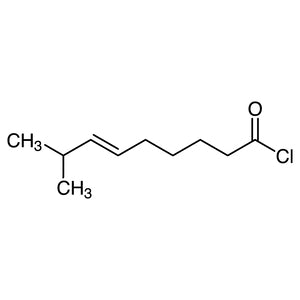
TCI M1826 trans-8-Methyl-6-nonenoyl Chloride is an acyl chloride reagent built on a nine-carbon chain that carries a methyl branch at the 8-position and a single trans-configured double bond at the 6-position. The material functions as an acylation building block in organic synthesis laboratories, meaning it is a reagent that delivers an unsaturated acyl fragment to nucleophilic groups such as amines, alcohols, or phenols. This branched fatty acid framework is the same skeleton that forms the side-chain portion of capsaicin and related capsaicinoid compounds, which is why the reagent frequently serves as a starting point for preparing vanillyl amides and their analogues for research purposes.
The principal appeal of this compound lies in the reactivity of its acyl chloride group, which far exceeds that of the parent carboxylic acid. The strongly polarized carbon–chlorine bond leaves the carbonyl carbon highly susceptible to nucleophilic attack, so amide or ester bond formation proceeds quickly under mild conditions, generally requiring no more than an acid-scavenging base at low to ambient temperature. The trans configuration of the double bond is already embedded in the molecule from the outset, so researchers do not need to add an isomerization step or a geometric separation stage, which would otherwise consume considerable time and material.
In Indonesian laboratories, a reagent of this type is typically used in university and institutional research settings where synthetic organic chemistry, natural product chemistry, and pharmaceutical development work are carried out. It suits groups preparing capsaicinoid analogues and other amide derivatives on a bench scale, where a ready-to-use acylating agent with defined geometry shortens the route considerably. Because it is a moisture-sensitive reagent, it is normally handled in laboratories equipped with basic inert-atmosphere and dry-glassware practice.
Related TCI products
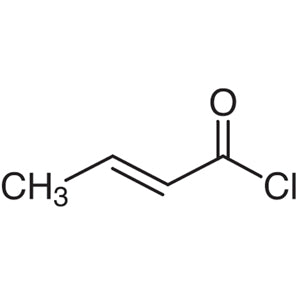
- TCI C0424 10487-71-5 Crotonoyl Chloride (cis- and trans- mixture)
- TCI A0127 4023-65-8 trans-Aconitic Acid
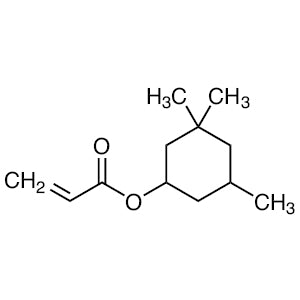
- TCI T3984 86178-38-3 3,3,5-Trimethylcyclohexyl Acrylate (cis- and trans- mixture) (stabilized with MEHQ)
- TCI T3033 52831-11-5 Trimethyl 1,3,5-Cyclohexanetricarboxylate (cis- and trans- mixture)
- TCI T3029 185855-30-5 Trimethyl 1,2,4-Cyclohexanetricarboxylate (cis- and trans- mixture)
- TCI T2827 54458-61-6 2,3,4,5-Tetramethylcyclopent-2-en-1-one (cis- and trans- mixture)
- Capsaicinoid analogue synthesis: the nine-carbon branched unsaturated chain corresponds directly to the acyl side chain of capsaicin, so coupling it with vanillylamine gives the target amide without additional chain-construction steps.
- Vanillyl amide preparation for research: the highly electrophilic acyl chloride reacts readily with the amine group of vanillylamine derivatives, allowing amide bond formation under mild conditions with a simple acid-scavenging base.
- General amide bond formation: any primary or secondary amine can be acylated with this reagent, making it useful for building libraries of unsaturated branched-chain amides for structure-activity investigations.
- Ester synthesis from alcohols and phenols: alcohols and phenolic hydroxyl groups are esterified quickly by the acyl chloride, providing access to unsaturated branched esters without the need for coupling agents or acid catalysis.
- Introduction of defined trans-alkene geometry: because the trans double bond is already fixed in the starting material, it serves as a building block for targets where alkene stereochemistry must be carried through the synthesis unchanged.
| Brand | TCI (Tokyo Chemical Industry) |
|---|---|
| CAS number | 95636-02-5 |
| Molecular formula | — |
| Purity | — |
| Category | Chemistry > Building Blocks > Non-Heterocyclic Building Blocks |
| Pack sizes | available in standard TCI research-scale packaging; please confirm the current pack options when ordering |
| Physical form | — |
| Storage | keep tightly sealed and protected from moisture |
- Product code: M1826
Acyl chlorides are moisture-sensitive and react with water to release hydrogen chloride, so this reagent should be kept tightly closed in its original container, preferably under an inert atmosphere and in a cool, dry place away from water, alcohols, amines, and strong bases. Transfer with dry syringes or cannula through a septum rather than pouring in open air, and use glassware that has been dried before use. All handling should take place in a functioning fume hood, with gloves, safety goggles, and a laboratory coat, since the vapour is corrosive and irritating to the eyes and respiratory tract. Keep an acid-neutralizing spill material nearby and consult the manufacturer's safety data sheet before use.
—
Produk Terkait
-
CrotonoylChloride(cis-andtrans-mixture) TCI C0424
Regular price From Rp 795.900,00Regular price -
trans-AconiticAcid TCI A0127
Regular price From Rp 2.068.500,00Regular price -
3,3,5-TrimethylcyclohexylAcrylate(cis-andtrans-mixture)(stabilizedwithMEHQ) TCI T3984
Regular price From Rp 1.510.950,00Regular price -
Trimethyl1,3,5-Cyclohexanetricarboxylate(cis-andtrans-mixture) TCI T3033
Regular price From Rp 5.274.150,00Regular price -
Trimethyl1,2,4-Cyclohexanetricarboxylate(cis-andtrans-mixture) TCI T3029
Regular price From Rp 1.590.750,00Regular price -
2,3,4,5-Tetramethylcyclopent-2-en-1-one(cis-andtrans-mixture) TCI T2827
Regular price Rp 3.630.900,00Regular price -
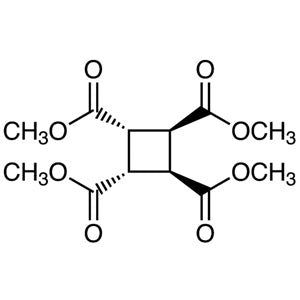
Tetramethylcis,trans,cis-1,2,3,4-Cyclobutanetetracarboxylate TCI T2769
Regular price Rp 4.479.300,00Regular price -
3,3,5-TrimethylcyclohexylSalicylate(cis-andtrans-mixture) TCI T2278
Regular price From Rp 664.650,00Regular price