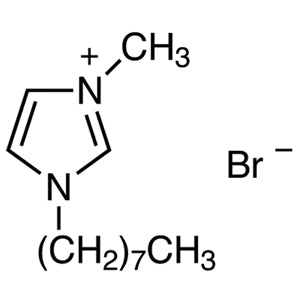
1-Methyl-3-n-octylimidazolium Bromide from TCI, catalogue code M1904, is an ionic liquid built on an imidazolium cation carrying a long n-octyl chain and paired with a bromide anion. Ionic liquids are organic salts that melt at relatively low temperatures, which allows them to serve as reaction media without the need for conventional molecular solvents. In laboratory work this material is used as an alternative solvent, an extraction medium, an electrolyte, and at the same time as a precursor for generating other ionic liquids through anion exchange reactions that are straightforward to carry out.
The properties that make this compound attractive begin with its very low vapour pressure, its capacity to dissolve a wide range of both organic and inorganic compounds, and a broad thermal stability range compared with ordinary organic solvents. The n-octyl chain on the cation gives the molecule an amphiphilic character, so the compound displays surfactant-like behaviour and is able to interact with water–oil interfaces as well as with solid surfaces. The bromide anion is comparatively easy to exchange for other anions such as tetrafluoroborate, hexafluorophosphate, or bis(trifluoromethanesulfonyl)imide, so a single starting material can give rise to a family of ionic liquids with differing polarity.
In Indonesian laboratories this material is typically found in university and institutional research groups working on green chemistry, separation science, and electrochemistry, where a solvent with negligible vapour pressure is preferred over volatile organic alternatives. It is commonly used at bench scale for method development and for preparing derivative ionic liquids in-house, allowing a group to build a range of media from one stock item rather than purchasing each variant separately.
TCI brochures (PDF)
- Ionic Liquids 2026-06-08 · p. 9
Related TCI products
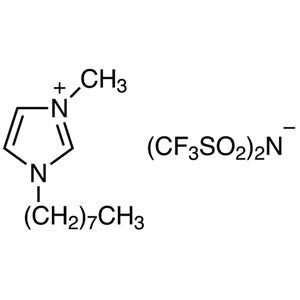
- TCI M3039 178631-04-4 1-Methyl-3-n-octylimidazolium Bis(trifluoromethanesulfonyl)imide
- TCI M2732 244193-52-0 1-Methyl-3-n-octylimidazolium Tetrafluoroborate
- TCI M2440 403842-84-2 1-Methyl-3-n-octylimidazolium Trifluoromethanesulfonate
- TCI M2063 304680-36-2 1-Methyl-3-n-octylimidazolium Hexafluorophosphate
- TCI M2062 64697-40-1 1-Methyl-3-n-octylimidazolium Chloride
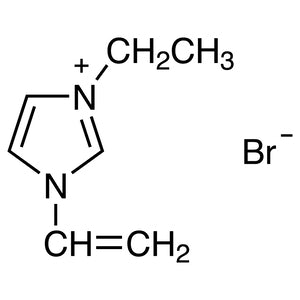
- TCI V0183 34311-88-1 3-Ethyl-1-vinyl-1H-imidazol-3-ium Bromide
- Alternative reaction solvent — its low vapour pressure and wide thermal stability range let reactions be run and heated without the solvent loss and vapour exposure associated with conventional molecular solvents.
- Liquid–liquid extraction medium — the amphiphilic n-octyl chain supports interaction at water–oil interfaces, making the material suitable for partitioning organic solutes between immiscible phases in separation studies.
- Electrolyte for electrochemical work — as an organic salt that is liquid at relatively low temperature, it provides intrinsic ionic conductivity without a supporting molecular solvent being required.
- Precursor for anion-exchange synthesis — the bromide anion is readily replaced by tetrafluoroborate, hexafluorophosphate, or bis(trifluoromethanesulfonyl)imide, letting one stock item yield several ionic liquids of differing polarity.
- Interface and surface studies — surfactant-like behaviour arising from the long alkyl chain allows the compound to be applied in work involving solid surfaces and interfacial phenomena.
| Brand | TCI, catalogue code M1904 |
|---|---|
| CAS number | 61545-99-1 |
| Molecular formula | — |
| Purity | — |
| Category | Chemistry > Specialty Synthesis > Ionic Liquids [Specialty Synthesis] |
| Pack sizes | please refer to the current TCI packaging options for this catalogue code |
| Physical form | ionic liquid (organic salt that melts at relatively low temperature) |
| Storage | keep in the closed original container under the conditions stated on the manufacturer's label |
Store the container tightly closed in a cool, dry place away from direct sunlight and sources of heat, following the conditions given on the manufacturer's label and safety data sheet. The original supplier container is the preferred vessel; if transfer is required, use clean, dry, chemically compatible glassware with a secure closure, since ionic liquids of this type readily take up atmospheric moisture. Handle in a fume hood using gloves, safety glasses, and a laboratory coat, avoid contact with skin and eyes, and keep the material separate from incompatible chemicals. Label all secondary containers clearly and dispose of residues through the laboratory's chemical waste procedure.
—
Produk Terkait
-
1-Methyl-3-n-octylimidazoliumBis(trifluoromethanesulfonyl)imide TCI M3039
Regular price From Rp 1.856.400,00Regular priceRp 1.313.550,00Sale price From Rp 1.856.400,00 -
1-Methyl-3-n-octylimidazoliumTetrafluoroborate TCI M2732
Regular price From Rp 1.060.500,00Regular priceRp 757.050,00Sale price From Rp 1.060.500,00 -
1-Methyl-3-n-octylimidazoliumTrifluoromethanesulfonate TCI M2440
Regular price Rp 3.419.850,00Regular priceRp 2.406.600,00Sale price Rp 3.419.850,00 -
1-Methyl-3-n-octylimidazoliumHexafluorophosphate TCI M2063
Regular price From Rp 1.618.050,00Regular priceRp 1.146.600,00Sale price From Rp 1.618.050,00 -
1-Methyl-3-n-octylimidazoliumChloride TCI M2062
Regular price From Rp 928.200,00Regular priceRp 664.650,00Sale price From Rp 928.200,00 -
3-Ethyl-1-vinyl-1H-imidazol-3-iumBromide TCI V0183
Regular price From Rp 1.033.200,00Regular priceRp 738.150,00Sale price From Rp 1.033.200,00 -
1-Butyl-3-methylimidazoliumBromide TCI B2193
Regular price Rp 1.140.300,00Regular priceRp 812.700,00Sale price Rp 1.140.300,00 -
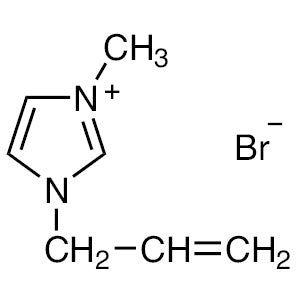
1-Allyl-3-methyl-1H-imidazol-3-iumBromide TCI A2765
Regular price From Rp 1.351.350,00Regular priceRp 960.750,00Sale price From Rp 1.351.350,00