TCI M3039 1-Methyl-3-n-octylimidazolium Bis(trifluoromethanesulfonyl)imide is an ionic liquid that pairs a long octyl-chain imidazolium cation with the bis(trifluoromethanesulfonyl)imide anion, commonly abbreviated as NTf2 or TFSI. This combination produces one of the most extensively studied classes of ionic liquids, valued for its hydrophobic and stable character. In the laboratory, the compound is used as a water-immiscible extraction phase, as a high-performance electrolyte, and as a reaction medium for processes that demand high thermal and electrochemical stability.
The properties behind its selection begin with the NTf2 anion, which is very weakly coordinating, charge-delocalised, and hydrophobic. This anion lowers viscosity and melting point relative to halide counterparts, widens the electrochemical window, and improves thermal stability. Combined with the strongly lipophilic n-octyl chain on the cation, the result is an ionic liquid that is generally immiscible with water and capable of forming a sharply defined two-phase system. These characteristics make it particularly useful in extraction work, catalyst immobilisation, and liquid membrane applications.
In Indonesian laboratories, this ionic liquid is typically handled in university research groups, government research institutes, and industrial R&D units working on separation science, electrochemistry, and green solvent chemistry. It is normally ordered in small research quantities for method development rather than routine analysis, and is used on the bench in fume hoods alongside standard glassware, electrochemical cells, and extraction apparatus.
TCI brochures (PDF)
- Ionic Liquids 2026-06-08 · p. 9
Related TCI products
- TCI V0145 1013027-27-4 1-Vinylimidazole Bis(trifluoromethanesulfonyl)imide
- TCI B5421 1312310-16-9 3,3'-(Butane-1,4-diyl)bis(1-vinyl-3-imidazolium) Bis(trifluoromethanesulfonyl)imide
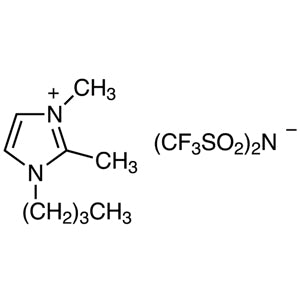
- TCI B3159 350493-08-2 1-Butyl-2,3-dimethylimidazolium Bis(trifluoromethanesulfonyl)imide
- TCI B2477 174899-83-3 1-Butyl-3-methylimidazolium Bis(trifluoromethanesulfonyl)imide
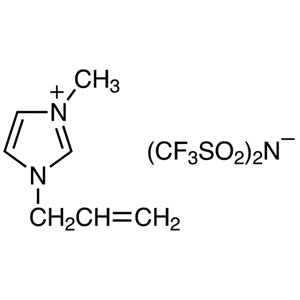
- TCI A3210 655249-87-9 1-Allyl-3-methylimidazolium Bis(trifluoromethanesulfonyl)imide
- TCI M3210 353239-08-4 1-Methylimidazole Bis(trifluoromethanesulfonyl)imide
- Liquid-liquid extraction: the hydrophobic NTf2 anion and lipophilic n-octyl chain give clean phase separation from aqueous samples, allowing a distinct two-phase system for transferring target species.
- Electrochemical studies: the wide electrochemical window and weakly coordinating anion make it suitable as an electrolyte medium where conventional solvents would decompose at the applied potentials.
- Catalyst immobilisation: the water-immiscible ionic phase can retain a catalyst while aqueous or organic product streams are separated, supporting recovery and reuse of the catalytic species.
- Supported liquid membrane research: its hydrophobic nature and low volatility allow it to be held within a membrane support for selective transport studies without rapid loss of the liquid phase.
- High-temperature reaction medium: the improved thermal stability contributed by the NTf2 anion suits reactions that must be run as a medium at elevated temperature with negligible solvent evaporation.
| Brand | TCI |
|---|---|
| CAS number | 178631-04-4 |
| Molecular formula | — |
| Purity | — |
| Category | Chemistry > Specialty Synthesis > Ionic Liquids [Specialty Synthesis] |
| Pack sizes | available in standard TCI research pack sizes; please confirm the current packing option when ordering |
| Physical form | ionic liquid (liquid at ordinary handling temperature) |
| Storage | keep tightly closed in a cool, dry place away from moisture |
- Product code: M3039
Store the container tightly closed in a cool, dry, well-ventilated area, protected from moisture, since water uptake can alter the behaviour of the ionic liquid phase. Original supplier bottles with a well-sealing closure are preferred; where transfer is necessary, use clean, dry glass containers with chemically resistant caps. Handle in a fume hood using nitrile gloves, safety goggles, and a laboratory coat, and avoid contact with skin and eyes. Use dry syringes or pipettes for dispensing to limit atmospheric moisture pickup, keep the material away from strong oxidising agents, and consult the manufacturer's safety data sheet before use. Dispose of residues as chemical waste in accordance with institutional procedures.
—
Produk Terkait
-
1-VinylimidazoleBis(trifluoromethanesulfonyl)imide TCI V0145
Regular price Rp 2.809.800,00Regular priceRp 1.980.300,00Sale price Rp 2.809.800,00 -
3,3'-(Butane-1,4-diyl)bis(1-vinyl-3-imidazolium)Bis(trifluoromethanesulfonyl)imide TCI B5421
Regular price Rp 2.439.150,00Regular priceRp 1.720.950,00Sale price Rp 2.439.150,00 -
1-Butyl-2,3-dimethylimidazoliumBis(trifluoromethanesulfonyl)imide TCI B3159
Regular price From Rp 1.431.150,00Regular priceRp 1.016.400,00Sale price From Rp 1.431.150,00 -
1-Butyl-3-methylimidazoliumBis(trifluoromethanesulfonyl)imide TCI B2477
Regular price From Rp 1.351.350,00Regular priceRp 960.750,00Sale price From Rp 1.351.350,00 -
1-Allyl-3-methylimidazoliumBis(trifluoromethanesulfonyl)imide TCI A3210
Regular price From Rp 2.093.700,00Regular priceRp 1.479.450,00Sale price From Rp 2.093.700,00 -
1-MethylimidazoleBis(trifluoromethanesulfonyl)imide TCI M3210
Regular price From Rp 1.934.100,00Regular priceRp 1.368.150,00Sale price From Rp 1.934.100,00 -
1-Methyl-3-(4-sulfobutyl)imidazoliumBis(trifluoromethanesulfonyl)imide TCI M3119
Regular price From Rp 1.618.050,00Regular priceRp 1.146.600,00Sale price From Rp 1.618.050,00 -
1-Methyl-3-propylimidazoliumBis(trifluoromethanesulfonyl)imide TCI M3059
Regular price From Rp 1.538.250,00Regular priceRp 1.090.950,00Sale price From Rp 1.538.250,00