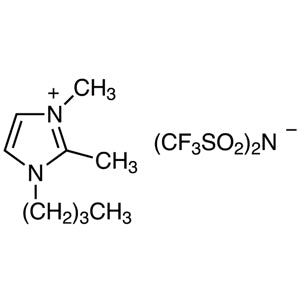
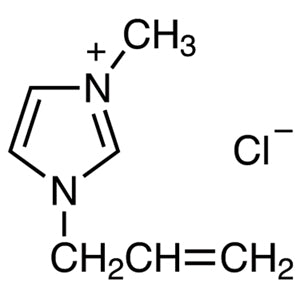
1-Allyl-3-methylimidazolium Bis(trifluoromethanesulfonyl)imide is an ionic liquid widely used in complex chemical reactions within laboratory settings. As a unique ionic compound, it consists of the cation 1-allyl-3-methylimidazolium and the anion bis(trifluoromethanesulfonyl)imide. This material plays a crucial role in various synthetic processes due to its exceptional chemical stability and non-volatile nature. Its ability to remain in liquid form at high temperatures makes it ideal for reactions that require elevated thermal conditions.
The properties of this ionic liquid make it a preferred choice for advanced chemical applications. It is non-toxic, stable under a wide range of chemical conditions, and has low viscosity, which facilitates efficient mixing and reaction processes. Its solubility in various organic solvents enhances its utility in separation and purification techniques. These characteristics ensure that it remains a reliable and safe material for use in modern laboratory environments.
In Indonesian laboratories, this ionic liquid is commonly used in applied chemistry research, particularly in organic synthesis and electrochemistry. Its versatility supports the development of new technologies, including batteries and catalysts. Due to its unique properties, it is a valuable resource for academic and industrial research institutions in Indonesia.
Advantages (TCI brochure)
- Bears allyl groups, reported as useful starting material for polymers with ionic liquid properties
TCI brochures (PDF)
- Monomers for Poly(Ionic Liquid) Synthesis 2025-09-19 · p. 1
- Ionic Liquids 2026-06-08 · p. 7
Related TCI products
- TCI V0145 1013027-27-4 1-Vinylimidazole Bis(trifluoromethanesulfonyl)imide
- TCI B5421 1312310-16-9 3,3'-(Butane-1,4-diyl)bis(1-vinyl-3-imidazolium) Bis(trifluoromethanesulfonyl)imide
- TCI B3159 350493-08-2 1-Butyl-2,3-dimethylimidazolium Bis(trifluoromethanesulfonyl)imide
- TCI B2477 174899-83-3 1-Butyl-3-methylimidazolium Bis(trifluoromethanesulfonyl)imide
- TCI A2084 65039-10-3 1-Allyl-3-methylimidazolium Chloride
- TCI M3210 353239-08-4 1-Methylimidazole Bis(trifluoromethanesulfonyl)imide
- Organic synthesis applications benefit from this ionic liquid due to its non-volatile nature and high thermal stability, allowing for prolonged reaction times without evaporation.
- Electrochemical studies utilize this material because of its stable ionic environment and ability to support redox reactions under controlled conditions.
- Solvent replacement in green chemistry is enhanced by its low toxicity and recyclability, making it a sustainable alternative to traditional volatile solvents.
- Catalytic processes are supported by its ability to dissolve a wide range of substrates, improving reaction efficiency and product yield.
- Battery development leverages its ionic conductivity and thermal stability, contributing to the performance and longevity of advanced energy storage systems.
From the TCI brochure
- Polymeric electrolytes
| Brand | TCI |
|---|---|
| CAS number | 655249-87-9 |
| Molecular formula | — |
| Purity | — |
| Category | Chemistry > Specialty Synthesis > Ionic Liquids |
| Pack sizes | Available in various quantities as per supplier specifications |
| Physical form | Liquid |
| Storage | Store in a cool, dry place away from direct sunlight and incompatible materials |
This ionic liquid should be stored in a cool, dry environment, away from direct sunlight and sources of heat. It is recommended to use sealed, non-reactive containers such as glass or high-density polyethylene to prevent contamination and evaporation. As it is non-volatile, it does not require refrigeration but should be kept in a secure location to avoid accidental spills. In laboratory settings, proper personal protective equipment, including gloves and safety goggles, should be worn when handling. Regular inspection of storage containers is advised to ensure integrity and safety.
—
Produk Terkait
-
1-VinylimidazoleBis(trifluoromethanesulfonyl)imide TCI V0145
Regular price Rp 2.809.800,00Regular priceRp 1.980.300,00Sale price Rp 2.809.800,00 -
3,3'-(Butane-1,4-diyl)bis(1-vinyl-3-imidazolium)Bis(trifluoromethanesulfonyl)imide TCI B5421
Regular price Rp 2.439.150,00Regular priceRp 1.720.950,00Sale price Rp 2.439.150,00 -
1-Butyl-2,3-dimethylimidazoliumBis(trifluoromethanesulfonyl)imide TCI B3159
Regular price From Rp 1.431.150,00Regular priceRp 1.016.400,00Sale price From Rp 1.431.150,00 -
1-Butyl-3-methylimidazoliumBis(trifluoromethanesulfonyl)imide TCI B2477
Regular price From Rp 1.351.350,00Regular priceRp 960.750,00Sale price From Rp 1.351.350,00 -
1-Allyl-3-methylimidazoliumChloride TCI A2084
Regular price From Rp 1.351.350,00Regular priceRp 960.750,00Sale price From Rp 1.351.350,00 -
1-MethylimidazoleBis(trifluoromethanesulfonyl)imide TCI M3210
Regular price From Rp 1.934.100,00Regular priceRp 1.368.150,00Sale price From Rp 1.934.100,00 -
1-Methyl-3-(4-sulfobutyl)imidazoliumBis(trifluoromethanesulfonyl)imide TCI M3119
Regular price From Rp 1.618.050,00Regular priceRp 1.146.600,00Sale price From Rp 1.618.050,00 -
1-Methyl-3-propylimidazoliumBis(trifluoromethanesulfonyl)imide TCI M3059
Regular price From Rp 1.538.250,00Regular priceRp 1.090.950,00Sale price From Rp 1.538.250,00