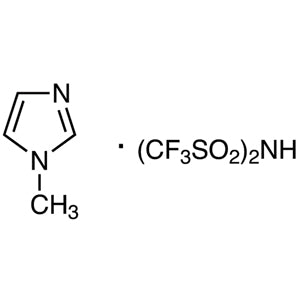
TCI M3210 1-Methylimidazole Bis(trifluoromethanesulfonyl)imide, CAS number 353239-08-4, is a protic ionic liquid formed from 1-methylimidazole paired with the bis(trifluoromethanesulfonyl)imide anion. Unlike aprotic ionic liquids, whose cations are fully quaternised, protic ionic liquids carry a transferable proton on the cation, and this property opens the possibility of proton conduction within the medium. In the laboratory, the material is used as an electrolyte, a reaction medium, an acid catalyst, and as a subject of study in its own right within the physical chemistry of ionic liquids.
The characteristics that make this material a preferred choice are the combination of the NTf2 anion — weakly coordinating, hydrophobic, and electrochemically stable — with an imidazolium cation that carries a labile proton. The NTf2 anion provides a wide electrochemical window, good thermal stability, and extremely low vapour pressure, while the protic nature of the cation contributes Brønsted acidity that can be exploited catalytically and simultaneously serves as a pathway for proton conduction. This pairing is what makes the compound a widely investigated material for intermediate-temperature fuel cell electrolytes, that is, systems that require proton transport without depending on liquid water.
In Indonesian laboratories, this ionic liquid is typically encountered in university and institutional research groups working on electrochemistry, energy materials, and green solvent chemistry, where it is used at small scale for electrolyte formulation, cyclic voltammetry and conductivity studies, or as a catalytic reaction medium in organic synthesis. It is normally purchased in research quantities and handled within a broader ionic liquid screening programme rather than consumed in routine analysis.
TCI brochures (PDF)
- Ionic Liquids 2026-06-08 · p. 7
Related TCI products
- TCI V0145 1013027-27-4 1-Vinylimidazole Bis(trifluoromethanesulfonyl)imide
- TCI B5421 1312310-16-9 3,3'-(Butane-1,4-diyl)bis(1-vinyl-3-imidazolium) Bis(trifluoromethanesulfonyl)imide
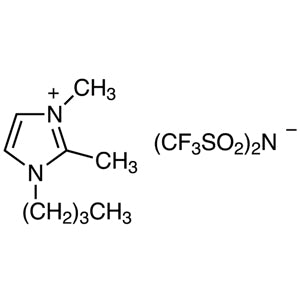
- TCI B3159 350493-08-2 1-Butyl-2,3-dimethylimidazolium Bis(trifluoromethanesulfonyl)imide
- TCI B2477 174899-83-3 1-Butyl-3-methylimidazolium Bis(trifluoromethanesulfonyl)imide
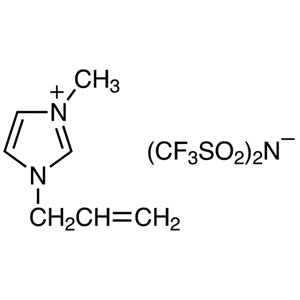
- TCI A3210 655249-87-9 1-Allyl-3-methylimidazolium Bis(trifluoromethanesulfonyl)imide
- TCI M3119 909390-59-6 1-Methyl-3-(4-sulfobutyl)imidazolium Bis(trifluoromethanesulfonyl)imide
- Electrolyte formulation for electrochemical studies, since the NTf2 anion offers a wide electrochemical window and negligible vapour pressure, allowing measurements over extended potential ranges without solvent loss.
- Intermediate-temperature fuel cell research, because the transferable proton on the imidazolium cation supports proton conduction in systems that must operate without relying on liquid water.
- Brønsted acid catalysis in organic synthesis, where the labile proton on the protic cation supplies acidity while the ionic liquid itself simultaneously acts as the reaction medium.
- Non-volatile reaction medium for thermally demanding preparations, as the very low vapour pressure and good thermal stability of the NTf2 salt reduce solvent evaporation during extended heating.
- Physical chemistry investigation of ionic liquids, serving as a reference protic system for studies of proton transfer, ion association, conductivity, and hydrophobic anion behaviour in neat salts.
| Brand | TCI |
|---|---|
| CAS number | 353239-08-4 |
| Molecular formula | — |
| Purity | — |
| Category | Chemistry > Specialty Synthesis > Ionic Liquids [Specialty Synthesis] |
| Pack sizes | available in research-scale laboratory pack sizes; please confirm the current packing option when ordering |
| Physical form | ionic liquid (liquid salt at working temperature) |
| Storage | keep in a tightly closed container, protected from moisture, in accordance with the manufacturer's stated storage conditions |
Store the container tightly closed in a cool, dry, well-ventilated area away from incompatible materials and from sources of heat or ignition, following the storage conditions stated by the manufacturer. Because the material is hygroscopic in practical handling terms, transfers are best carried out with dry glassware or, where water uptake would affect results, inside a glovebox or under an inert atmosphere. Use the original supplier container or a chemically compatible sealed vessel with a secure closure, and label all secondary containers clearly. Handle in a fume hood using safety glasses, chemically resistant gloves, and a laboratory coat, avoid contact with skin and eyes, and consult the manufacturer's safety data sheet before use and before disposal of residues.
—
Produk Terkait
-
1-VinylimidazoleBis(trifluoromethanesulfonyl)imide TCI V0145
Regular price Rp 2.809.800,00Regular priceRp 1.980.300,00Sale price Rp 2.809.800,00 -
3,3'-(Butane-1,4-diyl)bis(1-vinyl-3-imidazolium)Bis(trifluoromethanesulfonyl)imide TCI B5421
Regular price Rp 2.439.150,00Regular priceRp 1.720.950,00Sale price Rp 2.439.150,00 -
1-Butyl-2,3-dimethylimidazoliumBis(trifluoromethanesulfonyl)imide TCI B3159
Regular price From Rp 1.431.150,00Regular priceRp 1.016.400,00Sale price From Rp 1.431.150,00 -
1-Butyl-3-methylimidazoliumBis(trifluoromethanesulfonyl)imide TCI B2477
Regular price From Rp 1.351.350,00Regular priceRp 960.750,00Sale price From Rp 1.351.350,00 -
1-Allyl-3-methylimidazoliumBis(trifluoromethanesulfonyl)imide TCI A3210
Regular price From Rp 2.093.700,00Regular priceRp 1.479.450,00Sale price From Rp 2.093.700,00 -
1-Methyl-3-(4-sulfobutyl)imidazoliumBis(trifluoromethanesulfonyl)imide TCI M3119
Regular price From Rp 1.618.050,00Regular priceRp 1.146.600,00Sale price From Rp 1.618.050,00 -
1-Methyl-3-propylimidazoliumBis(trifluoromethanesulfonyl)imide TCI M3059
Regular price From Rp 1.538.250,00Regular priceRp 1.090.950,00Sale price From Rp 1.538.250,00 -
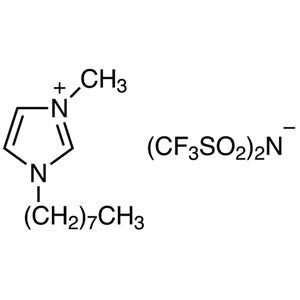
1-Methyl-3-n-octylimidazoliumBis(trifluoromethanesulfonyl)imide TCI M3039
Regular price From Rp 1.856.400,00Regular priceRp 1.313.550,00Sale price From Rp 1.856.400,00