TCI M3059 is 1-Methyl-3-propylimidazolium Bis(trifluoromethanesulfonyl)imide, CAS number 216299-72-8, an ionic liquid built from an imidazolium cation carrying methyl and propyl substituents paired with a bistriflimide anion. Ionic liquids are salts that remain liquid at or near room temperature, and it is precisely this property that makes them a material class of their own in the laboratory. Rather than serving merely as a solvent, this material functions as both a reaction medium and an electrolyte, providing a highly charged environment without the need to add supporting salts as would be required in conventional organic solvents.
The properties that make it a preferred choice are its combination of very low vapour pressure, a wide electrochemical stability window, adequate ionic conductivity, and the hydrophobic character contributed by the bistriflimide anion. Low vapour pressure means the material is practically non-volatile, so it can be used safely in vacuum systems, in long-duration measurements, and in high-temperature experiments without loss of volume. The wide electrochemical window allows researchers to observe redox processes at extreme potentials that would decompose ordinary solvents, while the hydrophobic nature of the anion shapes how the liquid behaves in contact with water.
In Indonesian laboratories, this ionic liquid is typically encountered in university research groups and institutional laboratories working on electrochemistry, materials, and specialty synthesis. It is usually purchased in small research quantities rather than bulk volumes, since a single experiment consumes very little. Work of this kind is commonly carried out in laboratories that already run electrochemical cells or controlled-atmosphere setups, where a non-volatile, thermally forgiving medium simplifies handling in warm and humid ambient conditions.
TCI brochures (PDF)
- Ionic Liquids for Battery Research 2026-04-13 · p. 1
- Ionic Liquids 2026-06-08 · p. 9
Related TCI products
- TCI V0145 1013027-27-4 1-Vinylimidazole Bis(trifluoromethanesulfonyl)imide
- TCI B5421 1312310-16-9 3,3'-(Butane-1,4-diyl)bis(1-vinyl-3-imidazolium) Bis(trifluoromethanesulfonyl)imide
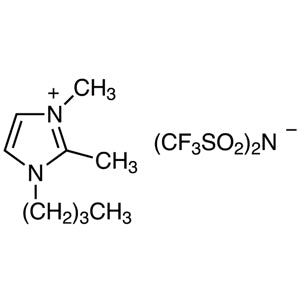
- TCI B3159 350493-08-2 1-Butyl-2,3-dimethylimidazolium Bis(trifluoromethanesulfonyl)imide
- TCI B2477 174899-83-3 1-Butyl-3-methylimidazolium Bis(trifluoromethanesulfonyl)imide
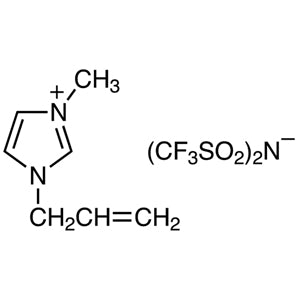
- TCI A3210 655249-87-9 1-Allyl-3-methylimidazolium Bis(trifluoromethanesulfonyl)imide
- TCI M3210 353239-08-4 1-Methylimidazole Bis(trifluoromethanesulfonyl)imide
- Electrochemical research: it serves as an electrolyte in its own right, offering a wide potential window so that redox events far outside the range of conventional solvents can be studied without solvent breakdown.
- Reaction media for specialty synthesis: the liquid acts as a charged, non-volatile reaction environment, allowing chemistry to proceed at elevated temperature without the solvent loss that plagues volatile organic media.
- Vacuum-compatible experiments: because the material has extremely low vapour pressure, it can remain in an evacuated system for extended periods without evaporating or contaminating the vacuum line.
- High-temperature and long-duration studies: the absence of measurable volatility means sample volume stays effectively constant through prolonged runs, keeping concentrations reliable from the first measurement to the last.
- Separation and biphasic work: the hydrophobic character imparted by the bistriflimide anion governs how the liquid behaves alongside aqueous phases, which is exploited in extraction and two-phase experimental designs.
| Brand | TCI (Tokyo Chemical Industry) |
|---|---|
| CAS number | 216299-72-8 |
| Molecular formula | — |
| Purity | — |
| Category | Chemistry > Specialty Synthesis > Ionic Liquids [Specialty Synthesis] |
| Pack sizes | supplied in research-scale quantities; please confirm the available pack size when ordering |
| Physical form | ionic liquid — liquid at or near room temperature |
| Storage | keep in a closed container, protected from moisture |
- Chemical name: 1-Methyl-3-propylimidazolium Bis(trifluoromethanesulfonyl)imide
Store the material in a tightly closed original container in a cool, dry place away from direct sunlight and heat sources. Because the bistriflimide anion makes the liquid hydrophobic, contact with atmospheric moisture is still best avoided, so keep the container sealed and consider dispensing under an inert atmosphere where the experimental work demands it. Handle in a fume hood using gloves, safety glasses, and a laboratory coat, and use clean, dry glassware or syringes for transfer to avoid introducing water or contaminants. Although the very low vapour pressure means there is little inhalation risk from evaporation, spills should be contained promptly since the liquid will not simply dry off a surface. Always consult the manufacturer's safety data sheet before use.
—
Produk Terkait
-
1-VinylimidazoleBis(trifluoromethanesulfonyl)imide TCI V0145
Regular price Rp 2.809.800,00Regular priceRp 1.980.300,00Sale price Rp 2.809.800,00 -
3,3'-(Butane-1,4-diyl)bis(1-vinyl-3-imidazolium)Bis(trifluoromethanesulfonyl)imide TCI B5421
Regular price Rp 2.439.150,00Regular priceRp 1.720.950,00Sale price Rp 2.439.150,00 -
1-Butyl-2,3-dimethylimidazoliumBis(trifluoromethanesulfonyl)imide TCI B3159
Regular price From Rp 1.431.150,00Regular priceRp 1.016.400,00Sale price From Rp 1.431.150,00 -
1-Butyl-3-methylimidazoliumBis(trifluoromethanesulfonyl)imide TCI B2477
Regular price From Rp 1.351.350,00Regular priceRp 960.750,00Sale price From Rp 1.351.350,00 -
1-Allyl-3-methylimidazoliumBis(trifluoromethanesulfonyl)imide TCI A3210
Regular price From Rp 2.093.700,00Regular priceRp 1.479.450,00Sale price From Rp 2.093.700,00 -
1-MethylimidazoleBis(trifluoromethanesulfonyl)imide TCI M3210
Regular price From Rp 1.934.100,00Regular priceRp 1.368.150,00Sale price From Rp 1.934.100,00 -
1-Methyl-3-(4-sulfobutyl)imidazoliumBis(trifluoromethanesulfonyl)imide TCI M3119
Regular price From Rp 1.618.050,00Regular priceRp 1.146.600,00Sale price From Rp 1.618.050,00 -
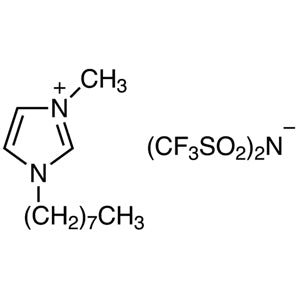
1-Methyl-3-n-octylimidazoliumBis(trifluoromethanesulfonyl)imide TCI M3039
Regular price From Rp 1.856.400,00Regular priceRp 1.313.550,00Sale price From Rp 1.856.400,00