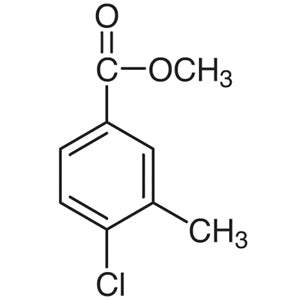
TCI M1935 Methyl 4-Chloro-3-methylbenzoate is a methyl ester of benzoic acid whose aromatic ring carries a chlorine atom at the four position and a methyl group at the three position. The material is classified as a non-heterocyclic building block, meaning a simple aromatic starting material that serves as the initial framework for assembling more complex molecules. This clearly defined three-substituent pattern allows researchers to reach target compounds with a specific substituent arrangement without passing through sequences of aromatic substitution reactions that frequently produce isomer mixtures difficult to separate.
The characteristics that make this compound a preferred choice are its stability combined with the variety of its reactive sites. The methyl ester group is the most readily accessible centre for transformation: it can be hydrolysed to the carboxylic acid, converted to an amide using coupling reagents, transesterified, or reduced to the benzylic alcohol, which can subsequently be oxidised or converted into a leaving group. The aromatic chlorine atom is comparatively inert under ordinary conditions, so it survives transformations carried out at the ester, yet it can still be activated through modern palladium catalysis for cross-coupling reactions.
In Indonesian laboratories, this type of building block is typically used in university research groups, synthetic and medicinal chemistry laboratories, and industrial research units that prepare candidate molecules on a laboratory scale. Because the substitution pattern is already fixed, the reagent shortens the synthetic route and reduces the purification burden, which is valuable where instrument time and separation capacity are limited. It is ordinarily handled in standard fume-hood glassware alongside routine organic reagents.
Related TCI products
- Multi-step organic synthesis: the defined three-substituent aromatic framework supplies a ready-made core, sparing researchers the isomer-mixture problems that arise from direct aromatic substitution routes.
- Palladium-catalysed cross-coupling chemistry: the aromatic chlorine can be activated under modern palladium catalysis, allowing new carbon-carbon or carbon-heteroatom bonds to be formed at a defined ring position.
- Carboxylic acid preparation: hydrolysis of the methyl ester gives the corresponding benzoic acid derivative cleanly, providing a convenient entry point for further acid-based chemistry in the laboratory.
- Amide and peptide-like bond formation: the ester is converted to amides using coupling reagents, making the compound useful for building libraries of related amide structures.
- Benzylic alcohol intermediates: reduction of the ester furnishes a benzylic alcohol that can be oxidised again or converted into a leaving group for subsequent substitution steps.
| Brand | TCI (Tokyo Chemical Industry) |
|---|---|
| CAS number | 91367-05-4 |
| Molecular formula | — |
| Purity | — |
| Category | Chemistry > Building Blocks > Non-Heterocyclic Building Blocks |
| Pack sizes | available in standard TCI laboratory pack sizes; please confirm the packaging option required |
| Physical form | — |
| Storage | keep in the tightly closed original container as indicated on the manufacturer's label |
- Catalogue code: M1935
- Chemical class: methyl benzoate ester bearing an aromatic chlorine and methyl substituent; non-heterocyclic building block
Store the container tightly closed in a cool, dry, and well-ventilated area away from direct sunlight, heat sources, ignition sources, and incompatible materials such as strong oxidising agents and strong bases. Keep the material in its original manufacturer container, or in a clean, chemically resistant, well-sealed glass bottle that is clearly labelled with the compound name and CAS number. Handle the compound inside a functioning fume hood, wearing safety goggles, a laboratory coat, and chemically resistant gloves. Avoid inhaling vapours and avoid contact with skin and eyes. Keep the container closed when not in use to limit moisture uptake, and always consult the manufacturer's safety data sheet before opening, weighing, or disposing of the material.
—
Produk Terkait
-
Methyl3-Chloro-4-methylbenzoate TCI M2136
Regular price From Rp 1.115.100,00Regular price -
tert-Butyl4-Formylbenzoate TCI B5414
Regular price From Rp 4.797.450,00Regular price -
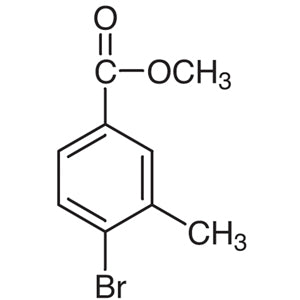
Methyl4-Bromo-3-methylbenzoate TCI B2256
Regular price From Rp 903.000,00Regular price -
Methyl2-Benzoylbenzoate TCI B1231
Regular price From Rp 903.000,00Regular price -
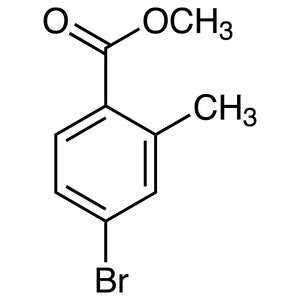
Methyl4-Bromo-2-methylbenzoate TCI M3630
Regular price From Rp 1.936.200,00Regular price -
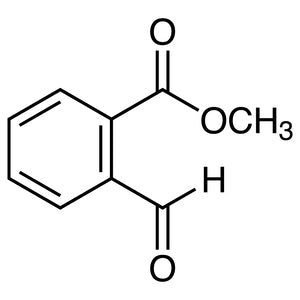
Methyl2-Formylbenzoate TCI M3552
Regular price From Rp 3.392.550,00Regular price -
Methyl3-Formylbenzoate TCI M3500
Regular price From Rp 1.829.100,00Regular price -
Methyl4-Isopropylbenzoate TCI M3307
Regular price From Rp 1.803.900,00Regular price