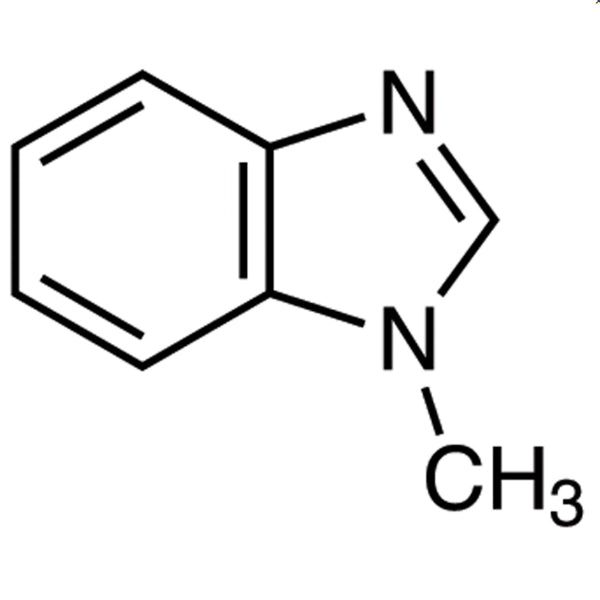
TCI M2173 1-Methylbenzimidazole is an aromatic heterocyclic compound of the benzimidazole family in which one of the two nitrogen atoms carries a methyl group at the N1 position. In organic synthesis laboratories, this material serves as a ready-to-use heterocyclic building block: the benzimidazole framework provides an imidazole ring fused to a benzene ring, while methylation at N1 removes the NH proton that normally complicates reactions. Researchers therefore gain a clean starting point for constructing target molecules without first performing a nitrogen protection step, which makes the synthetic route shorter and easier to control.
The characteristics that make this compound a frequent choice are the combination of a stable aromatic framework and the reactivity of the still-free N3 nitrogen. That nitrogen is both weakly basic and nucleophilic, so it is readily quaternised by alkyl halides to give benzimidazolium salts — the common precursors of N-heterocyclic carbene (NHC) ligands and of ionic liquids. At the same time, its lone pair can coordinate to transition metal centres, making the molecule a nitrogen-donor ligand in its own right. Because the N1 position is already blocked, reactions proceed at a single predictable site rather than giving mixtures of N1 and N3 products.
In Indonesian laboratories, this building block is typically used in university and institutional research groups working on organic synthesis, coordination chemistry, and catalyst development, as well as in medicinal chemistry programmes that explore benzimidazole-based scaffolds. It is generally ordered in small research quantities for method development, student thesis work, and exploratory route-finding, where the convenience of a pre-methylated nitrogen saves both reagents and working time in laboratories that operate with limited consumable budgets.
- Synthesis of benzimidazolium salts: the free N3 nitrogen is quaternised directly by alkyl halides, giving the salt in a single step without any prior protection or deprotection chemistry.
- Preparation of N-heterocyclic carbene (NHC) ligand precursors: the resulting benzimidazolium salts are deprotonated to generate NHC ligands widely used in transition metal catalysis research.
- Ionic liquid research: quaternisation with different alkyl chains produces benzimidazolium-based ionic liquids, allowing researchers to tune properties systematically from one common starting material.
- Coordination chemistry and complex formation: the lone pair on N3 binds transition metal centres, letting this compound act as a monodentate nitrogen-donor ligand in metal complex studies.
- Medicinal chemistry scaffold elaboration: the benzimidazole core is a recurring motif in bioactive molecules, and the pre-methylated nitrogen gives a single, predictable reaction site for analogue synthesis.
| Brand | TCI (Tokyo Chemical Industry) |
|---|---|
| CAS number | 1632-83-3 |
| Molecular formula | — |
| Purity | — |
| Category | Chemistry > Building Blocks > Heterocyclic Building Blocks |
| Pack sizes | available in standard TCI research-scale packaging; please confirm the currently listed pack options when ordering |
| Physical form | — |
| Storage | keep in a cool, dry place in the tightly closed original container |
- Product Code: M2173
Store the container tightly closed in a cool, dry, well-ventilated area away from direct sunlight, heat sources, strong oxidising agents, and strong acids. The original manufacturer's container is the most suitable storage vessel; if transferring, use clean, dry, chemically compatible glassware with a secure closure and label it clearly with the product name and CAS number. Handle the material inside a fume hood, and wear safety glasses, gloves, and a laboratory coat. Avoid inhaling dust and avoid contact with skin and eyes. Close the container promptly after weighing to limit moisture pickup, and always consult the manufacturer's Safety Data Sheet before use and before disposing of any residues.
—
Produk Terkait
-
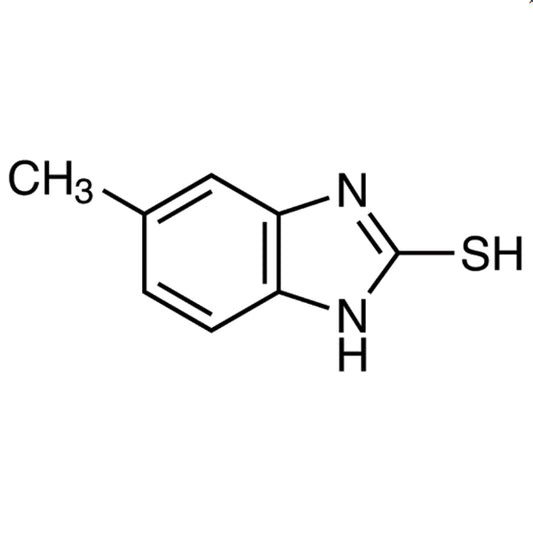
2-Mercapto-5-methylbenzimidazole TCI M1357
Regular price From Rp 1.246.350,00Regular price -
5-Methylbenzimidazole TCI M1321
Regular price Rp 1.936.200,00Regular price -
2-Methylbenzimidazole TCI M0286
Regular price Rp 1.298.850,00Regular price -
1,2-Dimethylbenzimidazole TCI D3665
Regular price From Rp 3.021.900,00Regular price -
5,6-Dimethylbenzimidazole TCI D1345
Regular price Rp 1.008.000,00Regular price -
2-BenzylbenzimidazoleHydrochloride TCI B4341
Regular price From Rp 1.988.700,00Regular price -
2-Phenylbenzimidazole TCI P1105
Regular price Rp 848.400,00Regular price -
2-Nonylbenzimidazole TCI N0671
Regular price Rp 1.670.550,00Regular price