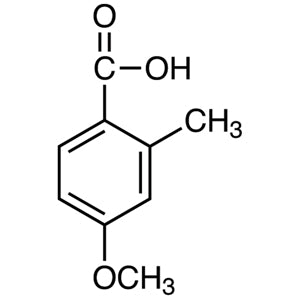
4-Methoxy-2-methylbenzoic Acid is a chemical compound widely used in laboratory settings for the synthesis of complex molecules. As a building block in organic chemistry, it plays a crucial role in the development of heterocyclic and non-heterocyclic compounds. This versatile reagent is commonly employed in research and development processes across various scientific fields, including pharmaceuticals and materials science. Its presence in chemical reactions allows for the creation of a wide range of functional derivatives, making it an essential component in modern synthetic strategies.
The compound is valued for its stability under controlled conditions and its ability to participate in multiple chemical reactions such as esterification, amidation, and substitution. Its solubility in organic solvents enhances its utility in purification and reaction processes. These properties make it a reliable and efficient choice for chemists working on intricate molecular structures. Additionally, its consistent performance in laboratory experiments ensures reproducibility and accuracy in research outcomes.
In Indonesian laboratories, 4-Methoxy-2-methylbenzoic Acid is frequently used by researchers and students in academic and research institutions. Its availability and reliable chemical properties make it a preferred choice for both educational and industrial applications. It supports a variety of experimental needs, from basic organic synthesis to advanced pharmaceutical development, ensuring its relevance in both teaching and research environments.
Related TCI products
- Synthesis of aromatic compounds requiring a benzoic acid core structure, as it provides a stable and reactive base for further functionalization.
- Development of pharmaceuticals where the compound contributes to the structural framework of drug molecules, enhancing bioavailability and efficacy.
- Organic chemistry experiments involving esterification and amidation reactions, where its reactivity and solubility properties are highly beneficial.
- Research in materials science for the creation of polymers and coatings, due to its ability to form stable derivatives under various reaction conditions.
- Educational purposes in undergraduate and graduate courses, where it serves as a fundamental reagent for teaching synthetic techniques and reaction mechanisms.
| Brand | TCI |
|---|---|
| CAS number | 6245-57-4 |
| Molecular formula | — |
| Purity | — |
| Category | Chemistry > Building Blocks > Non-Heterocyclic Building Blocks |
| Pack sizes | Available in various quantities as per standard chemical supply practices |
| Physical form | Solid, typically in crystalline or powder form |
| Storage | Store in a cool, dry place away from direct sunlight and moisture |
This compound should be stored in a cool, dry environment to maintain its chemical integrity and prevent degradation. It is recommended to keep it in airtight containers to avoid exposure to moisture and air, which can affect its stability. When handling, it is important to use appropriate personal protective equipment, such as gloves and safety goggles, to ensure safety. The compound is generally non-hazardous under normal conditions but should be handled with care in laboratory settings. Proper labeling of storage containers is essential to prevent accidental misuse. Regular inspection of storage conditions ensures that the compound remains suitable for use in chemical experiments.
—
Produk Terkait
-
4-Methoxy-3-methylbenzoicAcid TCI M2728
Regular price Rp 557.550,00Regular price -
3-Methoxy-2-methylbenzoicAcid TCI M2217
Regular price From Rp 505.050,00Regular price -
3-Methoxy-4-methylbenzoicAcid TCI M1426
Regular price From Rp 1.458.450,00Regular price -
2-Bromo-5-methylbenzoicAcid TCI B4145
Regular price From Rp 1.510.950,00Regular price -
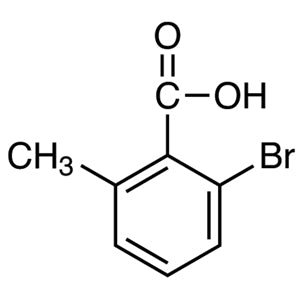
2-Bromo-6-methylbenzoicAcid TCI B4097
Regular price From Rp 1.431.150,00Regular price -
2-Bromo-4-methylbenzoicAcid TCI B3879
Regular price From Rp 795.900,00Regular price -
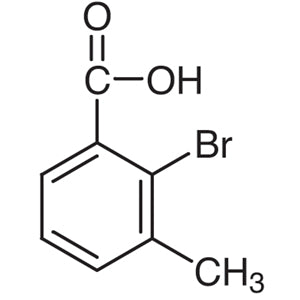
2-Bromo-3-methylbenzoicAcid TCI B3636
Regular price From Rp 769.650,00Regular price -
4-Bromo-2-methylbenzoicAcid TCI B3337
Regular price From Rp 3.260.250,00Regular price