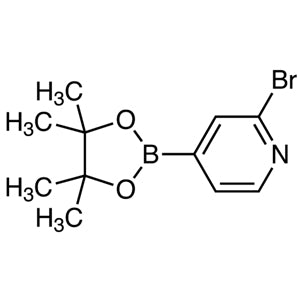
3-Methoxy-5-(4,4,5,5-tetramethyl-1,3,2-dioxaborolan-2-yl)pyridine is a specialized organic compound used in advanced laboratory settings for synthetic chemistry applications. This reagent plays a crucial role in the development of heterocyclic compounds and organoboron derivatives, making it an essential component in modern chemical research. Its unique structure enables it to participate in a variety of reaction mechanisms, including cross-coupling processes, which are vital for creating complex molecular architectures.
The compound is highly reactive and exhibits strong affinity for transition metals, which makes it a preferred choice in catalytic reactions. Its dioxaborolan-2-yl group enhances its stability under various reaction conditions while maintaining reactivity, allowing it to be used in a wide range of synthetic pathways. This combination of reactivity and stability ensures that it remains a valuable tool for chemists working on intricate molecular synthesis.
In Indonesian laboratories, this compound is widely utilized in organic chemistry research, particularly in academic and research institutions. Its application spans across the development of new compounds, pharmaceutical research, and the study of reaction mechanisms. Its reliability and performance make it a key reagent in the pursuit of scientific innovation and discovery.
TCI brochures (PDF)
- Suzuki-Miyaura Cross Coupling Reaction 2025-12-01 · p. 19
Related TCI products
- TCI T4400 942919-26-8 4-(4,4,5,5-Tetramethyl-1,3,2-dioxaborolan-2-yl)-1H-pyrrolo[2,3-b]pyridine
- TCI T3400 1009033-87-7 4-[4-(4,4,5,5-Tetramethyl-1,3,2-dioxaborolan-2-yl)phenyl]pyridine
- TCI T3399 1009033-83-3 4-[3-(4,4,5,5-Tetramethyl-1,3,2-dioxaborolan-2-yl)phenyl]pyridine
- TCI T3313 939430-30-5 3-[3-(4,4,5,5-Tetramethyl-1,3,2-dioxaborolan-2-yl)phenyl]pyridine
- TCI T2345 329214-79-1 3-(4,4,5,5-Tetramethyl-1,3,2-dioxaborolan-2-yl)pyridine
- TCI B5238 458532-82-6 2-Bromo-4-(4,4,5,5-tetramethyl-1,3,2-dioxaborolan-2-yl)pyridine
- Synthetic Organic Chemistry: This compound is widely used in the synthesis of heterocyclic compounds due to its ability to undergo cross-coupling reactions, which are essential for constructing complex molecular structures.
- Pharmaceutical Research: It plays a significant role in the development of new drugs, as it can be used to create bioactive molecules with specific functional groups.
- Catalytic Reactions: Its reactivity with transition metals makes it ideal for use in catalytic processes, particularly in Suzuki-Miyaura coupling reactions that are common in organic synthesis.
- Material Science: It is employed in the creation of advanced materials, where its unique chemical properties contribute to the formation of stable and functional compounds.
- Analytical Chemistry: Its well-defined structure and predictable behavior make it a useful reference material in analytical and structural studies.
| Brand | TCI |
|---|---|
| CAS number | 445264-60-8 |
| Molecular formula | — |
| Purity | — |
| Category | Chemistry > Organometallic Reagents > Organoboron [Organometallic Reagents] |
| Pack sizes | Available in various quantities as per supplier specifications |
| Physical form | Solid or liquid, depending on the specific formulation |
| Storage | Store in a cool, dry place away from moisture and direct sunlight |
This compound should be stored in a cool, dry environment to maintain its chemical integrity and prevent degradation. It is recommended to use airtight containers made of materials that are chemically inert, such as glass or high-density polyethylene, to avoid any unwanted reactions. Due to its reactivity, it should be handled with care, using appropriate personal protective equipment like gloves and safety goggles. It is important to ensure that the storage area is well-ventilated to minimize exposure to vapors. Avoid contact with incompatible substances, and keep it away from heat sources and direct sunlight. Proper labeling and storage conditions are essential to ensure the safety of laboratory personnel and the effectiveness of the compound in research applications.
—
Produk Terkait
-
4-(4,4,5,5-Tetramethyl-1,3,2-dioxaborolan-2-yl)-1H-pyrrolo[2,3-b]pyridine TCI T4400
Regular price From Rp 3.630.900,00Regular price -
4-[4-(4,4,5,5-Tetramethyl-1,3,2-dioxaborolan-2-yl)phenyl]pyridine TCI T3400
Regular price From Rp 1.565.550,00Regular price -
4-[3-(4,4,5,5-Tetramethyl-1,3,2-dioxaborolan-2-yl)phenyl]pyridine TCI T3399
Regular price From Rp 1.908.900,00Regular price -
3-[3-(4,4,5,5-Tetramethyl-1,3,2-dioxaborolan-2-yl)phenyl]pyridine TCI T3313
Regular price From Rp 4.982.250,00Regular price -
3-(4,4,5,5-Tetramethyl-1,3,2-dioxaborolan-2-yl)pyridine TCI T2345
Regular price From Rp 1.485.750,00Regular price -
2-Bromo-4-(4,4,5,5-tetramethyl-1,3,2-dioxaborolan-2-yl)pyridine TCI B5238
Regular price Rp 2.411.850,00Regular price -
2-Bromo-6-(4,4,5,5-tetramethyl-1,3,2-dioxaborolan-2-yl)pyridine TCI B5077
Regular price From Rp 2.306.850,00Regular price -
1-(tert-Butoxycarbonyl)-1,2,3,6-tetrahydro-4-(4,4,5,5-tetramethyl-1,3,2-dioxaborolan-2-yl)pyridine TCI B4051
Regular price Rp 2.279.550,00Regular price
![942919-26-8 4-(4,4,5,5-Tetramethyl-1,3,2-dioxaborolan-2-yl)-1H-pyrrolo[2,3-b]pyridine - AMI Scientific](http://amiscientific.com/cdn/shop/files/TCI2510T4400.jpg?v=1767145178&width=533)
![1009033-87-7 4-[4-(4,4,5,5-Tetramethyl-1,3,2-dioxaborolan-2-yl)phenyl]pyridine - AMI Scientific](http://amiscientific.com/cdn/shop/files/TCI2510T3400.jpg?v=1769143727&width=533)
![1009033-83-3 4-[3-(4,4,5,5-Tetramethyl-1,3,2-dioxaborolan-2-yl)phenyl]pyridine - AMI Scientific](http://amiscientific.com/cdn/shop/files/TCI2510T3399.jpg?v=1769058221&width=533)
![939430-30-5 3-[3-(4,4,5,5-Tetramethyl-1,3,2-dioxaborolan-2-yl)phenyl]pyridine - AMI Scientific](http://amiscientific.com/cdn/shop/files/TCI2510T3313.jpg?v=1769058203&width=533)