TCI M3085 942135-14-0, 4-(4-Methoxyphenyl)thieno[2,3-b:5,4-c']dipyridine-2-carboxamide, is a chemical compound widely used in life science research, particularly in cell biology and stem cell biology. This compound plays a crucial role in laboratory settings by enabling researchers to study molecular interactions and cellular mechanisms. Its complex structure allows it to interact with specific proteins and receptors, making it an essential tool for investigating biological processes at the molecular level.
This compound is preferred due to its chemical stability under certain conditions, ensuring consistent and reliable results in experimental studies. Its molecular design supports a wide range of analytical techniques, including spectroscopy and chromatography, which are vital for characterizing its properties and behavior. Additionally, its resistance to degradation simplifies storage and reuse, making it a valuable resource for long-term research projects.
In Indonesian laboratories, this compound is commonly used in biomedical and pharmacological research. Scientists rely on it to develop new drugs and understand the molecular mechanisms underlying stem cell differentiation and activation. Its versatility and reliability make it a key component in the toolkit of researchers working in these fields.
Advantages (TCI brochure)
- Stimulates osteoblast differentiation of osteoblast precursors
- Enhances bone regeneration in rodent bone defect models
- Induces osteogenic effects on stem cells
TCI brochures (PDF)
- Helioxanthin Analogue (TH) Promoting Osteogenic Differentiation 2024-09-17 · p. 1
- Thiophenes 2026-06-29 · p. 14
- Reagents for Biological Research 2025-03-11 · p. 38
Related TCI products
- TCI A2528 2627-69-2 5-Aminoimidazole-4-carboxamide 1-beta-D-Ribofuranoside
- TCI A2529 167869-21-8 2-(2-Amino-3-methoxyphenyl)chromone
- TCI T3498 251992-66-2 4-(p-Tolylthio)thieno[2,3-c]pyridine-2-carboxamide
- TCI P3271 171856-25-0 Spiro[cyclopenta[2,1-b:3,4-b']dipyridine-5,9'-fluorene]
- TCI D6264 198142-63-1 2',7'-Dibromospiro[cyclopenta[2,1-b:3,4-b']dipyridine-5,9'-fluorene]
- TCI B6552 2763205-15-6 2',7'-Bis(4,4,5,5-tetramethyl-1,3,2-dioxaborolan-2-yl)spiro[cyclopenta[2,1-b:3,4-b']dipyridine-5,9'-fluorene]
- In stem cell differentiation studies, this compound is used to investigate molecular pathways that regulate cell fate and development.
- For biological activity assays, it serves as an active ingredient to test the effects of specific molecular interactions on cellular behavior.
- In pharmacological research, it is employed to explore its potential as a therapeutic agent or drug candidate.
- During spectroscopic analysis, its unique molecular structure allows for precise identification and characterization using advanced analytical techniques.
- In long-term cell culture experiments, its stability ensures consistent results over extended periods, supporting reproducible research outcomes.
| Brand | TCI |
|---|---|
| CAS number | 942135-14-0 |
| Molecular formula | — |
| Purity | — |
| Category | Life Science > Cell Biology > Stem Cell Biology |
| Pack sizes | Available in various quantities as per standard laboratory supply |
| Physical form | Solid (as per standard chemical properties) |
| Storage | Store in a cool, dry place away from light and moisture |
Data from the TCI brochure
| Kemasan | 10mg / 50mg |
|---|
Source: TCI brochure LL069 (2024-09-17)
This compound should be stored in a cool, dry environment, away from direct sunlight and moisture to maintain its chemical stability. It is recommended to use airtight containers to prevent exposure to air and humidity, which could affect its integrity. Laboratory personnel should handle the compound with appropriate personal protective equipment, such as gloves and safety goggles, to ensure safety during use and storage. Due to its chemical nature, it should be kept in a secure location that is inaccessible to unauthorized individuals. Regular monitoring of storage conditions is advised to ensure optimal preservation and usability in research applications.
References cited in the TCI brochure
- Shinsuke Ohba. A novel osteogenic helioxanthin-derivative acts in a BMP-dependent manner Biochemical and Biophysical Research Communications, 2007. doi:10.1016/j.bbrc.2007.03.173
- Keiji Nakajima. Enhancement of bone formation ex vivo and in vivo by a helioxanthin-derivative Biochemical and Biophysical Research Communications, 2010. doi:10.1016/j.bbrc.2010.04.041
- Yujiro Maeda. Bone healing by sterilizable calcium phosphate tetrapods eluting osteogenic molecules Biomaterials, 2013. doi:10.1016/j.biomaterials.2013.03.089
- Kosuke Kanke. Stepwise Differentiation of Pluripotent Stem Cells into Osteoblasts Using Four Small Molecules under Serum-free and Feeder-free Conditions Stem Cell Reports, 2014. doi:10.1016/j.stemcr.2014.04.016
- Denise Zujur. Three-dimensional system enabling the maintenance and directed differentiation of pluripotent stem cells under defined conditions Science Advances, 2017. doi:10.1126/sciadv.1602875
- Yasuyuki Fujii. Bone regeneration by human dental pulp stem cells using a helioxanthin derivative and cell-sheet technology Stem Cell Research & Therapy, 2018. doi:10.1186/s13287-018-0783-7
Produk Terkait
-
5-Aminoimidazole-4-carboxamide1-beta-D-Ribofuranoside TCI A2528
Regular price Rp 2.597.700,00Regular priceRp 1.832.250,00Sale price Rp 2.597.700,00 -
2-(2-Amino-3-methoxyphenyl)chromone TCI A2529
Regular price Rp 3.392.550,00Regular priceRp 2.387.700,00Sale price Rp 3.392.550,00 -
4-(p-Tolylthio)thieno[2,3-c]pyridine-2-carboxamide TCI T3498
Regular price From Rp 4.266.150,00Regular priceRp 2.998.800,00Sale price From Rp 4.266.150,00 -
Spiro[cyclopenta[2,1-b:3,4-b']dipyridine-5,9'-fluorene] TCI P3271
Regular price From Rp 1.670.550,00Regular priceRp 1.183.350,00Sale price From Rp 1.670.550,00 -
2',7'-Dibromospiro[cyclopenta[2,1-b:3,4-b']dipyridine-5,9'-fluorene] TCI D6264
Regular price Rp 3.392.550,00Regular priceRp 2.387.700,00Sale price Rp 3.392.550,00 -
2',7'-Bis(4,4,5,5-tetramethyl-1,3,2-dioxaborolan-2-yl)spiro[cyclopenta[2,1-b:3,4-b']dipyridine-5,9'-fluorene] TCI B6552
Regular price From Rp 2.121.000,00Regular priceRp 1.498.350,00Sale price From Rp 2.121.000,00 -
1,2,4-Triazole-3-carboxamide TCI T2402
Regular price From Rp 2.147.250,00Regular priceRp 1.517.250,00Sale price From Rp 2.147.250,00 -
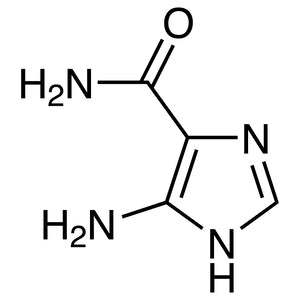
5-Amino-1H-imidazole-4-carboxamide TCI A3078
Regular price From Rp 1.670.550,00Regular priceRp 1.183.350,00Sale price From Rp 1.670.550,00