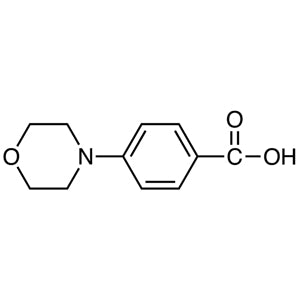
TCI M3100 4-(4-Morpholinyl)benzoic Acid is a heterocyclic building block that joins a morpholine ring to a benzoic acid framework through a nitrogen–aryl bond. This structural motif is extremely common in medicinal chemistry, because morpholine is one of the most frequently occurring heterocyclic rings in marketed drug molecules. In the laboratory, the compound serves as a ready-to-use fragment that supplies both a carboxylic acid handle for coupling and a pre-installed morpholine ring, saving the nucleophilic aromatic substitution step that normally demands harsh conditions or costly transition metal catalysts.
The property that makes this compound valuable is the dual role played by the morpholine ring: its nitrogen atom acts as an electron donor, while its ether oxygen contributes solubility. This combination improves the aqueous solubility profile of the resulting derivative molecules, a problem that frequently becomes a bottleneck in active compound development. The carboxylic acid group at the para position allows amide formation, ester formation, and conversion into a range of downstream heterocycles. It should be noted that, according to the manufacturer's product designation, this grade contains 05% N,N-Dimethylformamide at maximum.
In Indonesian laboratories, this building block is typically used in university research groups, pharmaceutical R&D units, and contract synthesis laboratories working on small-molecule discovery programmes. It is normally drawn from the building block inventory when a chemist needs to introduce a solubilising morpholine-aryl fragment without running a separate aromatic substitution step, which shortens the synthetic route and reduces reliance on specialised catalysts and equipment that may not be available in every local facility.
Related TCI products
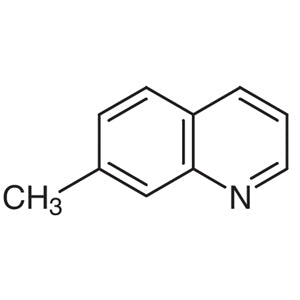
- TCI M0417 612-60-2 7-Methylquinoline (contains 25% 5-form at maximum)
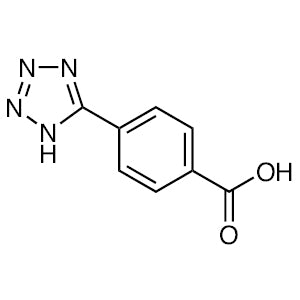
- TCI T3917 34114-12-0 4-(1H-Tetrazol-5-yl)benzoic Acid
- TCI T3788 157069-48-2 4-(4H-1,2,4-Triazol-4-yl)benzoic Acid
- TCI A2618 137281-39-1 4-[2-(2-Amino-4,7-dihydro-4-oxo-3H-pyrrolo[2,3-d]pyrimidin-5-yl)ethyl]benzoic Acid
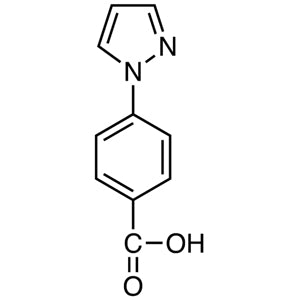
- TCI P2499 16209-00-0 4-(1H-Pyrazol-1-yl)benzoic Acid
- TCI M2935 956317-36-5 5-Methyl-2-(2H-1,2,3-triazol-2-yl)benzoic Acid
- Amide coupling chemistry: the para carboxylic acid group couples directly with amines, allowing chemists to append the solubilising morpholine-aryl fragment to a wide variety of scaffolds in a single step.
- Medicinal chemistry fragment libraries: because morpholine appears so often in marketed drug molecules, this building block lets research groups generate analogue series around a structurally validated and pharmaceutically relevant motif.
- Solubility optimisation studies: the ether oxygen of the morpholine ring improves the aqueous solubility profile of derivatives, making this material useful when poor solubility is limiting a candidate compound series.
- Ester synthesis and prodrug work: the carboxylic acid function is readily esterified, giving access to protected intermediates and modified derivatives without altering the morpholine-aryl core of the molecule.
- Heterocycle construction: the acid group can be converted into a range of downstream heterocyclic systems, so the compound serves as an entry point for building more elaborate ring architectures.
| Brand | TCI |
|---|---|
| CAS number | 7470-38-4 |
| Molecular formula | — |
| Purity | — |
| Category | Chemistry > Building Blocks > Heterocyclic Building Blocks |
| Pack sizes | available in the manufacturer's standard catalogue pack sizes; confirm the required pack when ordering |
| Physical form | — |
| Storage | keep in the original sealed container under the conditions stated on the product label and certificate of analysis |
- Grade note: contains 05% N,N-Dimethylformamide at maximum, as stated in the manufacturer's product designation
Store the material in its original tightly closed manufacturer container, kept in a cool, dry, well-ventilated chemical store away from direct sunlight, moisture, and incompatible materials such as strong bases and strong oxidising agents. Keep the container sealed between uses to limit moisture uptake and to contain the residual N,N-Dimethylformamide noted in the product designation. Handle in a fume hood using safety glasses, gloves, and a laboratory coat, and weigh out portions using clean, dry spatulas to avoid cross-contamination. Always consult the manufacturer's safety data sheet and product label before use, and dispose of residues and contaminated consumables through the laboratory's chemical waste stream.
—
Produk Terkait
-
7-Methylquinoline(contains25%5-formatmaximum) TCI M0417
Regular price From Rp 823.200,00Regular price -
4-(1H-Tetrazol-5-yl)benzoicAcid TCI T3917
Regular price From Rp 2.016.000,00Regular price -
4-(4H-1,2,4-Triazol-4-yl)benzoicAcid TCI T3788
Regular price From Rp 1.696.800,00Regular price -
4-[2-(2-Amino-4,7-dihydro-4-oxo-3H-pyrrolo[2,3-d]pyrimidin-5-yl)ethyl]benzoicAcid TCI A2618
Regular price From Rp 928.200,00Regular price -
4-(1H-Pyrazol-1-yl)benzoicAcid TCI P2499
Regular price Rp 1.724.100,00Regular price -
5-Methyl-2-(2H-1,2,3-triazol-2-yl)benzoicAcid TCI M2935
Regular price From Rp 1.008.000,00Regular price -
4-(4-Methylpiperazinyl)benzoicAcid TCI M2267
Regular price From Rp 1.167.600,00Regular price -
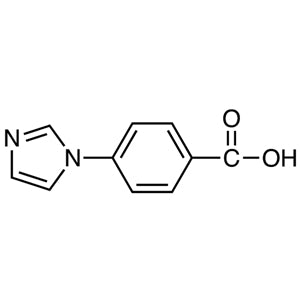
4-(1-Imidazolyl)benzoicAcid TCI I1017
Regular price Rp 3.683.400,00Regular price

![137281-39-1 4-[2-(2-Amino-4,7-dihydro-4-oxo-3H-pyrrolo[2,3-d]pyrimidin-5-yl)ethyl]benzoic Acid - AMI Scientific](http://amiscientific.com/cdn/shop/files/TCI2510A2618.jpg?v=1767083121&width=533)