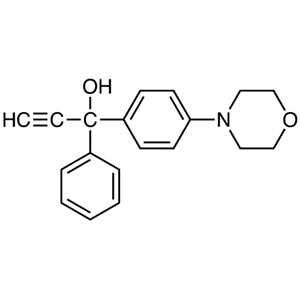
1-(4-Morpholinophenyl)-1-phenylprop-2-yn-1-ol, CAS 194940-93-7, is a heterocyclic building block supplied by TCI that combines three structural features in a single molecule: a tertiary propargylic alcohol, a morpholine ring acting as an electron-donating group, and two aromatic rings bonded to the same carbinol carbon. In the laboratory it serves as an intermediate in organic synthesis, particularly when researchers need a terminal alkyne fragment that already carries an electron-rich aromatic substituent, or when they are designing compounds with specific optical and electronic properties.
The characteristics that make this compound a preferred choice begin with its terminal alkyne, which is ready for use in cross-coupling reactions and click chemistry, sitting alongside a tertiary hydroxyl group that can be activated for propargylic substitution or rearrangement. The morpholinophenyl group confers strong electron-donor character, making the molecule attractive to researchers studying donor-acceptor systems, photoactive materials, or compounds with nonlinear optical response. The combination of two aromatic rings on the carbinol carbon makes this alcohol tertiary and relatively hindered, which influences the reaction pathways available to it.
In Indonesian laboratories, this building block is typically used in university and institutional research groups working on synthetic organic chemistry and functional materials. It is handled on a small scale at the bench, where a single pack supports multiple exploratory reaction attempts, structural modifications, and characterisation runs. Researchers generally reach for it during route development, when a preassembled fragment carrying both an alkyne handle and an electron-rich amine-substituted arene saves several synthetic steps.
- Cross-coupling reaction substrate: the terminal alkyne is directly available for coupling chemistry, so researchers can extend the molecular framework without first installing or unmasking an alkyne handle.
- Click chemistry building block: the unsubstituted alkyne terminus makes this compound suitable for cycloaddition-based conjugation work, where a reliable, preformed alkyne partner is required.
- Propargylic substitution chemistry: the tertiary hydroxyl group can be activated to generate propargylic intermediates, giving access to substitution and rearrangement products from a single starting material.
- Donor-acceptor system synthesis: the morpholinophenyl unit supplies strong electron-donating character, which is exactly what researchers need when assembling push-pull molecular architectures.
- Photoactive and nonlinear optical materials research: the combination of an electron-rich amine donor with an extended aromatic and alkyne framework suits studies of optical and electronic behaviour.
| Brand | TCI |
|---|---|
| CAS number | 194940-93-7 |
| Molecular formula | — |
| Purity | — |
| Category | Chemistry > Building Blocks > Heterocyclic Building Blocks |
| Pack sizes | available in standard TCI research-scale packaging; please confirm the currently listed size when ordering |
| Physical form | — |
| Storage | store according to the conditions stated on the manufacturer's label and safety data sheet |
- Chemical name: 1-(4-Morpholinophenyl)-1-phenylprop-2-yn-1-ol
Store this building block in its original tightly closed container, kept in a cool, dry and well-ventilated place away from direct sunlight, heat sources and incompatible chemicals. Amber glass or the supplier's original packaging is appropriate, since it limits light exposure and moisture ingress. Handle the material inside a fume hood while wearing safety glasses, nitrile gloves and a laboratory coat, and avoid generating dust during weighing. Reseal the container immediately after each use, label any secondary containers clearly, and consult the manufacturer's safety data sheet before first use and before disposal of residues.
—
Produk Terkait
-
TCI B5774 5,10-Bis(4,4,5,5-tetramethyl-1,3,2-dioxaborolan-2-yl)naphtho[1,2-c:5,6-c']bis([1,2,5]oxadiazole)
Regular price Rp 10.255.350,00Regular price -
Dihydroiodide TCI B6569
Regular price From Rp 1.936.200,00Regular price -
Trifluoromethanesulfonate TCI B7003
Regular price From Rp 1.936.200,00Regular price
![5,10-Bis(4,4,5,5-tetramethyl-1,3,2-dioxaborolan-2-yl)naphtho[1,2-c:5,6-c']bis([1,2,5]oxadiazole) - TCI B5774 - AMI Scientific](http://amiscientific.com/cdn/shop/files/TCI2510B5774.jpg?v=1769180228&width=533)