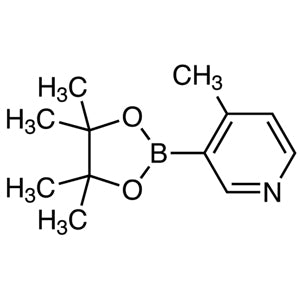
4-Methyl-3-(4,4,5,5-tetramethyl-1,3,2-dioxaborolan-2-yl)pyridine is a chemical compound widely used in organometallic reactions, particularly in the synthesis of heterocyclic compounds and boron derivatives. This reagent plays a crucial role in modern synthetic chemistry, especially in reactions that require precise control over molecular structure. It is a key component in the development of complex molecules, making it an essential tool for researchers working in advanced organic chemistry. Its application spans various fields, including pharmaceutical and materials science, where the ability to form stable intermediates is vital.
The compound is favored for its stability under controlled laboratory conditions and its ability to form stable bonds with metals such as palladium. These properties make it highly effective in coupling reactions like Suzuki and Kumada, which are essential for creating complex molecular architectures. Its chemical structure allows for high reactivity and selectivity, ensuring efficient and reproducible results in synthetic processes. Additionally, its non-toxic nature in controlled environments makes it a preferred choice for laboratories seeking safe and reliable reagents.
In Indonesian laboratories, this compound is commonly used in organic chemistry research, especially by academic institutions and research centers focused on molecular synthesis. Its role in developing new synthetic techniques and creating functional compounds makes it a valuable resource for both educational and industrial applications. The compound’s versatility and reliability contribute to its widespread use in the scientific community.
TCI brochures (PDF)
- Suzuki-Miyaura Cross Coupling Reaction 2025-12-01 · p. 19
Related TCI products
- TCI T4400 942919-26-8 4-(4,4,5,5-Tetramethyl-1,3,2-dioxaborolan-2-yl)-1H-pyrrolo[2,3-b]pyridine
- TCI T3400 1009033-87-7 4-[4-(4,4,5,5-Tetramethyl-1,3,2-dioxaborolan-2-yl)phenyl]pyridine
- TCI T3399 1009033-83-3 4-[3-(4,4,5,5-Tetramethyl-1,3,2-dioxaborolan-2-yl)phenyl]pyridine
- TCI T3313 939430-30-5 3-[3-(4,4,5,5-Tetramethyl-1,3,2-dioxaborolan-2-yl)phenyl]pyridine
- TCI T2345 329214-79-1 3-(4,4,5,5-Tetramethyl-1,3,2-dioxaborolan-2-yl)pyridine
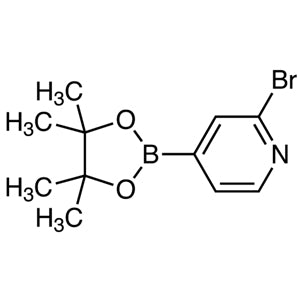
- TCI B5238 458532-82-6 2-Bromo-4-(4,4,5,5-tetramethyl-1,3,2-dioxaborolan-2-yl)pyridine
- Used in the synthesis of heterocyclic compounds due to its ability to form stable boron-containing intermediates.
- Applied in Suzuki coupling reactions to facilitate the formation of carbon-carbon bonds with high efficiency.
- Utilized in pharmaceutical research for the development of complex drug molecules requiring precise structural control.
- Employed in materials science for the creation of advanced polymers and functional materials.
- Integrated into academic research programs to support the training of students in modern synthetic methodologies.
| Brand | TCI |
|---|---|
| CAS number | 1171891-31-8 |
| Molecular formula | — |
| Purity | — |
| Category | Chemistry > Organometallic Reagents > Organoboron [Organometallic Reagents] |
| Pack sizes | Available in various quantities as per standard laboratory supply practices. |
| Physical form | Solid or liquid, depending on formulation and supplier specifications. |
| Storage | Store in a cool, dry place away from moisture and direct sunlight. |
This compound should be stored in a cool, dry environment to maintain its stability and prevent degradation. It is recommended to use airtight containers to minimize exposure to moisture and air, which can affect its reactivity. Proper labeling of storage containers is essential for safety and traceability. In laboratory settings, it should be handled with standard chemical safety protocols, including the use of personal protective equipment such as gloves and goggles. Although it is considered non-toxic in controlled environments, it is still important to follow general laboratory safety practices to ensure safe handling and storage.
—
Produk Terkait
-
4-(4,4,5,5-Tetramethyl-1,3,2-dioxaborolan-2-yl)-1H-pyrrolo[2,3-b]pyridine TCI T4400
Regular price From Rp 3.630.900,00Regular price -
4-[4-(4,4,5,5-Tetramethyl-1,3,2-dioxaborolan-2-yl)phenyl]pyridine TCI T3400
Regular price From Rp 1.565.550,00Regular price -
4-[3-(4,4,5,5-Tetramethyl-1,3,2-dioxaborolan-2-yl)phenyl]pyridine TCI T3399
Regular price From Rp 1.908.900,00Regular price -
3-[3-(4,4,5,5-Tetramethyl-1,3,2-dioxaborolan-2-yl)phenyl]pyridine TCI T3313
Regular price From Rp 4.982.250,00Regular price -
3-(4,4,5,5-Tetramethyl-1,3,2-dioxaborolan-2-yl)pyridine TCI T2345
Regular price From Rp 1.485.750,00Regular price -
2-Bromo-4-(4,4,5,5-tetramethyl-1,3,2-dioxaborolan-2-yl)pyridine TCI B5238
Regular price Rp 2.411.850,00Regular price -
2-Bromo-6-(4,4,5,5-tetramethyl-1,3,2-dioxaborolan-2-yl)pyridine TCI B5077
Regular price From Rp 2.306.850,00Regular price -
1-(tert-Butoxycarbonyl)-1,2,3,6-tetrahydro-4-(4,4,5,5-tetramethyl-1,3,2-dioxaborolan-2-yl)pyridine TCI B4051
Regular price Rp 2.279.550,00Regular price
![942919-26-8 4-(4,4,5,5-Tetramethyl-1,3,2-dioxaborolan-2-yl)-1H-pyrrolo[2,3-b]pyridine - AMI Scientific](http://amiscientific.com/cdn/shop/files/TCI2510T4400.jpg?v=1767145178&width=533)
![1009033-87-7 4-[4-(4,4,5,5-Tetramethyl-1,3,2-dioxaborolan-2-yl)phenyl]pyridine - AMI Scientific](http://amiscientific.com/cdn/shop/files/TCI2510T3400.jpg?v=1769143727&width=533)
![1009033-83-3 4-[3-(4,4,5,5-Tetramethyl-1,3,2-dioxaborolan-2-yl)phenyl]pyridine - AMI Scientific](http://amiscientific.com/cdn/shop/files/TCI2510T3399.jpg?v=1769058221&width=533)
![939430-30-5 3-[3-(4,4,5,5-Tetramethyl-1,3,2-dioxaborolan-2-yl)phenyl]pyridine - AMI Scientific](http://amiscientific.com/cdn/shop/files/TCI2510T3313.jpg?v=1769058203&width=533)