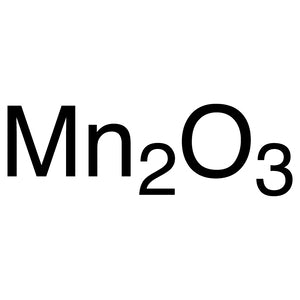
Manganese(III) Oxide (Mn₂O₃), with CAS number 1317-34-6, is an inorganic compound widely used in chemical experiments. This material is known for its strong oxidizing properties and is commonly employed as a catalyst in various chemical reactions, particularly in oxidation and reduction processes. Its versatility makes it a valuable component in both research and educational settings. In the laboratory, Mn₂O₃ is often used in the synthesis of complex compounds and in the purification of metals. Its ability to participate in multiple chemical reactions makes it a key player in inorganic chemistry applications.
The physical and chemical properties of Manganese(III) Oxide make it a preferred choice for laboratory use. It has a dense crystalline structure and a dark brown color, which are characteristic of its chemical composition. The compound's stability and reactivity allow it to be used in a wide range of experimental conditions. Its high reactivity also makes it suitable for reactions requiring controlled oxidation. Additionally, the availability of Mn₂O₃ in various packaging formats ensures that it can be used in both small-scale and large-scale experiments with ease.
In Indonesian laboratories, Manganese(III) Oxide is commonly used in chemical research, especially in catalysis, the synthesis of inorganic compounds, and material composition analysis. It is also frequently used in educational settings to demonstrate oxidation reactions and to teach students about the behavior of inorganic compounds. Its reliability and effectiveness make it a staple in both academic and industrial chemical laboratories.
TCI brochures (PDF)
- Metallic Salts 2025-11-06 · p. 6
- Transition Metal Catalysts 2026-04-10 · p. 6
- Catalytic Oxidation Reactions: Manganese(III) Oxide is ideal for oxidation processes due to its strong oxidizing properties, making it suitable for reactions requiring controlled oxidation.
- Inorganic Compound Synthesis: The compound is widely used in the synthesis of complex inorganic materials due to its reactivity and ability to participate in various chemical transformations.
- Metal Purification Processes: Its oxidizing nature helps in the purification of metals by facilitating the removal of impurities through controlled oxidation reactions.
- Chemical Analysis Techniques: Manganese(III) Oxide is used in analytical chemistry for its ability to react with various substances, aiding in the identification and quantification of compounds.
- Educational Demonstrations: It serves as a valuable teaching tool in laboratories, helping students understand oxidation-reduction reactions and the behavior of inorganic compounds.
| Brand | TCI |
|---|---|
| CAS number | 1317-34-6 |
| Molecular formula | — |
| Purity | — |
| Category | Chemistry > Catalysis and Inorganic Chemistry > Metallic Salts |
| Pack sizes | Available in various sizes to suit different experimental needs |
| Physical form | Solid, dark brown crystalline powder |
| Storage | — |
Manganese(III) Oxide should be stored in a cool, dry place away from moisture and direct sunlight. It is recommended to use airtight containers to prevent exposure to air and humidity, which could affect its stability. Due to its oxidizing nature, it should be handled with care and stored separately from reducing agents to avoid unwanted reactions. In laboratory settings, it is advisable to use appropriate personal protective equipment, such as gloves and safety goggles, when handling the compound. Proper labeling of storage containers is essential to ensure safe handling and prevent accidental exposure. Regular inspection of storage conditions is recommended to maintain the integrity and effectiveness of the material.
—
Produk Terkait
-
Manganese(IV)Oxide TCI M3448
Regular price From Rp 530.250,00Regular price -
Manganese(II,III)Oxide TCI M3447
Regular price From Rp 1.087.800,00Regular price -
LithiumManganeseNickelOxide(LiMn15Ni05O4) TCI L0391
Regular price From Rp 3.155.250,00Regular price -
Zirconium(IV)Oxide TCI Z0049
Regular price From Rp 848.400,00Regular price -
Ytterbium(III)Oxide TCI Y0008
Regular price From Rp 505.050,00Regular price -
Yttrium(III)Oxide TCI Y0007
Regular price From Rp 955.500,00Regular price -
Vanadium(IV)Oxide TCI V0177
Regular price From Rp 1.803.900,00Regular price -
Vanadium(III)Oxide TCI V0170
Regular price From Rp 1.167.600,00Regular price