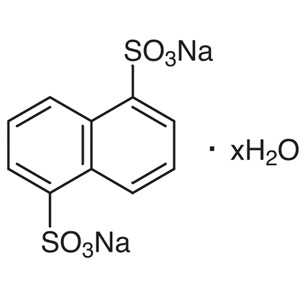
TCI N0012 Disodium 1,5-Naphthalenedisulfonate Hydrate, bearing CAS number 1655-29-4, is the hydrated disodium salt of naphthalene-1,5-disulfonic acid. Two sulfonate groups occupy the 1 and 5 positions on opposite sides of the naphthalene framework, producing a symmetrical molecule with an even distribution of charge. In the laboratory, this material serves as a non-heterocyclic building block for the synthesis of sulfonated aromatic compounds, as an ion-pairing anion, and as a component in research on naphthalene-based materials that require a charged linking group at both ends of the molecule.
The properties that make this compound a preferred choice begin with its molecular symmetry, which simplifies nuclear magnetic resonance spectra and makes characterisation considerably easier to read and interpret. Its high water solubility follows from the two fully ionised sulfonate groups carried on the aromatic core. The hydrate form indicates that water molecules are bound within the crystal lattice, so molecular weight calculations for quantitative weighing must refer to the hydration information stated on the package label. As a sodium salt, the material is a solid that is stable at room temperature and far easier to handle than the corresponding sulfonic acid form.
In Indonesian laboratories, this building block is typically used in synthetic organic chemistry groups at universities and research institutes, in materials chemistry work exploring naphthalene scaffolds, and in analytical laboratories where a symmetrical sulfonated aromatic is needed as an ion-pairing component. Its solid, stable, room-temperature nature suits local working conditions, where warm and humid ambient air makes a well-behaved crystalline salt more practical to weigh and store than a corrosive free acid.
Related TCI products
- TCI N0441 1655-29-4 Disodium 1,5-Naphthalenedisulfonate
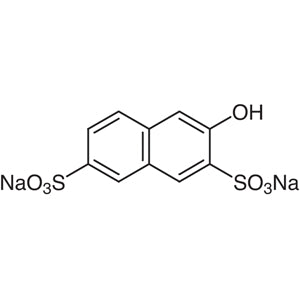
- TCI N0029 135-51-3 Disodium 3-Hydroxy-2,7-naphthalenedisulfonate
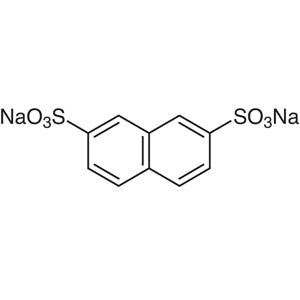
- TCI N0014 1655-35-2 Disodium 2,7-Naphthalenedisulfonate
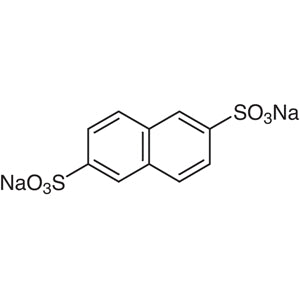
- TCI N0013 1655-45-4 Disodium 2,6-Naphthalenedisulfonate
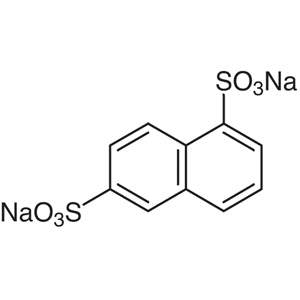
- TCI N0011 1655-43-2 Disodium 1,6-Naphthalenedisulfonate
- TCI A0337 842-15-9 Monopotassium 7-Amino-1,3-naphthalenedisulfonate Hydrate
- Synthesis of sulfonated aromatic compounds: the 1,5-disubstituted naphthalene core provides a ready-made, symmetrically functionalised starting framework, sparing the chemist a separate and often difficult direct sulfonation step.
- Ion-pairing applications: the fully ionised divalent sulfonate anion pairs effectively with cationic species in solution, a role directly supported by the compound's high aqueous solubility and stable charge distribution.
- Naphthalene-based materials research: the molecule carries a charged linking group at each end, which suits studies building extended structures that require anchoring points on both terminals of the aromatic unit.
- Non-heterocyclic building block chemistry: as a purely carbocyclic sulfonated scaffold, it serves preparative routes where heteroatom-containing cores would introduce unwanted reactivity or coordination behaviour.
- Reference and method development work: the symmetrical substitution pattern yields simplified nuclear magnetic resonance spectra, making this compound convenient for developing and verifying characterisation procedures for sulfonated aromatics.
| Brand | TCI (Tokyo Chemical Industry), catalogue number N0012 |
|---|---|
| CAS number | 1655-29-4 |
| Molecular formula | — |
| Purity | — |
| Category | Chemistry > Building Blocks > Non-Heterocyclic Building Blocks |
| Pack sizes | available in standard TCI research-scale packaging; please refer to the current listing for available sizes |
| Physical form | solid, stable at room temperature |
| Storage | keep in a tightly closed container at room temperature, protected from moisture |
- Chemical form: disodium salt, hydrate — hydration details are stated on the package label
Store the container tightly closed at room temperature in a dry location, since the hydrate form is sensitive to changes in ambient humidity and uncontrolled moisture uptake can affect the accuracy of quantitative weighing. Original manufacturer packaging or a clean, well-sealed glass or chemically resistant plastic container is suitable. Handle the solid in a well-ventilated area or a fume hood to avoid inhaling dust, and wear gloves, safety glasses, and a laboratory coat. Use clean, dry spatulas to prevent contamination and avoid introducing water into the bulk container. Always consult the manufacturer's safety data sheet before use, and check the hydration information on the label when calculating molecular weight for quantitative work.
—
Produk Terkait
-
Disodium1,5-Naphthalenedisulfonate TCI N0441
Regular price From Rp 505.050,00Regular price -
Disodium3-Hydroxy-2,7-naphthalenedisulfonate TCI N0029
Regular price From Rp 1.510.950,00Regular price -
Disodium2,7-Naphthalenedisulfonate TCI N0014
Regular price Rp 2.094.750,00Regular price -
Disodium2,6-Naphthalenedisulfonate TCI N0013
Regular price Rp 1.035.300,00Regular price -
Disodium1,6-Naphthalenedisulfonate TCI N0011
Regular price Rp 4.108.650,00Regular price -
Monopotassium7-Amino-1,3-naphthalenedisulfonateHydrate TCI A0337
Regular price From Rp 903.000,00Regular price -
Disodium1-Naphthol-3,6-disulfonateHydrate TCI V0037
Regular price Rp 584.850,00Regular price -
Sodium4-Amino-1,5-naphthalenedisulfonate TCI A0342
Regular price Rp 1.298.850,00Regular price