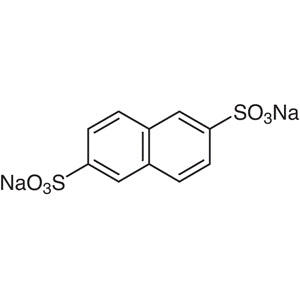
TCI N0013 Disodium 2,6-Naphthalenedisulfonate, CAS 1655-45-4, is the disodium salt of naphthalene-2,6-disulfonic acid, an isomer sulfonated at both beta positions of the naphthalene ring system. The 2,6 arrangement carries particular significance in organic chemistry because it represents the linear substitution pattern that underlies a range of important intermediates, including synthetic routes toward difunctional naphthalene derivatives. In the laboratory, this material serves as a non-heterocyclic building block, a source of doubly charged aromatic anions, and a reference material in studies concerned with the separation of naphthalenedisulfonate isomers.
The properties that make this compound a preferred choice begin with its high molecular symmetry combined with a linear geometry that maximises the distance between the two functional groups, a consideration that matters when the compound is used as a linker in the assembly of larger molecular structures. Both sulfonate groups are strongly acidic and already present in salt form, so the material exists as a stable solid that is not extremely hygroscopic and is straightforward to weigh out. Good solubility in water allows reactions and analyses to be carried out in aqueous media, while the aromatic framework contributes a characteristic ultraviolet absorption that is useful for detection and monitoring.
In Indonesian laboratories, this reagent typically finds a place in university and institutional research groups working on organic synthesis and materials chemistry, as well as in analytical laboratories that need a well-defined aromatic sulfonate for method development. Its water solubility and solid, easily handled form suit routine bench work in facilities where aqueous chemistry predominates, and its role as a reference material supports chromatographic and spectroscopic work on naphthalenedisulfonate systems.
Related TCI products
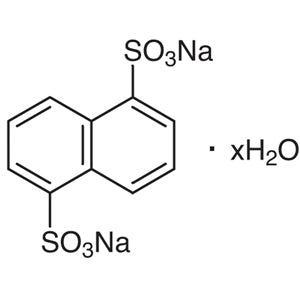
- TCI N0441 1655-29-4 Disodium 1,5-Naphthalenedisulfonate
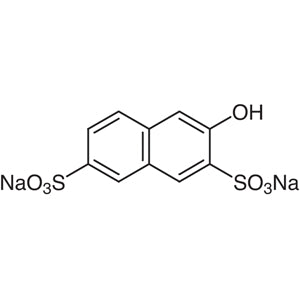
- TCI N0029 135-51-3 Disodium 3-Hydroxy-2,7-naphthalenedisulfonate
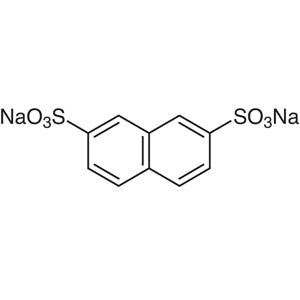
- TCI N0014 1655-35-2 Disodium 2,7-Naphthalenedisulfonate
- TCI N0012 1655-29-4 Disodium 1,5-Naphthalenedisulfonate Hydrate
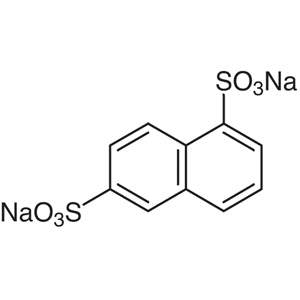
- TCI N0011 1655-43-2 Disodium 1,6-Naphthalenedisulfonate
- TCI A0337 842-15-9 Monopotassium 7-Amino-1,3-naphthalenedisulfonate Hydrate
- Non-heterocyclic building block in organic synthesis, where the linear 2,6 substitution pattern provides a rigid aromatic core with two widely separated reactive positions for further elaboration.
- Precursor route toward difunctional naphthalene derivatives, since both beta positions already carry sulfonate groups that define the substitution geometry of the intermediates that follow.
- Source of doubly charged aromatic anions in solution chemistry, useful wherever a stable, well-characterised dianionic aromatic species is required in an aqueous reaction medium.
- Reference material in naphthalenedisulfonate isomer separation studies, giving analysts a defined 2,6 isomer standard against which chromatographic retention and resolution can be assessed.
- Linker component in the assembly of larger molecular structures, where high molecular symmetry and maximised spacing between the two functional groups govern the resulting architecture.
| Brand | TCI |
|---|---|
| CAS number | 1655-45-4 |
| Molecular formula | — |
| Purity | — |
| Category | Chemistry > Building Blocks > Non-Heterocyclic Building Blocks |
| Pack sizes | available in standard TCI catalogue pack sizes; please confirm the sizes currently listed for this item code |
| Physical form | stable solid, soluble in water |
| Storage | keep in a closed container under normal laboratory storage conditions, away from moisture |
Store the material in its original tightly closed container at normal laboratory storage conditions, protected from moisture and kept away from incompatible substances. Glass or suitable chemically resistant plastic containers with well-sealing closures are appropriate for transfers and for any working stock prepared in the laboratory. Although the compound is a stable salt and is not extremely hygroscopic, containers should be reclosed promptly after weighing to preserve sample quality. Handle the solid in a well-ventilated area or fume hood to avoid dust formation and inhalation, and wear a laboratory coat, safety goggles, and chemical resistant gloves. Avoid contact with skin and eyes, and wash hands thoroughly after handling. Label all prepared aqueous solutions clearly and dispose of residues in accordance with institutional chemical waste procedures.
—
Produk Terkait
-
Disodium1,5-Naphthalenedisulfonate TCI N0441
Regular price From Rp 505.050,00Regular price -
Disodium3-Hydroxy-2,7-naphthalenedisulfonate TCI N0029
Regular price From Rp 1.510.950,00Regular price -
Disodium2,7-Naphthalenedisulfonate TCI N0014
Regular price Rp 2.094.750,00Regular price -
Disodium1,5-NaphthalenedisulfonateHydrate TCI N0012
Regular price Rp 477.750,00Regular price -
Disodium1,6-Naphthalenedisulfonate TCI N0011
Regular price Rp 4.108.650,00Regular price -
Monopotassium7-Amino-1,3-naphthalenedisulfonateHydrate TCI A0337
Regular price From Rp 903.000,00Regular price -
Disodium1-Naphthol-3,6-disulfonateHydrate TCI V0037
Regular price Rp 584.850,00Regular price -
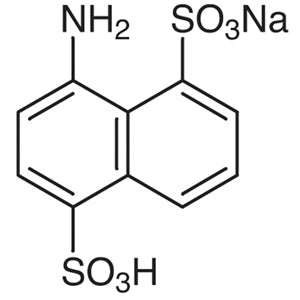
Sodium4-Amino-1,5-naphthalenedisulfonate TCI A0342
Regular price Rp 1.298.850,00Regular price