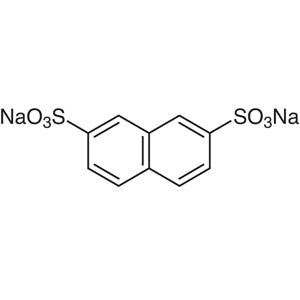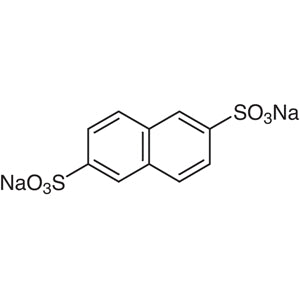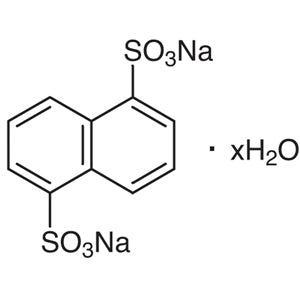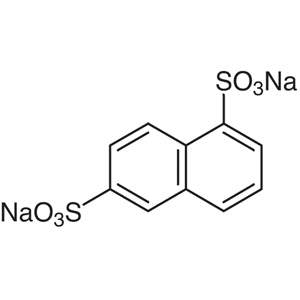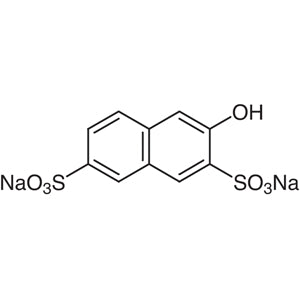
Disodium 3-Hydroxy-2,7-naphthalenedisulfonate is the disodium salt of a naphthol derivative that carries two sulfonate groups on its naphthalene framework. The combination of a phenolic hydroxyl group with two sulfonate groups yields a compound that is highly soluble in water while retaining an aromatic ring system that remains active toward substitution reactions. In the laboratory, this material serves primarily as a coupling component in the synthesis of water-soluble azo dyes — colorants used for natural fibers as well as analytical staining reagents. Beyond dye chemistry, the compound is a useful building block for preparing other sulfonated naphthalene derivatives.
The properties that make this reagent a preferred choice begin with its excellent water solubility, conferred by the two sulfonate groups, which removes the need for organic co-solvents in aqueous coupling work. This is paired with the reactivity of the naphthol group, which allows diazonium coupling reactions to proceed rapidly under weakly basic conditions. The double anionic charge helps the resulting dye products bind to charged fibers and prevents aggregation in solution. The sodium salt form is more stable, not excessively hygroscopic, and far easier to handle than the corresponding free sulfonic acid, which is strongly corrosive. Ultraviolet absorption by the naphthalene core also makes reaction monitoring straightforward.
In Indonesian laboratories, this building block is typically encountered in synthetic organic chemistry groups, textile and dye chemistry programmes, and analytical laboratories that prepare their own staining solutions. Academic research units and industrial R&D laboratories working on colorant development use it where a reliable, water-soluble coupling partner is required. Its handling convenience relative to free sulfonic acids makes it well suited to teaching laboratories and shared facilities where simpler storage and safer routine handling are practical priorities.
Related TCI products
- TCI N0441 1655-29-4 Disodium 1,5-Naphthalenedisulfonate
- TCI N0014 1655-35-2 Disodium 2,7-Naphthalenedisulfonate
- TCI N0013 1655-45-4 Disodium 2,6-Naphthalenedisulfonate
- TCI N0012 1655-29-4 Disodium 1,5-Naphthalenedisulfonate Hydrate
- TCI N0011 1655-43-2 Disodium 1,6-Naphthalenedisulfonate
- TCI A0337 842-15-9 Monopotassium 7-Amino-1,3-naphthalenedisulfonate Hydrate
- Azo dye synthesis — serves as the coupling component that reacts with diazonium salts under weakly basic conditions, with the reactive naphthol group driving rapid and reproducible colour formation.
- Water-soluble colorant preparation — the two sulfonate groups deliver the aqueous solubility needed to produce dyes that dissolve fully without organic co-solvents in the final formulation.
- Dyeing of natural fibers — the double anionic charge promotes attachment of the resulting dye products to charged fiber surfaces while preventing aggregation of dye molecules in the dyebath.
- Preparation of analytical staining reagents — supports laboratory-scale synthesis of dyes used as analytical colorants, where consistent coupling behaviour and clean aqueous chemistry are essential.
- Sulfonated naphthalene derivative synthesis — acts as a general building block for further functionalisation of the naphthalene core, with ultraviolet absorption allowing convenient reaction monitoring.
| Brand | TCI |
|---|---|
| CAS number | 135-51-3 |
| Molecular formula | — |
| Purity | — |
| Category | Chemistry > Building Blocks > Non-Heterocyclic Building Blocks |
| Pack sizes | available in standard TCI research-scale packaging; please confirm the current pack options when ordering |
| Physical form | sodium salt of a sulfonated naphthol derivative, highly soluble in water |
| Storage | keep in a tightly closed container in a cool, dry place away from moisture |
Store the container tightly closed in a cool, dry, well-ventilated area, protected from moisture and away from direct sunlight. Although the sodium salt form is not excessively hygroscopic and is considerably easier to handle than the strongly corrosive free sulfonic acid, good laboratory practice still applies: keep the material in its original chemically resistant container or in a suitable glass or high-density polyethylene vessel with a secure closure. Weigh and transfer the solid in a fume hood or a well-ventilated area to avoid dust inhalation, and wear safety glasses, gloves, and a laboratory coat. Use clean, dry spatulas to prevent contamination of the stock, close the container immediately after use, and label any prepared aqueous solutions clearly with their contents and preparation date.
—
Produk Terkait
-
Disodium1,5-Naphthalenedisulfonate TCI N0441
Regular price From Rp 505.050,00Regular price -
Disodium2,7-Naphthalenedisulfonate TCI N0014
Regular price Rp 2.094.750,00Regular price -
Disodium2,6-Naphthalenedisulfonate TCI N0013
Regular price Rp 1.035.300,00Regular price -
Disodium1,5-NaphthalenedisulfonateHydrate TCI N0012
Regular price Rp 477.750,00Regular price -
Disodium1,6-Naphthalenedisulfonate TCI N0011
Regular price Rp 4.108.650,00Regular price -
Monopotassium7-Amino-1,3-naphthalenedisulfonateHydrate TCI A0337
Regular price From Rp 903.000,00Regular price -
Disodium1-Naphthol-3,6-disulfonateHydrate TCI V0037
Regular price Rp 584.850,00Regular price -
Sodium4-Amino-1,5-naphthalenedisulfonate TCI A0342
Regular price Rp 1.298.850,00Regular price