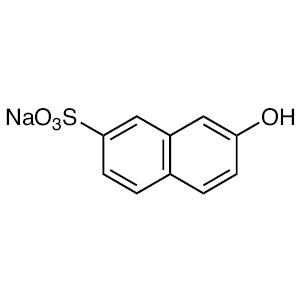
TCI N0036 Sodium 2-Naphthol-7-sulfonate, CAS number 135-55-7, is the sodium salt of 2-naphthol-7-sulfonic acid, an isomer known in classical dye literature as an F acid derivative. The compound belongs to the family of naphtholsulfonates widely employed as coupling components, and its particular substitution pattern gives it colour characteristics and solubility behaviour distinct from those of the 6-sulfonate isomer. In the laboratory it serves as a water-soluble aromatic building block that is ready to be brought directly into reaction, and equally as a reference material in studies of how sulfonate group position influences reaction behaviour and product properties.
The advantages of this compound rest on three structural features working together. The sulfonate group guarantees high solubility in aqueous media, allowing reactions to be run in water-based systems without recourse to auxiliary organic solvents. The naphtholic hydroxyl group remains chemically active and available for azo coupling reactions, preserving the synthetic utility that makes naphthol derivatives valuable to dye chemists. The solid salt form is stable and straightforward to handle, weigh, and store under normal laboratory conditions. Researchers select the 7-sulfonate isomer specifically when a defined molecular geometry is required in the final product — for example, to tune colour shade, dye solubility, or affinity toward fibres.
Consistent quality from TCI helps ensure that differences observed between experimental runs genuinely originate from the variables under investigation rather than from variability in the starting material. For laboratories in Indonesia working in synthetic organic chemistry, dye and pigment research, and materials characterisation, this matters a great deal: reproducible starting materials are the foundation on which comparative studies, method development, and student training work are built, whether in university research groups, institutional laboratories, or industrial R&D units.
Related TCI products
- TCI N0035 135-76-2 Sodium 2-Naphthol-6-sulfonate
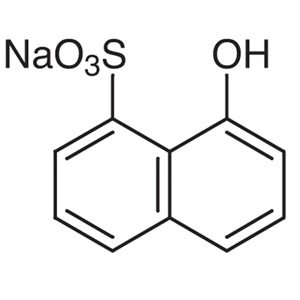
- TCI N0034 20215-36-5 Sodium 1-Naphthol-8-sulfonate
- TCI N0033 6099-57-6 Sodium 1-Naphthol-4-sulfonate
- TCI A0508 153277-35-1 Sodium Anthraquinone-2-sulfonate Monohydrate
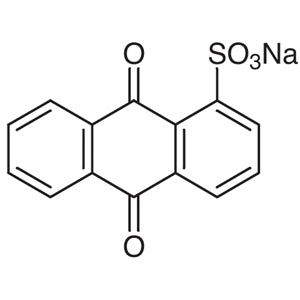
- TCI A1428 128-56-3 Sodium Anthraquinone-1-sulfonate
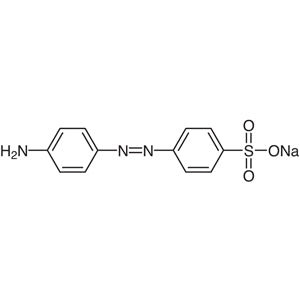
- TCI A0748 2491-71-6 Sodium 4-Aminoazobenzene-4'-sulfonate
- Azo dye synthesis — the active naphtholic hydroxyl group makes this compound a reliable coupling component for preparing azo dyes with defined structure in aqueous reaction media.
- Isomer comparison studies — researchers pair the 7-sulfonate with the 6-sulfonate isomer to investigate how sulfonate position governs reaction behaviour, colour character, and final product properties.
- Aromatic building block chemistry — as a water-soluble non-heterocyclic building block, it enters multi-step synthetic sequences without requiring prior solubilisation steps or organic co-solvents.
- Dye property tuning — laboratories choose this isomer when the target molecular geometry must deliver a particular colour shade, dye solubility profile, or fibre affinity.
- Reference and comparison material — the consistent quality of this TCI grade allows it to serve as a benchmark substance in comparative experiments and method development work.
| Brand | TCI (Tokyo Chemical Industry) |
|---|---|
| CAS number | 135-55-7 |
| Molecular formula | — |
| Purity | — |
| Category | Chemistry > Building Blocks > Non-Heterocyclic Building Blocks |
| Pack sizes | available in standard TCI research packaging; please confirm the size required when ordering |
| Physical form | solid salt |
| Storage | keep in a cool, dry place in a tightly closed container |
- Chemical identity: sodium salt of 2-naphthol-7-sulfonic acid
Store the container tightly closed in a cool, dry, well-ventilated area, away from direct sunlight and sources of moisture, since the sulfonate salt form is readily water-soluble and can absorb atmospheric humidity if left open. Use clean, dry glass or chemically compatible plastic containers with secure closures, and reseal immediately after each withdrawal. Handle the solid in a fume hood or a well-ventilated workspace to avoid inhaling dust, and wear standard laboratory personal protective equipment including safety glasses, gloves, and a laboratory coat. Use dedicated clean spatulas to prevent cross-contamination that could compromise experimental reproducibility. Consult the manufacturer's safety data sheet before first use and follow institutional procedures for disposal of residues and contaminated materials.
—
Produk Terkait
-
Sodium2-Naphthol-6-sulfonate TCI N0035
Regular price From Rp 980.700,00Regular price -
Sodium1-Naphthol-8-sulfonate TCI N0034
Regular price From Rp 1.405.950,00Regular price -
Sodium1-Naphthol-4-sulfonate TCI N0033
Regular price From Rp 903.000,00Regular price -
SodiumAnthraquinone-2-sulfonateMonohydrate TCI A0508
Regular price From Rp 769.650,00Regular price -
SodiumAnthraquinone-1-sulfonate TCI A1428
Regular price From Rp 1.140.300,00Regular price -
Sodium4-Aminoazobenzene-4'-sulfonate TCI A0748
Regular price From Rp 1.087.800,00Regular price -
Sodium2-Nitroaniline-4-sulfonate TCI N0371
Regular price From Rp 1.273.650,00Regular price -
Sodium1,2-Naphthoquinone-4-sulfonate TCI N0043
Regular price From Rp 664.650,00Regular price