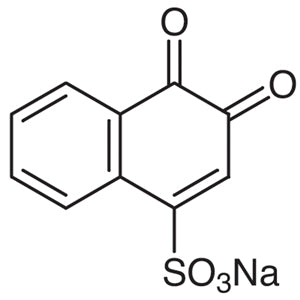
TCI N0043 Sodium 1,2-Naphthoquinone-4-sulfonate with CAS number 521-24-4 is a classic analytical reagent widely known by the abbreviation NQS. The compound combines a highly electrophilic 1,2-naphthoquinone core with a sodium sulfonate group that confers water solubility, making it a very practical derivatization reagent for nitrogen-containing compounds. In the laboratory, NQS is used to convert primary amines, secondary amines, and amino acids into colored products that can be measured spectrophotometrically, which has made it the backbone of many simple yet reliable assay methods.
The property that makes this reagent a preferred choice is the reactivity of the sulfonate group, which acts as a leaving group readily displaced by nitrogen nucleophiles, producing orange to red naphthoquinone derivatives with strong absorption in the visible region. The reaction proceeds under mild aqueous conditions, generally in a weakly alkaline medium, without requiring special organic solvents or complicated equipment. Its crystalline solid is yellow to orange and light-sensitive, so reagent solutions are usually prepared fresh before use to keep measurement results consistent and reproducible.
In Indonesian laboratories, this reagent supports routine analytical work in pharmaceutical quality control units, university teaching and research laboratories, and food and environmental testing facilities. Because the method relies on visible-region spectrophotometry rather than more elaborate instrumentation, it remains accessible to laboratories that need dependable quantitative results without heavy instrument investment. Its aqueous compatibility also suits sample preparation routines that are already water-based, simplifying day-to-day workflow.
Related TCI products
- TCI A0508 153277-35-1 Sodium Anthraquinone-2-sulfonate Monohydrate
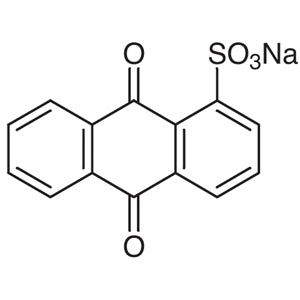
- TCI A1428 128-56-3 Sodium Anthraquinone-1-sulfonate
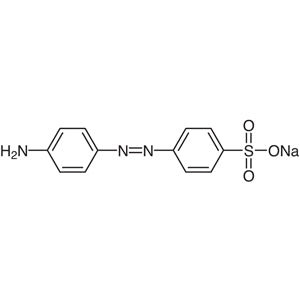
- TCI A0748 2491-71-6 Sodium 4-Aminoazobenzene-4'-sulfonate
- TCI N0371 5042-33-1 Sodium 2-Nitroaniline-4-sulfonate
- TCI N0036 135-55-7 Sodium 2-Naphthol-7-sulfonate
- TCI N0035 135-76-2 Sodium 2-Naphthol-6-sulfonate
- Spectrophotometric assay of primary amines: the sulfonate group is readily displaced by the amine nitrogen, giving a strongly absorbing colored derivative that can be quantified directly in the visible region.
- Determination of secondary amines: NQS reacts with secondary amine nitrogen under mild aqueous alkaline conditions, producing stable colored products suitable for straightforward spectrophotometric measurement without organic solvent systems.
- Amino acid quantification: the reagent converts amino acids into orange to red naphthoquinone derivatives, allowing simple and reliable content determination using standard laboratory spectrophotometers.
- Derivatization of nitrogen-containing compounds: the electrophilic 1,2-naphthoquinone core provides a practical route to color-forming derivatives that make otherwise poorly absorbing analytes measurable.
- Routine assay method development: because reactions run in mild aqueous media without specialized equipment, NQS suits laboratories developing simple, robust, and easily transferable quantitative assay procedures.
| Brand | TCI |
|---|---|
| CAS number | 521-24-4 |
| Molecular formula | — |
| Purity | — |
| Category | Chemistry > Building Blocks > Non-Heterocyclic Building Blocks |
| Pack sizes | available in standard TCI catalog pack sizes; please confirm the packaging option when ordering |
| Physical form | yellow to orange crystalline solid |
| Storage | light-sensitive; store protected from light |
Store the reagent in its original tightly closed container, protected from light, since the compound is light-sensitive. Amber glass bottles or containers kept inside an opaque secondary enclosure are appropriate for both the solid and any prepared solutions. Keep the material in a cool, dry, well-ventilated chemical storage area away from moisture and incompatible substances. Because reagent solutions lose consistency over time, prepare them fresh before use rather than storing them for extended periods. Handle the solid in a fume hood or well-ventilated workspace using standard laboratory personal protective equipment, including a lab coat, safety goggles, and chemically resistant gloves. Avoid raising dust during weighing, close the container promptly after use, and follow institutional procedures for chemical waste disposal.
—
Produk Terkait
-
SodiumAnthraquinone-2-sulfonateMonohydrate TCI A0508
Regular price From Rp 769.650,00Regular price -
SodiumAnthraquinone-1-sulfonate TCI A1428
Regular price From Rp 1.140.300,00Regular price -
Sodium4-Aminoazobenzene-4'-sulfonate TCI A0748
Regular price From Rp 1.087.800,00Regular price -
Sodium2-Nitroaniline-4-sulfonate TCI N0371
Regular price From Rp 1.273.650,00Regular price -
Sodium2-Naphthol-7-sulfonate TCI N0036
Regular price Rp 1.749.300,00Regular price -
Sodium2-Naphthol-6-sulfonate TCI N0035
Regular price From Rp 980.700,00Regular price -
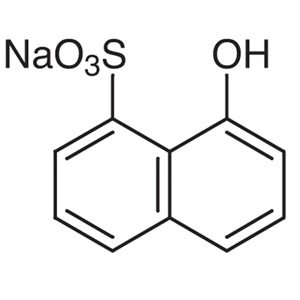
Sodium1-Naphthol-8-sulfonate TCI N0034
Regular price From Rp 1.405.950,00Regular price -
Sodium1-Naphthol-4-sulfonate TCI N0033
Regular price From Rp 903.000,00Regular price