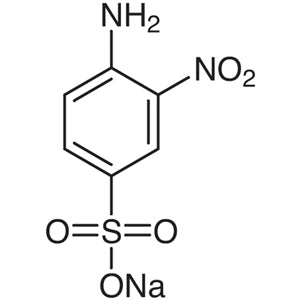
Sodium 2-Nitroaniline-4-sulfonate is a chemical compound widely used in laboratory settings for its versatility in organic synthesis and chemical reactions. This compound plays a crucial role in the development of complex molecules, particularly in pharmaceutical and organic chemistry research. Its unique structure, featuring both nitro and sulfonate functional groups, allows for a wide range of chemical transformations, making it a valuable reagent in synthetic pathways. Due to its reactivity and functional group diversity, it is frequently employed in the preparation of intermediates and derivatives in various chemical processes.
The compound is known for its high purity and stability under controlled conditions, which makes it a preferred choice for laboratory applications requiring precision and consistency. Its solubility in organic solvents such as ethyl acetate and acetone facilitates efficient purification and separation techniques. These properties enhance its usability in both qualitative and quantitative chemical analyses. Additionally, its chemical stability ensures that it remains effective throughout multiple reaction cycles, contributing to the reliability of experimental outcomes.
In Indonesian laboratories, Sodium 2-Nitroaniline-4-sulfonate is commonly used in organic chemistry research, drug development, and analytical chemistry. Its availability in the local market supports scientific activities by providing researchers with a reliable and high-quality reagent. The compound’s role in synthesizing complex molecules and its compatibility with various experimental techniques make it a staple in both academic and industrial research settings.
Related TCI products
- Organic synthesis where functional group manipulation is required due to its nitro and sulfonate groups.
- Pharmaceutical research for the development of new drug molecules as a building block in synthetic pathways.
- Analytical chemistry applications for its use in chromatographic and spectroscopic analyses due to its distinct chemical properties.
- Industrial chemical processes that require high-purity reagents for consistent and reproducible results.
- Research into reaction mechanisms and reactivity studies due to its versatile chemical behavior and stability.
| Brand | TCI |
|---|---|
| CAS number | 5042-33-1 |
| Molecular formula | — |
| Purity | — |
| Category | Chemistry > Building Blocks > Non-Heterocyclic Building Blocks |
| Pack sizes | Available in various quantities as per standard laboratory supply formats |
| Physical form | Solid powder |
| Storage | Store in a cool, dry place away from light and incompatible substances |
Sodium 2-Nitroaniline-4-sulfonate should be stored in a cool, dry environment to maintain its chemical stability and prevent degradation. It is recommended to use airtight containers made of glass or high-density polyethylene to protect it from moisture and contaminants. Due to its reactivity, it should be kept away from strong oxidizing agents and incompatible materials. Proper labeling and storage in designated chemical cabinets are essential for safety. Laboratory personnel should always wear appropriate personal protective equipment when handling this compound to minimize exposure risks. Regular inspection of storage conditions ensures the compound remains in optimal condition for use in experimental procedures.
—
Produk Terkait
-
Sodium4-Aminoazobenzene-4'-sulfonate TCI A0748
Regular price From Rp 1.087.800,00Regular price -
Sodium4-Hydroxyazobenzene-4'-sulfonate TCI H0327
Regular price From Rp 1.140.300,00Regular price -
2-Iodo-4-nitroaniline TCI I0878
Regular price From Rp 1.246.350,00Regular price -
4-Bromo-3-nitroaniline TCI B4876
Regular price From Rp 637.350,00Regular price -
2-Bromo-4-nitroaniline TCI B4873
Regular price From Rp 1.220.100,00Regular price -
4-Bromo-2-methyl-6-nitroaniline TCI B3730
Regular price From Rp 717.150,00Regular price -
4-Bromo-2-nitroaniline TCI B3033
Regular price From Rp 689.850,00Regular price -
2-Bromo-6-chloro-4-nitroaniline TCI B1771
Regular price Rp 477.750,00Regular price