


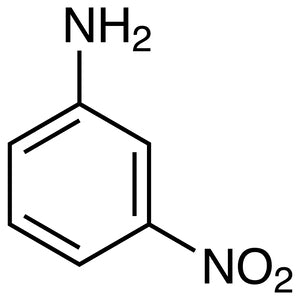
3-Nitroaniline is a chemical compound widely used in laboratories for various chemical reactions, particularly in the synthesis of complex molecules. As a key building block in chemical research, it plays a crucial role in the development of both heterocyclic and non-heterocyclic compounds. Its presence in the chemical inventory of Indonesian laboratories underscores its importance in advancing scientific research and industrial applications. This compound is essential for chemists working on the creation of new materials, pharmaceuticals, and other chemical products.
The compound’s high reactivity, due to the nitro group (-NO₂) at the 3-position of aniline, makes it a preferred choice for substitution and reduction reactions. This reactivity allows it to participate in a wide range of chemical transformations, making it a versatile reagent in synthetic chemistry. Its ability to undergo various chemical modifications makes it a valuable tool for researchers aiming to create new compounds with specific functional groups. Additionally, its stability under normal conditions ensures safe handling and long-term storage, which is critical for laboratory operations.
In Indonesian laboratories, 3-Nitroaniline is commonly used in chemical synthesis, particularly in the development of pharmaceutical compounds and industrial chemicals. It is frequently found in research projects related to drug discovery, material science, and chemical engineering. Its role in these fields highlights its significance as a fundamental reagent in both academic and industrial settings.
- Pharmaceutical research utilizes 3-Nitroaniline as a precursor for synthesizing active pharmaceutical ingredients due to its reactivity and structural versatility.
- Material science applications benefit from its ability to participate in substitution reactions, enabling the creation of advanced polymers and coatings.
- Industrial chemical synthesis relies on 3-Nitroaniline for the production of dyes, intermediates, and specialty chemicals due to its stability and reactivity.
- Organic chemistry experiments use it as a building block for the synthesis of complex organic molecules through various reaction pathways.
- Environmental studies incorporate it in the analysis of nitroaromatic compounds to assess their impact on ecosystems and water quality.
| Brand | TCI |
|---|---|
| CAS number | 99-09-2 |
| Molecular formula | — |
| Purity | — |
| Category | Chemistry > Building Blocks > Non-Heterocyclic Building Blocks |
| Pack sizes | Available in various quantities as per standard laboratory supply |
| Physical form | Solid, typically in crystalline or powder form |
| Storage | Store in a cool, dry place away from direct sunlight and incompatible materials |
3-Nitroaniline should be stored in a cool, dry environment to maintain its chemical stability. It is recommended to keep it in a sealed container to prevent moisture absorption and contamination. Due to its potential reactivity, it should be stored away from strong oxidizing agents and incompatible substances. Laboratory personnel should handle it with appropriate personal protective equipment, such as gloves and safety goggles, to ensure safety. Proper ventilation is essential when working with this compound to minimize exposure. Regular monitoring of storage conditions is necessary to ensure the integrity of the material and compliance with safety standards.
—
Product Categories
Produk Terkait
-
4-Nitroaniline TCI N0119
Regular price From Rp 610.050,00Regular priceRp 426.300,00Sale price From Rp 610.050,00 -
2-Nitroaniline TCI N0118
Regular price From Rp 584.850,00Regular priceRp 408.450,00Sale price From Rp 584.850,00 -
2-Methyl-4-nitroaniline TCI N0529
Regular price Rp 1.644.300,00Regular priceRp 1.149.750,00Sale price Rp 1.644.300,00 -
2-Chloro-4-nitroaniline TCI C0214
Regular price Rp 823.200,00Regular priceRp 575.400,00Sale price Rp 823.200,00 -
2-Iodo-4-nitroaniline TCI I0878
Regular price From Rp 1.246.350,00Regular priceRp 871.500,00Sale price From Rp 1.246.350,00 -
4-Bromo-3-nitroaniline TCI B4876
Regular price From Rp 637.350,00Regular priceRp 445.200,00Sale price From Rp 637.350,00 -
2-Bromo-4-nitroaniline TCI B4873
Regular price From Rp 1.220.100,00Regular priceRp 852.600,00Sale price From Rp 1.220.100,00 -
4-Bromo-2-methyl-6-nitroaniline TCI B3730
Regular price From Rp 717.150,00Regular priceRp 500.850,00Sale price From Rp 717.150,00


