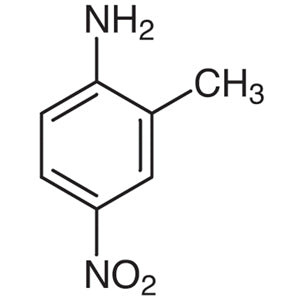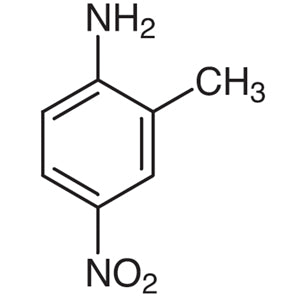
2-Methyl-4-nitroaniline is a chemical compound widely used as a foundational material in various chemical reactions, particularly in the synthesis of aromatic and heterocyclic compounds. This compound plays a crucial role in laboratory settings by serving as a building block for more complex molecular structures. Its unique molecular structure, featuring a nitro group and a methyl group, contributes to its high reactivity and versatility in chemical transformations. In laboratory applications, it is commonly utilized in substitution reactions and nitration processes, making it an essential component for synthetic chemists.
The compound’s stability combined with its reactivity makes it a preferred choice for a wide range of experimental applications. Its ability to interact with various reagents under both acidic and basic conditions enhances its utility in diverse chemical processes. The high purity of 2-Methyl-4-nitroaniline ensures reliable results, making it suitable for research that demands precision and consistency. This characteristic is especially valuable in academic and industrial laboratories where accuracy is paramount.
In Indonesian laboratories, 2-Methyl-4-nitroaniline is extensively used in organic chemistry research, particularly in higher education institutions and research organizations. Its availability and consistent quality make it a key reagent in the development of new compounds and molecular modifications. The compound is a fundamental tool for chemists working on synthetic pathways and structural analysis in both academic and applied research environments.
TCI brochures (PDF)
- Used in the synthesis of aromatic compounds due to its reactivity and ability to participate in nitration reactions.
- Applied in substitution reactions where its functional groups facilitate the formation of complex organic molecules.
- Employed in organic chemistry research for the development of new chemical structures and molecular modifications.
- Utilized in academic laboratories for teaching and experimental purposes requiring precise chemical reagents.
- Integrated into industrial research for the creation of pharmaceutical and chemical products through synthetic pathways.
| Brand | TCI |
|---|---|
| CAS number | 99-52-5 |
| Molecular formula | — |
| Purity | — |
| Category | Chemistry > Building Blocks > Non-Heterocyclic Building Blocks |
| Pack sizes | Available in various quantities as per standard laboratory supply options |
| Physical form | Solid |
| Storage | Store in a cool, dry place away from direct sunlight and incompatible materials |
2-Methyl-4-nitroaniline should be stored in a cool, dry environment to maintain its stability and prevent degradation. It is recommended to keep the compound in a tightly sealed container to avoid moisture exposure, which can affect its chemical integrity. Suitable storage containers include glass or high-density polyethylene (HDPE) vessels that are resistant to chemical reactions. In laboratory settings, it is important to handle the compound with care, using appropriate personal protective equipment such as gloves and safety goggles. The compound should be stored away from incompatible substances like strong acids or bases to ensure safety. Regular inspection of storage conditions is advised to maintain optimal chemical properties and ensure safe handling practices.
—
Product Categories
Produk Terkait
-
4-Nitroaniline TCI N0119
Regular price From Rp 610.050,00Regular price -
2-Nitroaniline TCI N0118
Regular price From Rp 584.850,00Regular price -
3-Nitroaniline TCI N0117
Regular price From Rp 1.035.300,00Regular price -
2-Methyl-4-nitroaniline TCI N0116
Regular price From Rp 928.200,00Regular price -
4-Methyl-2-nitroaniline TCI N0114
Regular price Rp 505.050,00Regular price -
4-Chloro-2-nitroaniline TCI C0215
Regular price From Rp 505.050,00Regular price -
2-Chloro-4-nitroaniline TCI C0214
Regular price Rp 823.200,00Regular price -
2-Iodo-4-nitroaniline TCI I0878
Regular price From Rp 1.246.350,00Regular price