

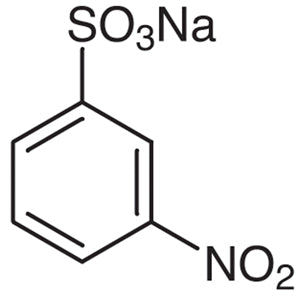
Sodium 3-Nitrobenzenesulfonate is a chemical compound widely used in laboratory settings for its versatility in chemical reactions. It serves as a key building block in the synthesis of aromatic and heterocyclic compounds, playing a crucial role in organic chemistry. This compound is commonly found in chemical laboratories as a reagent for substitution and nitration reactions. Its utility extends to various synthetic pathways where controlled reactivity and stability are essential.
As a sulfonate salt, Sodium 3-Nitrobenzenesulfonate exhibits high stability and good solubility in water, making it ideal for reactions requiring high reactivity. Its molecular structure includes both nitro and sulfonate groups, contributing to its polar nature and reactivity. These characteristics allow it to interact effectively with other reagents, enhancing its applicability in diverse chemical processes. The compound’s stability and solubility also make it suitable for a wide range of experimental conditions.
In Indonesian laboratories, Sodium 3-Nitrobenzenesulfonate is frequently used in chemical research, particularly in the synthesis of organic compounds and the study of chemical reactivity. It is also employed in the development of pharmaceuticals and industrial chemicals. Due to its availability and reliability, it remains a preferred choice among researchers and chemists in the region.
- Organic Synthesis: Sodium 3-Nitrobenzenesulfonate is ideal for organic synthesis due to its reactivity and stability, enabling the creation of complex aromatic and heterocyclic compounds.
- Nitration Reactions: This compound is commonly used in nitration processes as it provides a stable nitro group, facilitating controlled chemical transformations.
- Pharmaceutical Development: Its role in synthesizing pharmaceutical compounds makes it valuable in drug research and development efforts.
- Industrial Chemistry: It is widely used in industrial chemical processes for the production of various chemical intermediates and specialty products.
- Chemical Reactivity Studies: The compound’s polar nature and reactivity make it a preferred choice for studying chemical reactivity and reaction mechanisms.
| Brand | TCI |
|---|---|
| CAS number | 127-68-4 |
| Molecular formula | — |
| Purity | — |
| Category | Chemistry > Building Blocks > Non-Heterocyclic Building Blocks |
| Pack sizes | Available in various quantities as per standard laboratory supply |
| Physical form | Solid |
| Storage | Store in a cool, dry place away from moisture and direct sunlight |
Sodium 3-Nitrobenzenesulfonate should be stored in a cool, dry environment to maintain its chemical stability. It is recommended to keep the compound in airtight containers to prevent moisture absorption, which could affect its solubility and reactivity. While it is generally stable under normal laboratory conditions, it should be handled with care to avoid exposure to extreme temperatures or direct contact with incompatible substances. Proper labeling and storage in a designated chemical storage area are essential for safety and efficiency. Regular inspection of storage conditions ensures that the compound remains in optimal condition for use in laboratory applications.
—
Produk Terkait
-
Pentafluorophenyl4-Nitrobenzenesulfonate TCI P2231
Regular price From Rp 848.400,00Regular price -
Pyridinium3-Nitrobenzenesulfonate TCI P0941
Regular price From Rp 664.650,00Regular price -
(S)-Glycidyl3-Nitrobenzenesulfonate TCI G0287
Regular price From Rp 2.094.750,00Regular price -
(R)-Glycidyl3-Nitrobenzenesulfonate TCI G0286
Regular price From Rp 3.180.450,00Regular price


