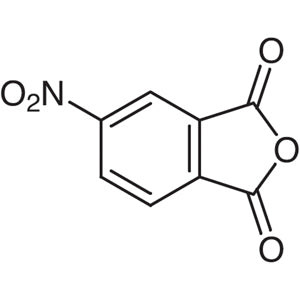
4-Nitrophthalic Anhydride is a chemical compound widely used in laboratory settings, particularly in the synthesis of complex organic compounds. As a key building block in organic chemistry, it serves as a versatile reagent for various reactions, including esterification and amidation. Its role in the laboratory is critical for creating heterocyclic and aromatic compounds, which are essential in pharmaceutical and industrial chemical applications. Due to its high reactivity, it is often employed in reactions involving amines, alcohols, and acids, making it a valuable tool for chemists working on advanced synthesis projects.
The compound’s stability and reactivity make it a preferred choice for researchers seeking precise control over chemical reactions. Its molecular structure allows it to participate effectively in multiple reaction pathways, offering flexibility in synthetic strategies. Additionally, its anhydride functionality enables the formation of esters and amides under controlled conditions, which is crucial for developing new compounds with specific properties. These characteristics make it a reliable and efficient reagent for both academic and industrial research environments.
In Indonesian laboratories, 4-Nitrophthalic Anhydride is commonly used in organic chemistry research, especially in the development of pharmaceutical compounds and industrial chemicals. Its application extends to projects focused on the creation of new materials and the modification of existing chemical structures. Researchers in Indonesia rely on this compound for its predictable behavior and ability to contribute to the synthesis of complex molecules with high precision and efficiency.
- Organic synthesis of pharmaceutical compounds due to its reactivity and ability to form esters and amides.
- Development of new materials through controlled chemical reactions involving amines and alcohols.
- Synthesis of heterocyclic and aromatic compounds for use in pharmaceutical and industrial applications.
- Research in chemical modification of existing compounds to enhance their properties and functionality.
- Support for academic and industrial projects requiring precise and stable chemical reagents for complex syntheses.
| Brand | TCI |
|---|---|
| CAS number | 5466-84-2 |
| Molecular formula | — |
| Purity | — |
| Category | Chemistry > Building Blocks > Non-Heterocyclic Building Blocks |
| Pack sizes | Available in various quantities as per supplier specifications |
| Physical form | Solid |
| Storage | Store in a cool, dry place away from moisture and direct sunlight |
4-Nitrophthalic Anhydride should be stored in a cool, dry environment to maintain its chemical stability. It is recommended to keep it in a sealed container to prevent exposure to moisture, which can affect its reactivity. The compound should be stored away from direct sunlight and sources of heat to avoid degradation. Suitable containers for storage include glass or high-density polyethylene vessels that are resistant to chemical reactions. In laboratory settings, it is important to handle the compound with appropriate personal protective equipment, such as gloves and safety goggles, to ensure safe handling and minimize potential exposure. Proper ventilation should also be maintained when working with this substance to ensure a safe working environment.
—
Produk Terkait
-
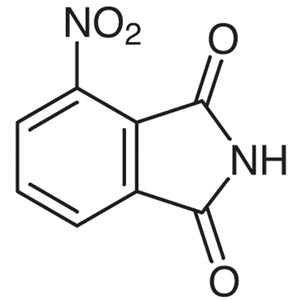
3-Nitrophthalimide TCI N0666
Regular price From Rp 2.439.150,00Regular price -
4-Nitrophthalimide TCI N0247
Regular price From Rp 717.150,00Regular price -
N-Hydroxy-4-nitrophthalimide TCI H1036
Regular price From Rp 1.458.450,00Regular price -
Dimethyl3-Nitrophthalate TCI D5310
Regular price From Rp 2.757.300,00Regular price -
3-NitrophthalicAnhydride TCI N0245
Regular price From Rp 1.829.100,00Regular price -
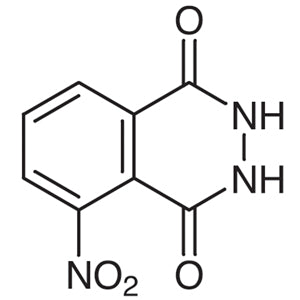
3-NitrophthalicHydrazide TCI N0622
Regular price From Rp 875.700,00Regular price -
4-NitrophthalicAcid TCI N0244
Regular price From Rp 610.050,00Regular price -
3-NitrophthalicAcid TCI N0243
Regular price From Rp 477.750,00Regular price