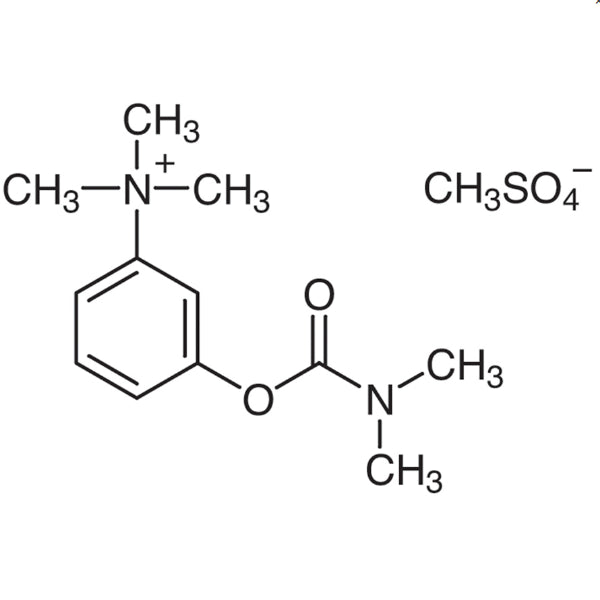
Neostigmine Methyl Sulfate is a chemical compound widely used in pharmaceutical research and biochemical studies. As an analog of neostigmine, it functions as a potent inhibitor of acetylcholinesterase, making it a critical reagent in experimental settings. This compound is essential for investigating the mechanisms of drugs related to the peripheral nervous system. Its role in laboratory research is pivotal, especially in the development of therapeutic agents targeting neurological disorders. Due to its strong cholinesterase inhibitory activity, it is frequently used in neuropharmacological and therapeutic research to understand the effects of cholinergic agents on biological systems.
The compound is valued for its chemical stability under controlled conditions, though it is sensitive to moisture and direct sunlight. Its complex molecular structure allows for specific interactions with various biological targets, making it a versatile tool in drug discovery and pharmacological studies. Additionally, its ability to mimic the effects of neostigmine makes it a preferred choice for researchers exploring cholinergic pathways and their implications in disease mechanisms. Its reliability and consistency in experimental outcomes further enhance its appeal in laboratory environments.
In Indonesian laboratories, Neostigmine Methyl Sulfate is commonly used in research related to neurological diseases such as Parkinson’s disease and memory disorders. It is also employed in in vitro testing and pharmacological experiments to study biological responses to various stimuli. Its application in both basic and applied research underscores its importance in advancing scientific understanding and developing new therapeutic strategies.
TCI brochures (PDF)
- Neurotransmission Research Reagents 2026-07-17 · p. 1
- Quaternary Ammonium Salts 2025-11-10 · p. 10
- Pharmaceutical Ingredients for Research and Experimental Use 2026-03-09 · p. 28
- Neuropharmacological research utilizes Neostigmine Methyl Sulfate to study the effects of cholinergic agents on nerve signal transmission and synaptic function.
- In vitro testing benefits from its ability to inhibit acetylcholinesterase, aiding in the evaluation of drug efficacy and mechanism of action in cellular environments.
- Neurological disease studies rely on this compound to explore the role of cholinesterase inhibition in conditions like Parkinson’s and Alzheimer’s disease.
- Drug development programs incorporate it to screen potential therapeutic agents targeting acetylcholine pathways in the nervous system.
- Toxicological assessments use Neostigmine Methyl Sulfate to evaluate the safety and biological impact of cholinergic compounds in experimental models.
| Brand | TCI |
|---|---|
| CAS number | 51-60-5 |
| Molecular formula | — |
| Purity | — |
| Category | Life Science > Biochemicals and Reagents > Pharmaceutical Research Reagents |
| Pack sizes | Available in various quantities as per standard laboratory requirements |
| Physical form | Solid powder |
| Storage | Store in a cool, dry place away from direct sunlight |
Neostigmine Methyl Sulfate should be stored in a cool, dry environment to maintain its chemical stability. It is recommended to keep the compound in airtight containers to prevent exposure to moisture and humidity, which can degrade its potency. Direct sunlight should be avoided to prevent photodegradation. In laboratory settings, it is important to handle the compound with appropriate personal protective equipment, such as gloves and safety goggles, to ensure safety. Proper labeling of storage containers is essential for easy identification and safe handling. Regular monitoring of storage conditions ensures the compound remains effective for experimental use.
—
Product Categories
- Biochemicals and ReagentsPharmaceutical Research Reagents (for Experimental Use)Neurotransmitter Agent Ingredients (for Research and Experimental Use)
- Cell BiologyCell Signaling and NeuroscienceNeuroscience
- Pharmaceutical Development and Drug Discovery ResearchPharmaceutical Research Reagents (for Experimental Use)Neurotransmitter Agent Ingredients (for Research and Experimental Use)
Produk Terkait
-
AtropineSulfateMonohydrate TCI A0550
Regular price From Rp 1.908.900,00Regular priceRp 1.350.300,00Sale price From Rp 1.908.900,00 -
NeostigmineBromide TCI N0358
Regular price From Rp 2.464.350,00Regular priceRp 1.738.800,00Sale price From Rp 2.464.350,00 -
PyridostigmineBromide TCI P1339
Regular price From Rp 4.266.150,00Regular priceRp 2.998.800,00Sale price From Rp 4.266.150,00 -
SerotoninCreatinineSulfateMonohydrate TCI S0036
Regular price Rp 3.048.150,00Regular priceRp 2.147.250,00Sale price Rp 3.048.150,00 -
4-AminobutyricAcid TCI A0282
Regular price From Rp 505.050,00Regular priceRp 352.800,00Sale price From Rp 505.050,00 -
AcetylcholineChloride TCI A0084
Regular price From Rp 1.405.950,00Regular priceRp 998.550,00Sale price From Rp 1.405.950,00 -
WAY-100635Maleate TCI W0016
Regular price From Rp 5.300.400,00Regular priceRp 3.722.250,00Sale price From Rp 5.300.400,00 -
VenlafaxineHydrochloride TCI V0110
Regular price From Rp 795.900,00Regular priceRp 572.250,00Sale price From Rp 795.900,00