

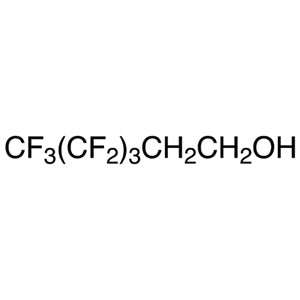
1H,1H,2H,2H-Nonafluoro-1-hexanol (Nonafluoro-1-hexanol) is a specialized chemical compound with a unique molecular structure containing multiple fluorine atoms. This compound is widely used in laboratory settings for advanced synthesis applications, particularly in reactions that require a fluorous environment. Its molecular design allows it to function as both a solvent and a reagent in complex chemical processes, making it an essential tool for researchers working in specialized synthesis fields. Due to its chemical stability and resistance to degradation, it is highly valued in experiments where long-term reliability is crucial.
The compound's polar and hydrophobic properties make it a preferred choice in various chemical processes. Its ability to dissolve in organic solvents enhances its versatility in different reaction conditions. Additionally, its hydrophobic nature allows it to act as a protective layer or medium that remains unaffected by water, which is particularly useful in reactions where moisture control is critical. These unique characteristics make it an ideal material for applications requiring both solubility and chemical resistance.
In Indonesian laboratories, Nonafluoro-1-hexanol is commonly used in synthetic chemistry, especially in fluorous synthesis. It is often employed as a solvent or reagent in reactions that require a stable and inert environment. Its high fluorine content ensures that it remains chemically inert under a wide range of conditions, making it a reliable choice for researchers working on complex chemical processes.
TCI brochures (PDF)
- Fluorous Chemistry 2025-01-21 · p. 5
- Building Blocks for Organic Semiconductor 2026-03-24 · p. 45
- Fluorination Reagents, Fluorinated Building Blocks 2026-03-18 · p. 53
Related TCI products
- Fluorous Synthesis: This compound is ideal for fluorous synthesis due to its high fluorine content and chemical stability, allowing it to act as a selective medium for specific reactions.
- Solvent for Organic Reactions: Its ability to dissolve in organic solvents makes it a suitable choice for use as a solvent in various organic chemical reactions.
- Protective Layer in Reactions: The hydrophobic nature of the compound allows it to serve as a protective layer, preventing unwanted interactions with water or moisture.
- Precipitation and Separation Processes: Its unique polar and hydrophobic properties make it effective in precipitation and separation techniques, aiding in the isolation of desired compounds.
- Chemical Stability Testing: Its resistance to degradation makes it useful in experiments that require long-term chemical stability and inertness.
| Brand | TCI |
|---|---|
| CAS number | 2043-47-2 |
| Molecular formula | — |
| Purity | — |
| Category | Chemistry > Specialty Synthesis > Fluorous Synthesis |
| Pack sizes | — |
| Physical form | Liquid |
| Storage | Store in a cool, dry place away from light and moisture |
This compound should be stored in a cool, dry environment, away from direct light and moisture to maintain its chemical integrity. It is recommended to use airtight containers made of materials that are chemically inert, such as glass or high-density polyethylene, to prevent contamination and evaporation. Due to its hydrophobic nature, it is important to handle it with care to avoid exposure to water or reactive substances. In laboratory settings, it should be kept in a well-ventilated area, and appropriate personal protective equipment, such as gloves and safety goggles, should be worn when handling. Its chemical stability ensures that it remains safe and effective when stored and handled properly.
—
Produk Terkait
-
4,4,5,5,6,6,7,7,7-Nonafluoro-1-heptanol TCI N1040
Regular price Rp 3.021.900,00Regular priceRp 2.112.600,00Sale price Rp 3.021.900,00 -
1H,1H-Nonafluoro-1-pentanol TCI N0810
Regular price Rp 1.035.300,00Regular priceRp 723.450,00Sale price Rp 1.035.300,00 -
NonafluorovalericAcid TCI N0605
Regular price Rp 1.696.800,00Regular priceRp 1.202.250,00Sale price Rp 1.696.800,00 -
1H,1H-Undecafluoro-1-hexanol TCI U0074
Regular price Rp 3.207.750,00Regular priceRp 2.242.800,00Sale price Rp 3.207.750,00 -
1H,1H,2H,2H-Tridecafluoro-1-n-octanol TCI T2528
Regular price Rp 875.700,00Regular priceRp 612.150,00Sale price Rp 875.700,00 -
2-Ethyl-1-hexanol TCI E0122
Regular price Rp 477.750,00Regular priceRp 333.900,00Sale price Rp 477.750,00 -
Trifluoromethyl1,1,2,2,3,3,4,4,4-Nonafluorobutane-1-sulfonate TCI T4150
Regular price Rp 2.889.600,00Regular priceRp 2.020.200,00Sale price Rp 2.889.600,00 -
NonafluorovalericAcid(ca.0.5mol/LinWater)[Ion-PairReagentforLC-MS] TCI A5714
Regular price Rp 2.227.050,00Regular priceRp 1.572.900,00Sale price Rp 2.227.050,00


![2706-90-3 Nonafluorovaleric Acid (ca. 0.5mol/L in Water) [Ion-Pair Reagent for LC-MS] - AMI Scientific](http://amiscientific.com/cdn/shop/files/TCI2510A5714.jpg?v=1768358993&width=533)