

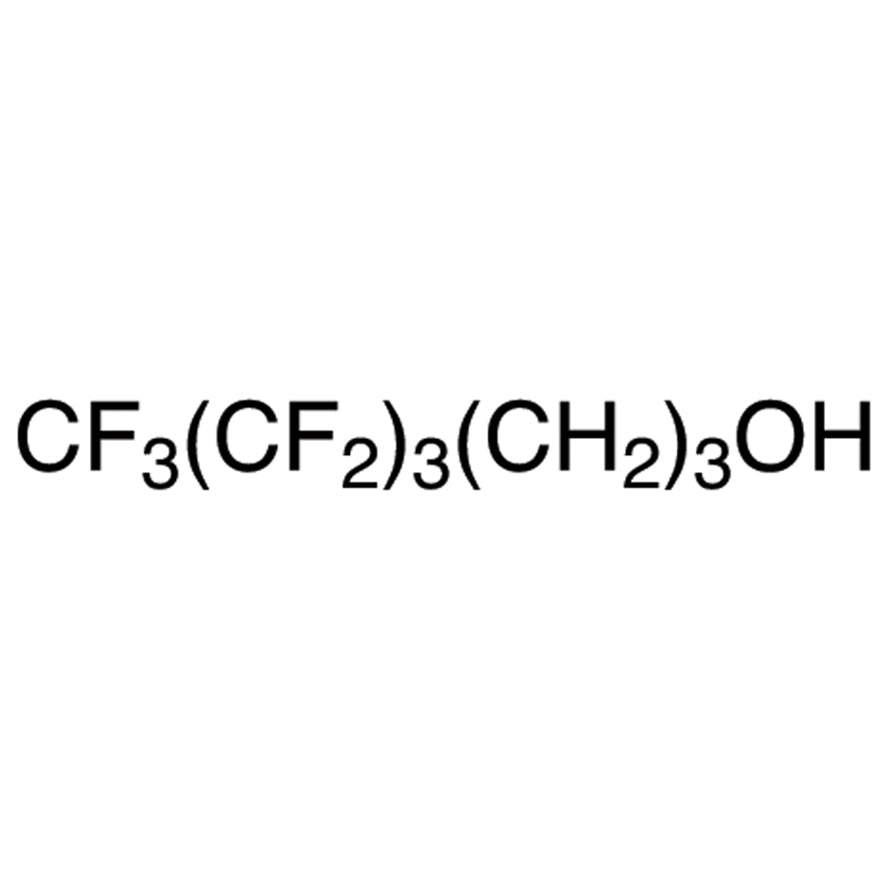
TCI N1040, also known as 4,4,5,5,6,6,7,7,7-Nonafluoro-1-heptanol with CAS number 83310-97-8, is a specialized chemical compound used in laboratory settings, particularly in material science and organic chemistry. This reagent is valued for its unique molecular structure, which includes multiple fluorine atoms. These fluorine atoms significantly influence the compound’s chemical properties, making it an essential tool for researchers working on solubility enhancement or material synthesis. Its presence in laboratory workflows is critical for achieving precise chemical reactions and maintaining the integrity of experimental processes.
The compound’s stability and resistance to chemical reactions make it a preferred choice for use in high-precision environments. The fluorinated structure contributes to its inertness, ensuring minimal unwanted side reactions during experiments. Additionally, its solubility in specific organic solvents allows for efficient mixing and separation processes, which are essential in analytical and synthetic chemistry. These properties make it an ideal reagent for laboratories requiring reliable and consistent chemical behavior.
In Indonesian laboratories, TCI N1040 is commonly used in research related to material science, organic chemistry, and chemical analysis. Its availability in the local market supports academic and industrial research efforts, enabling scientists to conduct experiments that require high chemical stability and solubility. Its role in supporting advanced research is vital for the development of new materials and chemical processes.
TCI brochures (PDF)
- Fluorous Chemistry 2025-01-21 · p. 4
- Building Blocks for Organic Semiconductor 2026-03-24 · p. 45
Related TCI products
- TCI N0810 355-28-2 1H,1H-Nonafluoro-1-pentanol
- TCI N0600 2043-47-2 1H,1H,2H,2H-Nonafluoro-1-hexanol
- TCI T1701 375-82-6 1H,1H-Tridecafluoro-1-heptanol
- TCI T4150 79410-57-4 Trifluoromethyl 1,1,2,2,3,3,4,4,4-Nonafluorobutane-1-sulfonate
- TCI A5714 2706-90-3 Nonafluorovaleric Acid (ca. 0.5mol/L in Water) [Ion-Pair Reagent for LC-MS]
- TCI O0492 129135-86-0 Sodium Bis(nonafluorobutanesulfonyl)imide
- Material synthesis experiments benefit from TCI N1040 due to its solubility-enhancing properties and chemical stability, allowing for precise control over reaction conditions.
- Organic chemistry research utilizes this compound to improve solubility of complex molecules, facilitating more efficient purification and reaction processes.
- Chemical analysis applications rely on TCI N1040 for its inert nature, ensuring accurate and reproducible results in analytical procedures.
- Advanced material development projects use TCI N1040 as a building block to create fluorinated compounds with tailored properties for industrial applications.
- Laboratory testing for environmental and industrial applications leverages TCI N1040’s stability to simulate and study chemical interactions under controlled conditions.
| Brand | TCI |
|---|---|
| CAS number | 83310-97-8 |
| Molecular formula | — |
| Purity | — |
| Category | Materials Science > Material Building Blocks > Solubility Enhancing Reagents |
| Pack sizes | — |
| Physical form | Liquid |
| Storage | Store in a cool, dry place away from direct sunlight |
TCI N1040 should be stored in a cool, dry environment, away from direct sunlight and sources of heat. It is recommended to use airtight containers made of materials that are chemically inert to prevent any unwanted reactions. Due to its chemical stability, it does not require refrigeration but should be protected from moisture and contaminants. In laboratory settings, it is important to handle the compound with appropriate personal protective equipment to ensure safety. Always ensure that the container is sealed properly to maintain the integrity of the compound and prevent any potential exposure. Proper storage and handling are essential to maintain its effectiveness and safety in experimental processes.
—
Produk Terkait
-
1H,1H-Nonafluoro-1-pentanol TCI N0810
Regular price From Rp 1.035.300,00Regular price -
1H,1H,2H,2H-Nonafluoro-1-hexanol TCI N0600
Regular price From Rp 1.458.450,00Regular price -
1H,1H-Tridecafluoro-1-heptanol TCI T1701
Regular price From Rp 1.087.800,00Regular price -
Trifluoromethyl1,1,2,2,3,3,4,4,4-Nonafluorobutane-1-sulfonate TCI T4150
Regular price From Rp 2.889.600,00Regular price -
NonafluorovalericAcid(ca.0.5mol/LinWater)[Ion-PairReagentforLC-MS] TCI A5714
Regular price Rp 2.174.550,00Regular price -
SodiumBis(nonafluorobutanesulfonyl)imide TCI O0492
Regular price From Rp 1.590.750,00Regular price -
1H,1H,2H,2H-NonafluorohexylMethacrylate(stabilizedwithTBC) TCI N1143
Regular price From Rp 1.485.750,00Regular price -
1H,1H,2H,2H-NonafluorohexylAcrylate(stabilizedwithTBC) TCI N1107
Regular price From Rp 1.670.550,00Regular price


![2706-90-3 Nonafluorovaleric Acid (ca. 0.5mol/L in Water) [Ion-Pair Reagent for LC-MS] - AMI Scientific](http://amiscientific.com/cdn/shop/files/TCI2510A5714.jpg?v=1768358993&width=533)


