

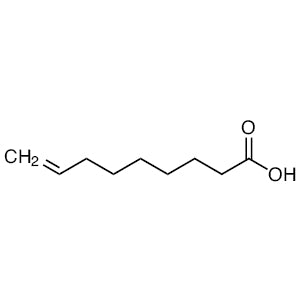
8-Nonenoic Acid from TCI (product code N0752) is a medium-chain fatty acid with a nine-carbon backbone. One end of the chain has a terminal double bond and the other end has a carboxylic acid group. This bifunctional structure makes it a versatile aliphatic building block for synthetic work. In the laboratory, chemists use it as a linker, as a monomer precursor, and as a starting material for reactions that target either the terminal alkene or the carboxyl group on its own. It fits well into multistep synthesis where a controlled, stepwise modification of a linear carbon chain is needed.
The main strength of this compound is that its two reactive groups can be modified orthogonally, meaning one group can be changed while the other stays intact. The terminal alkene suits olefin metathesis, thiol-ene coupling, hydroboration, epoxidation, and hydrosilylation. The carboxyl group can be turned into esters or amides, or used to anchor the molecule to metal oxide surfaces. The fairly long methylene chain adds hydrophobic character and conformational flexibility. These features make the compound a good choice for building surface layers, functional polymers, and amphiphilic molecules, where both chain length and end-group reactivity matter to the final design.
In Indonesia, this material is relevant to organic and polymer chemistry laboratories that need a reliable bifunctional aliphatic intermediate. It also serves materials science laboratories working on surface modification and nanoparticle functionalisation, where the carboxyl group binds to oxide surfaces and the alkene stays free for later coupling. Oleochemical laboratories studying fatty acid derivatives will also find it useful as a model compound. University research groups, government research institutes, and industrial R&D teams can use it in method development, exploratory synthesis, and small-scale research projects.
Related TCI products
- Olefin metathesis: the terminal alkene is an accessible reaction site for cross-metathesis and chain-extension reactions, while the carboxylic acid at the other end is left available for later derivatisation.
- Thiol-ene click chemistry: the unhindered terminal double bond reacts readily with thiols, so this compound suits the efficient construction of functional linkers, crosslinked networks, and modified polymer side chains.
- Surface modification of metal oxides and nanoparticles: the carboxyl group can anchor to oxide surfaces, while the hydrophobic methylene chain and free alkene form a reactive, well-defined organic layer for further coupling.
- Synthesis of esters and amides as monomer precursors: converting the carboxyl group gives polymerisable or functional derivatives, and the terminal alkene is kept intact for polymerisation or post-polymerisation modification.
- Preparation of amphiphilic molecules and fatty acid derivatives: the polar carboxyl head combined with a flexible nine-carbon chain makes it a practical model and building block for oleochemical and surfactant-related research.
| Brand | TCI (product code N0752) |
|---|---|
| CAS number | 31642-67-8 |
| Molecular formula | — |
| Purity | — |
| Category | Chemistry > Building Blocks > Non-Heterocyclic Building Blocks |
| Pack sizes | 5 g |
| Physical form | — |
| Storage | keep tightly closed in a cool, dry, well-ventilated place, following the supplier's label and Safety Data Sheet |
- Structure: nine-carbon fatty acid with a terminal alkene and a carboxylic acid group
Store 8-Nonenoic Acid in its original, tightly sealed container in a cool, dry, well-ventilated area, away from direct sunlight, heat sources, and strong oxidising agents. Because the terminal alkene can react with oxidants, limit unnecessary exposure to air and reseal the container right after use. Always follow the storage conditions on the TCI label and Safety Data Sheet. Handle the compound in a fume hood and wear chemical-resistant gloves, safety glasses, and a laboratory coat. Avoid contact with skin and eyes and do not breathe in vapours. Use clean glass or compatible chemical-resistant containers when transferring or weighing the material, and label all secondary containers clearly. Dispose of waste according to institutional and local chemical waste regulations.
—
Produk Terkait
-
2-NonenoicAcid TCI N0426
Regular price Rp 4.133.850,00Regular price -
3-NonenoicAcid TCI N0312
Regular price From Rp 1.035.300,00Regular price

