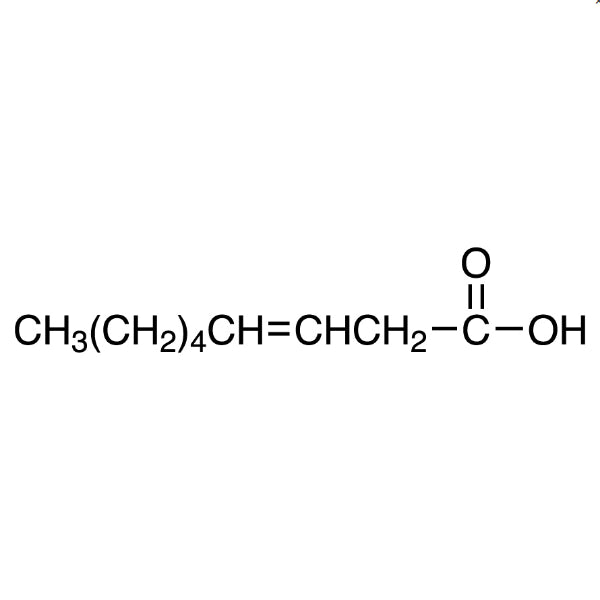
3-Nonenoic Acid (TCI N0312), with CAS number 4124-88-3, is an organic compound widely used in scientific research, particularly in the field of materials science. This material plays a crucial role in laboratory settings, especially in the synthesis of colloidal quantum dots (QDs), which are essential for advanced electronic and optical applications. Its unique molecular structure, featuring a long carbon chain and a carboxyl group at the end, enables it to act as a ligand or stabilizer in the preparation of nanomaterials. Due to its chemical and physical properties, it is a key component in the development of novel materials with tailored optical and electronic characteristics.
The compound’s solubility in organic solvents and its stable molecular structure make it a preferred choice for researchers. It is non-reactive under certain conditions, which enhances its versatility in various synthetic processes. Its ability to remain chemically stable during repeated use ensures consistency in experimental outcomes. These properties make it an ideal reagent for the synthesis of quantum dots and other nanomaterials, supporting the creation of advanced electronic components and optoelectronic devices.
In Indonesian laboratories, 3-Nonenoic Acid is commonly used in research related to electronic and optical materials. It is a staple in academic and industrial research settings, where it supports the development of next-generation materials. Its availability and reliability make it a valuable resource for scientists working on nanotechnology and material science projects.
TCI brochures (PDF)
- Colloidal Quantum Dot (QD) Research Reagents 2026-05-21 · p. 4
- Lipids 2025-12-17 · p. 5
- Colloidal Quantum Dot Synthesis: 3-Nonenoic Acid is ideal for stabilizing and functionalizing quantum dots, ensuring uniform particle size and optical properties.
- Organic Semiconductor Fabrication: Its molecular structure allows it to act as a ligand in the synthesis of organic semiconductors, enhancing charge transport properties.
- Nanoparticle Stabilization: The compound provides effective stabilization of nanoparticles in colloidal solutions, preventing aggregation and ensuring long-term stability.
- Surface Functionalization of Nanomaterials: It is used to modify the surface of nanomaterials, enabling controlled interactions with other molecules or substrates.
- Optical Material Development: Its chemical stability and solubility make it suitable for the development of advanced optical materials with tailored absorption and emission properties.
| Brand | TCI |
|---|---|
| CAS number | 4124-88-3 |
| Molecular formula | — |
| Purity | — |
| Category | Materials Science > Electronic Materials > Colloidal Quantum Dot (QD) Research Reagents |
| Pack sizes | Available in various quantities as per standard laboratory requirements |
| Physical form | Liquid |
| Storage | Store in a cool, dry place away from direct sunlight |
3-Nonenoic Acid should be stored in a cool, dry environment, away from direct sunlight and sources of heat. It is recommended to keep the material in a sealed container to prevent exposure to air and moisture. Due to its chemical stability, it does not require refrigeration but should be protected from potential contaminants. In laboratory settings, it is important to handle the compound with care, using appropriate personal protective equipment such as gloves and safety goggles. The compound is non-reactive under normal conditions, making it relatively safe to handle, but standard chemical safety protocols should still be followed to ensure a safe working environment.
—
Produk Terkait
-
2-NonenoicAcid TCI N0426
Regular price Rp 4.186.350,00Regular priceRp 2.943.150,00Sale price Rp 4.186.350,00 -
ValericAcid TCI V0003
Regular price From Rp 610.050,00Regular priceRp 426.300,00Sale price From Rp 610.050,00 -
2-UndecenoicAcid TCI U0032
Regular price Rp 2.571.450,00Regular priceRp 1.813.350,00Sale price Rp 2.571.450,00 -
10-UndecenoicAcid TCI U0007
Regular price From Rp 557.550,00Regular priceRp 405.300,00Sale price From Rp 557.550,00 -
UndecanoicAcid TCI U0004
Regular price From Rp 1.008.000,00Regular priceRp 720.300,00Sale price From Rp 1.008.000,00 -
cis-15-TetracosenoicAcid TCI T1642
Regular price Rp 6.784.050,00Regular priceRp 4.759.650,00Sale price Rp 6.784.050,00 -
BehenicAcid TCI B1747
Regular price Rp 4.028.850,00Regular priceRp 2.832.900,00Sale price Rp 4.028.850,00 -
BehenicAcid TCI B1248
Regular price From Rp 848.400,00Regular priceRp 609.000,00Sale price From Rp 848.400,00