

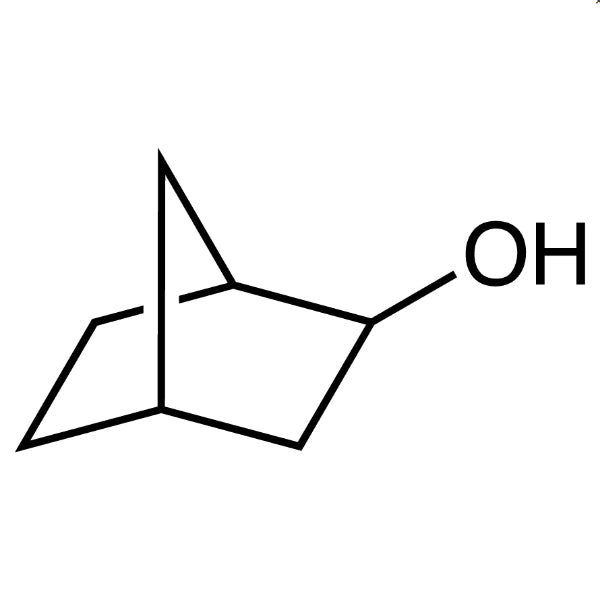
exo-Norborneol is a bicyclic secondary alcohol built on the norbornane (bicyclo[2.2.1]heptane) skeleton, with its hydroxyl group in the exo position. Supplied by TCI, it serves as a non-heterocyclic building block in organic synthesis. Chemists use it mainly to introduce a rigid bicyclic framework into target molecules. In the laboratory it is a common starting material for oxidation to the corresponding bicyclic ketone, for esterification, and for preparing other norbornyl derivatives. This makes it a practical intermediate for both synthetic and mechanistic work.
The main reason researchers choose exo-Norborneol is its locked norbornane geometry. Because the framework cannot flex, the exo and endo faces are clearly distinct. That makes the compound a reliable model for studying how stereochemistry affects reaction rates and product outcomes. Norbornyl chemistry also holds an important place in the history of physical organic chemistry, especially in discussions of the norbornyl carbocation and sigma-bond participation. The rigid skeleton gives functional groups a predictable orientation, which is useful when designing ligands, fragrance materials, or test compounds that need well-defined three-dimensional structures.
In Indonesian laboratories, exo-Norborneol suits chemistry research groups at universities and research institutes that work on organic synthesis, stereochemistry, and reaction mechanisms. It can support undergraduate and postgraduate projects that explore oxidation, esterification, or derivatization of bicyclic alcohols. It is also useful in advanced teaching settings where students study how molecular rigidity and exo/endo selectivity shape reactivity. Groups developing new ligands, fragrance-related compounds, or model substrates may also find it a convenient, well-defined starting material from a recognized reagent brand.
- Oxidation to bicyclic ketones: the secondary hydroxyl group on the rigid norbornane framework makes exo-Norborneol a convenient substrate for preparing the corresponding bicyclic ketone under standard oxidation methods.
- Esterification reactions: the exo-positioned hydroxyl group reacts readily with acylating agents, so the compound works well for preparing norbornyl esters used as intermediates or as model compounds.
- Synthesis of norbornyl derivatives: as a non-heterocyclic building block, it lets chemists introduce a rigid bicyclic scaffold into target molecules, with functional groups held in predictable orientations.
- Stereochemistry and mechanism studies: because the exo and endo faces are clearly distinguishable, it is a good model for studying how stereochemistry affects reaction rates, selectivity, and product distributions.
- Physical organic chemistry teaching and research: its link to classic discussions of the norbornyl carbocation and sigma-bond participation makes it valuable for exploring carbocation behavior and neighboring-group effects.
| Brand | TCI (product code N0775) |
|---|---|
| CAS number | 497-37-0 |
| Molecular formula | — |
| Purity | — |
| Category | Chemistry > Building Blocks > Non-Heterocyclic Building Blocks |
| Pack sizes | available in the TCI pack sizes shown on the product page |
| Physical form | see the TCI product documentation and Certificate of Analysis |
| Storage | follow the storage conditions on the TCI label and Safety Data Sheet |
Store exo-Norborneol in its original, tightly closed container in a cool, dry, well-ventilated area, away from heat sources, open flames, and strong oxidizing agents. Follow the storage conditions on the TCI label and Safety Data Sheet. Keep the container properly labeled, and reseal it promptly after each use to protect the material from moisture and contamination. When handling, wear standard personal protective equipment, including safety glasses, gloves, and a lab coat. Work in a fume hood or well-ventilated area, avoid inhaling dust or vapors, and avoid contact with skin and eyes. Clean up spills promptly, and dispose of waste according to institutional and local chemical waste regulations.
—
Produk Terkait
-
5-Norbornene-2,3-dimethanol(mixtureofendo-andexo-,predominantlyendo-isomer) TCI N0764
Regular price From Rp 2.016.000,00Regular price
