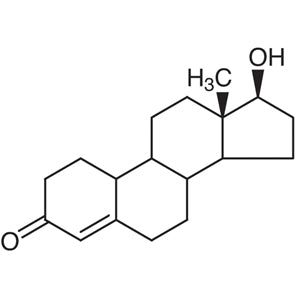
Nandrolone, also known as 19-nortestosterone, is an androgenic-anabolic steroid derived from testosterone. It differs from testosterone in that it has no methyl group at the C-19 position. TCI supplies this compound as a pharmaceutical research reagent for experimental use only. It is not intended for human or veterinary consumption. In the laboratory, Nandrolone is mainly used as a reference standard in steroid analysis, as a comparison compound in androgen receptor studies, and as a study material for steroid metabolism research in biochemistry and pharmacology.
Researchers choose Nandrolone because its structure is well characterised and it is an established reference point in the steroid pharmacology literature. Without the C-19 methyl group, its biological profile differs from that of testosterone. This makes the compound useful for studying structure-activity relationships across the steroid class. Nandrolone is also an important analyte in anti-doping analysis and forensic toxicology. Analytical laboratories need reference materials of clearly established identity to validate their chromatographic and mass spectrometric methods, and a well-documented compound from an established brand such as TCI meets that need.
In Indonesia, Nandrolone is relevant to university pharmacy laboratories, toxicology and forensic laboratories, drug testing institutions, and biochemical research groups working on steroid hormones. Academic researchers use it in pharmacology teaching and in receptor studies. Analytical and forensic laboratories use it as a comparison standard when developing and verifying detection methods. Buyers should confirm that the compound will be handled and documented in line with the institution's internal procedures and any applicable national regulations on controlled or restricted substances.
- Reference standard in steroid analysis: its well-characterised structure gives a reliable identity benchmark for qualitative and quantitative testing of steroid compounds in research samples.
- Androgen receptor studies: as a well-documented testosterone derivative, it is a suitable comparison compound for evaluating receptor binding and androgenic or anabolic activity in experimental models.
- Steroid metabolism research: biochemistry and pharmacology groups use it as a study substrate to investigate metabolic pathways and the metabolites formed from 19-nor steroids.
- Structure-activity relationship studies: because it lacks the C-19 methyl group, comparing it with testosterone helps researchers understand how small structural changes affect biological activity.
- Method validation in anti-doping and forensic toxicology: laboratories need comparison materials of clear identity to validate chromatography and mass spectrometry methods for detecting this important analyte.
| Brand | TCI (product code N0777) |
|---|---|
| CAS number | 434-22-0 |
| Molecular formula | — |
| Purity | — |
| Category | Life Science > Biochemicals and Reagents > Pharmaceutical Research Reagents (for Experimental Use) |
| Pack sizes | see the available options on the product listing |
| Physical form | solid; see the TCI product label and certificate of analysis for details |
| Storage | follow the storage conditions stated on the TCI label and Safety Data Sheet |
Store Nandrolone in its original, tightly closed container. Keep it in a cool, dry place away from direct light, heat and moisture, and follow the storage temperature given on the TCI label and Safety Data Sheet. Record the compound in the laboratory's chemical inventory and keep it in restricted-access storage, because it is a pharmacologically active steroid. Only trained personnel should handle it. They should wear gloves, a lab coat and eye protection, and weigh the powder in a fume hood or ventilated enclosure to avoid inhaling or touching it. Do not eat, drink or smoke in the handling area. This material is for experimental research use only and must never be given to humans or animals. Dispose of residues and contaminated materials according to institutional hazardous waste procedures and local regulations.
—
Produk Terkait
-
TCI B5774 5,10-Bis(4,4,5,5-tetramethyl-1,3,2-dioxaborolan-2-yl)naphtho[1,2-c:5,6-c']bis([1,2,5]oxadiazole)
Regular price Rp 10.255.350,00Regular price -
Dihydroiodide TCI B6569
Regular price From Rp 1.936.200,00Regular price -
Trifluoromethanesulfonate TCI B7003
Regular price From Rp 1.936.200,00Regular price
![5,10-Bis(4,4,5,5-tetramethyl-1,3,2-dioxaborolan-2-yl)naphtho[1,2-c:5,6-c']bis([1,2,5]oxadiazole) - TCI B5774 - AMI Scientific](http://amiscientific.com/cdn/shop/files/TCI2510B5774.jpg?v=1769180228&width=533)