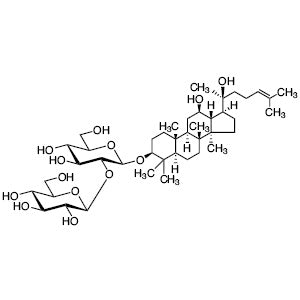
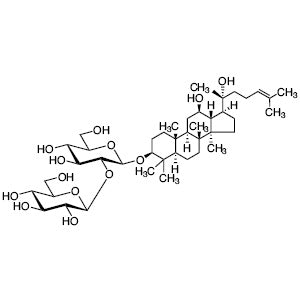
20(R)-Ginsenoside Rh2 is a chemical compound derived from the roots of the ginseng plant. It plays a significant role in laboratory research, particularly in the fields of chemical biology and glycoscience. This compound is widely used to study the biological effects of ginsenosides, which are a class of bioactive compounds found in ginseng. As a key component of ginseng, 20(R)-Ginsenoside Rh2 is of great interest to researchers exploring its potential in drug development and alternative therapies. Its presence in natural products makes it a valuable tool for understanding the pharmacological properties of plant-derived compounds.
The compound is valued for its molecular complexity and stability under specific conditions. It exhibits notable antioxidant and anti-inflammatory properties, which make it a preferred choice for experimental studies. These characteristics allow researchers to investigate its therapeutic potential in treating chronic diseases. Additionally, its chemical structure enables it to be used in various analytical techniques, enhancing its utility in both basic and applied research. The consistent quality and reliability of 20(R)-Ginsenoside Rh2 ensure that it meets the rigorous demands of scientific investigations.
In Indonesian laboratories, 20(R)-Ginsenoside Rh2 is commonly used by researchers in higher education institutions and research organizations. It is employed in studies focused on natural compounds and pharmaceutical product development. The compound’s relevance to health-related research contributes to the advancement of scientific knowledge and the exploration of new therapeutic applications. Its widespread use underscores its importance in both academic and industrial research settings.
TCI brochures (PDF)
- Steroids 2026-07-28 · p. 7
- Terpenes 2025-09-22 · p. 9
- Phytochemicals 2025-12-17 · p. 5
- Pharmaceutical Ingredients for Research and Experimental Use 2026-03-09 · p. 40
- Reagents for Biological Research 2025-03-11 · p. 47
- Bioactive Compound Research: This compound is ideal for studying the biological effects of ginsenosides, aiding in the understanding of their pharmacological properties and therapeutic applications.
- Drug Development: Its antioxidant and anti-inflammatory properties make it suitable for exploring its potential in the development of new pharmaceutical products.
- Natural Product Analysis: The compound’s molecular complexity allows it to be used in analytical techniques for characterizing natural products and their derivatives.
- Chronic Disease Studies: Its anti-inflammatory and antioxidant activities make it a valuable tool for investigating the effects of ginsenosides on chronic diseases.
- Pharmacological Mechanism Studies: Researchers use it to explore the mechanisms of action of natural compounds, contributing to the development of alternative therapies.
| Brand | TCI |
|---|---|
| CAS number | 112246-15-8 |
| Molecular formula | — |
| Purity | — |
| Category | Chemistry > Chemical Biology > Glycoscience |
| Pack sizes | As per supplier specifications |
| Physical form | Solid (as per standard product description) |
| Storage | Store in a cool, dry place away from light |
20(R)-Ginsenoside Rh2 should be stored in a cool, dry environment to maintain its stability and prevent degradation. It is recommended to keep the compound in a sealed container to protect it from moisture and light exposure. Laboratory personnel should handle the compound with care, using appropriate personal protective equipment such as gloves and safety goggles. Due to its chemical nature, it should be stored separately from incompatible substances to avoid any potential reactions. Proper labeling of storage containers is essential to ensure safe handling and prevent accidental exposure. Regular monitoring of storage conditions will help maintain the integrity of the compound for research use.
—
Product Categories
- GlycoscienceFunctional OligosaccharidesNatural Glycosides [Functional Oligosaccharides]
- Biochemicals and ReagentsCrude Medicine Ingredients for Research and Experimental Use
- Biochemicals and ReagentsPharmaceutical Research Reagents (for Experimental Use)Anti-osteoporosis Ingredients (for Research and Experimental Use)
- Biochemicals and ReagentsSteroidsPhytosteroids [Steroids]
- Biochemicals and ReagentsSteroidsSteroid Glycosides [Steroids]
- Biochemicals and ReagentsTerpenesTriterpenes
- Cell BiologyCancer ResearchAntitumor Agents for Research
- Cell BiologyCell Signaling and NeuroscienceCytokines, Growth Factors and Hormones
- Cell BiologyNutrition ResearchPhytochemicals
- Cell BiologyBone Metabolism ResearchBone Resorption Inhibitors [Bone Metabolism Research]
- Pharmaceutical Development and Drug Discovery ResearchPharmaceutical Research Reagents (for Experimental Use)Anti-osteoporosis Ingredients (for Research and Experimental Use)
- Pharmaceutical Development and Drug Discovery ResearchCrude Medicine Ingredients for Research and Experimental Use
Produk Terkait
-
GinsenosideRo TCI G0586
Regular price Rp 7.869.750,00Regular priceRp 5.518.800,00Sale price Rp 7.869.750,00 -
20(S)-GinsenosideRg3 TCI G0568
Regular price Rp 2.597.700,00Regular priceRp 1.832.250,00Sale price Rp 2.597.700,00 -
20(R)-GinsenosideRg3 TCI G0536
Regular price Rp 5.194.350,00Regular priceRp 3.647.700,00Sale price Rp 5.194.350,00 -
Digoxin TCI D1828
Regular price From Rp 1.113.000,00Regular priceRp 793.800,00Sale price From Rp 1.113.000,00 -
Digitoxin TCI D0542
Regular price Rp 3.843.000,00Regular priceRp 2.702.700,00Sale price Rp 3.843.000,00 -
Digitonin TCI D0540
Regular price Rp 1.696.800,00Regular priceRp 1.202.250,00Sale price Rp 1.696.800,00 -
NotoginsenosideR1 TCI N1129
Regular price Rp 4.823.700,00Regular priceRp 3.388.350,00Sale price Rp 4.823.700,00 -
GinsenosideRe TCI G0551
Regular price From Rp 5.352.900,00Regular priceRp 3.759.000,00Sale price From Rp 5.352.900,00