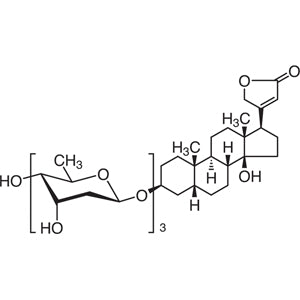
Digoxin is a chemical compound classified under the category of digitalis glycosides, commonly used in biochemical and pharmacological research. As a key component in the study of cardiac physiology, it plays a vital role in understanding the mechanisms of action of cardiac medications. Its strong pharmacological activity makes it an essential tool for investigating the effects of drugs on the cardiovascular system. In the laboratory, Digoxin is widely utilized for its ability to modulate heart rate and contractility, making it a valuable asset in pharmacological studies and drug development.
Digoxin is known for its chemical stability under controlled conditions, which ensures consistent results in experimental settings. However, it is highly sensitive to moisture and light, requiring careful handling and storage to maintain its integrity. These properties make it a preferred choice for researchers who require reliable and reproducible data. Its availability in solid form simplifies its use in both qualitative and quantitative analyses, enhancing its versatility in various laboratory applications.
In Indonesian laboratories, Digoxin is frequently used in public health and pharmaceutical research. It serves as a critical reagent for studying the pharmacological effects and mechanisms of action of drugs in human physiology. Its application supports the development of more effective and safe therapeutic options for the Indonesian population. Researchers rely on Digoxin to advance their understanding of cardiovascular diseases and improve treatment strategies.
TCI brochures (PDF)
- Reagents for Preparing Animal Disease Models 2024-09-13 · p. 1
- Traditional Medicine/Crude Medicine Research Reagents 2024-09-11 · p. 2
- Steroids 2026-07-28 · p. 7
- Plant Research Reagents 2026-02-24 · p. 9
- Phytochemicals 2025-12-17 · p. 5
- Reagents for Glyco Chemistry & Biology 5th Edition · p. 90
- Pharmacological research for studying cardiac drug mechanisms and effects on heart function.
- Development of new pharmaceuticals by analyzing the pharmacological properties of Digoxin.
- Toxicological studies to evaluate the safety and potential side effects of the compound.
- Biochemical experiments to investigate the interaction of Digoxin with cellular and molecular targets.
- Public health research to understand the impact of cardiac medications on human health and disease management.
| Brand | TCI |
|---|---|
| CAS number | 20830-75-5 |
| Molecular formula | — |
| Purity | — |
| Category | Chemistry > Chemical Biology > Glycoscience |
| Pack sizes | Available in various quantities as per standard laboratory requirements |
| Physical form | Solid |
| Storage | Must be stored in a cool, dry place away from light and moisture |
Digoxin should be stored in a cool, dry environment, away from direct light and moisture to maintain its chemical stability. It is recommended to use airtight containers made of glass or high-density polyethylene to prevent exposure to humidity. Due to its sensitivity, it is important to handle Digoxin with clean, dry gloves and avoid contact with moisture during preparation. In laboratory settings, it should be kept in a designated storage area with controlled environmental conditions to ensure its integrity. Always follow standard safety protocols when handling this compound to prevent degradation and ensure accurate experimental results.
—
Product Categories
- GlycoscienceFunctional OligosaccharidesNatural Glycosides [Functional Oligosaccharides]
- GlycoscienceTrisaccharides [Glycoscience]
- Biochemicals and ReagentsAnimal Disease Models PreparationReagents for Life-style related Disease Models
- Biochemicals and ReagentsCarbohydrates
- Biochemicals and ReagentsCrude Medicine Ingredients for Research and Experimental Use
- Biochemicals and ReagentsEnzymes, Enzyme Inhibitors, Enzyme SubstratesEnzyme Inhibitors [Biochemicals and Reagents]
- Biochemicals and ReagentsPharmaceutical Research Reagents (for Experimental Use)Pharmaceutical Research Reagents (Others)
- Biochemicals and Reagents
- Biochemicals and ReagentsSteroidsPhytosteroids [Steroids]
- Biochemicals and ReagentsSteroidsSteroid Glycosides [Steroids]
- Cell BiologyCell Signaling and NeuroscienceCytokines, Growth Factors and Hormones
- Cell BiologyNutrition ResearchPhytochemicals
- Pharmaceutical Development and Drug Discovery ResearchPharmaceutical Research Reagents (for Experimental Use)Pharmaceutical Research Reagents (Others)
- Pharmaceutical Development and Drug Discovery ResearchCrude Medicine Ingredients for Research and Experimental Use
Produk Terkait
-
Digitoxin TCI D0542
Regular price Rp 3.843.000,00Regular priceRp 2.702.700,00Sale price Rp 3.843.000,00 -
20(R)-GinsenosideRh2 TCI G0567
Regular price From Rp 4.293.450,00Regular priceRp 3.017.700,00Sale price From Rp 4.293.450,00 -
Digitonin TCI D0540
Regular price Rp 1.696.800,00Regular priceRp 1.202.250,00Sale price Rp 1.696.800,00 -
Acarbose TCI A2485
Regular price From Rp 2.757.300,00Regular priceRp 1.943.550,00Sale price From Rp 2.757.300,00 -
RebaudiosideA TCI R0095
Regular price From Rp 1.881.600,00Regular priceRp 1.331.400,00Sale price From Rp 1.881.600,00 -
Icariin TCI I0862
Regular price From Rp 1.881.600,00Regular priceRp 1.331.400,00Sale price From Rp 1.881.600,00 -
Paeoniflorin TCI P1876
Regular price Rp 4.611.600,00Regular priceRp 3.240.300,00Sale price Rp 4.611.600,00 -
Dioscin TCI D5167
Regular price Rp 6.678.000,00Regular priceRp 4.685.100,00Sale price Rp 6.678.000,00