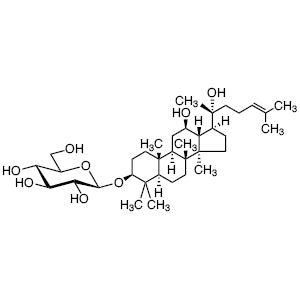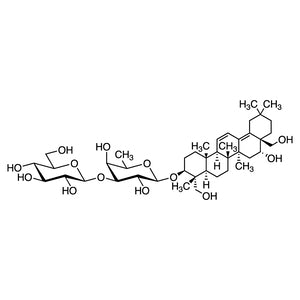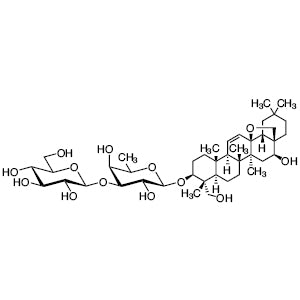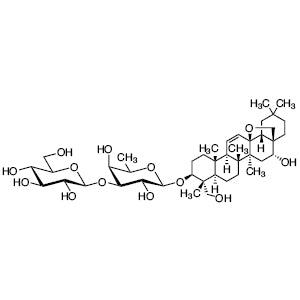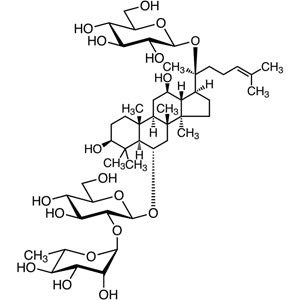
Ginsenoside Re is a chemical compound belonging to the ginsenoside family, a group of phytochemicals naturally found in ginseng roots. This compound plays a crucial role in biochemical and pharmacological research, where it is used to explore its biological activities, including antioxidant, anti-inflammatory, and potential therapeutic benefits for various medical conditions. In the laboratory, Ginsenoside Re serves as a key reagent for the synthesis of new compounds or as a standard for qualitative and quantitative analysis in chemical and pharmacological testing. Its presence in research helps scientists understand the mechanisms of action of natural compounds and their potential applications in drug development.
The compound's complex molecular structure allows for specific interactions with various proteins and enzymes in the body, making it a highly sought-after material in studies related to drug mechanisms and the biological effects of natural substances. Its stability under certain conditions further enhances its usability, enabling long-term storage and consistent performance in experiments. These properties make Ginsenoside Re an essential tool for researchers aiming to explore the therapeutic potential of natural compounds.
In Indonesian laboratories, Ginsenoside Re is widely used in applied research across pharmaceutical, biomedical, and health sciences. It is a vital tool for investigating the bioactive properties of natural products and their potential applications in drug discovery and development. Its availability and reliability make it a preferred choice for both academic and industrial research settings.
TCI brochures (PDF)
- Terpenes 2025-09-22 · p. 9
- Phytochemicals 2025-12-17 · p. 5
- Biochemical research utilizes Ginsenoside Re to study its antioxidant and anti-inflammatory properties, aiding in the development of natural therapeutics.
- Pharmacological studies employ this compound to evaluate its potential therapeutic effects on various diseases, supporting drug discovery efforts.
- Analytical chemistry applications benefit from Ginsenoside Re as a standard for qualitative and quantitative analysis in chromatographic and spectroscopic techniques.
- Drug development projects use it as a starting material for the synthesis of novel compounds with improved pharmacological profiles.
- Biomedical research incorporates Ginsenoside Re to investigate its interactions with biological systems, contributing to the understanding of natural product mechanisms.
| Brand | TCI |
|---|---|
| CAS number | 52286-59-6 |
| Molecular formula | — |
| Purity | — |
| Category | Chemistry > Chemical Biology > Glycoscience |
| Pack sizes | Available in various quantities as per supplier specifications |
| Physical form | Solid powder |
| Storage | Store in a cool, dry place away from light and moisture |
Ginsenoside Re should be stored in a cool, dry environment, away from direct light and moisture to maintain its stability and potency. It is recommended to use airtight containers to prevent exposure to air and humidity, which may affect its integrity. In laboratory settings, it should be handled with appropriate personal protective equipment, such as gloves and safety goggles, to ensure safety during manipulation. The compound should be kept in a secure location, away from incompatible substances to avoid any chemical reactions. Regular monitoring of storage conditions is essential to ensure the compound remains suitable for use in research applications. Proper storage practices help preserve the quality of Ginsenoside Re, ensuring reliable results in experimental studies.
—
Product Categories
- GlycoscienceDisaccharides [Glycoscience]
- GlycoscienceFunctional OligosaccharidesNatural Glycosides [Functional Oligosaccharides]
- Biochemicals and ReagentsCrude Medicine Ingredients for Research and Experimental Use
- Biochemicals and ReagentsTerpenesTriterpenes
- Cell BiologyNutrition ResearchPhytochemicals
- Pharmaceutical Development and Drug Discovery ResearchCrude Medicine Ingredients for Research and Experimental Use
Produk Terkait
-
NotoginsenosideR1 TCI N1129
Regular price Rp 4.823.700,00Regular priceRp 3.388.350,00Sale price Rp 4.823.700,00 -
GinsenosideRo TCI G0586
Regular price Rp 7.869.750,00Regular priceRp 5.518.800,00Sale price Rp 7.869.750,00 -
20(R)-GinsenosideRh2 TCI G0567
Regular price From Rp 4.293.450,00Regular priceRp 3.017.700,00Sale price From Rp 4.293.450,00 -
SaikosaponinB2 TCI A3610
Regular price Rp 6.438.600,00Regular priceRp 4.518.150,00Sale price Rp 6.438.600,00 -
SaikosaponinA TCI A3408
Regular price From Rp 2.411.850,00Regular priceRp 1.702.050,00Sale price From Rp 2.411.850,00 -
SaikosaponinD TCI A3405
Regular price From Rp 2.597.700,00Regular priceRp 1.832.250,00Sale price From Rp 2.597.700,00 -
MonoammoniumGlycyrrhizinate TCI M3857
Regular price From Rp 662.550,00Regular priceRp 478.800,00Sale price From Rp 662.550,00 -
alpha-Hederin TCI H1646
Regular price Rp 7.182.000,00Regular priceRp 5.037.900,00Sale price Rp 7.182.000,00