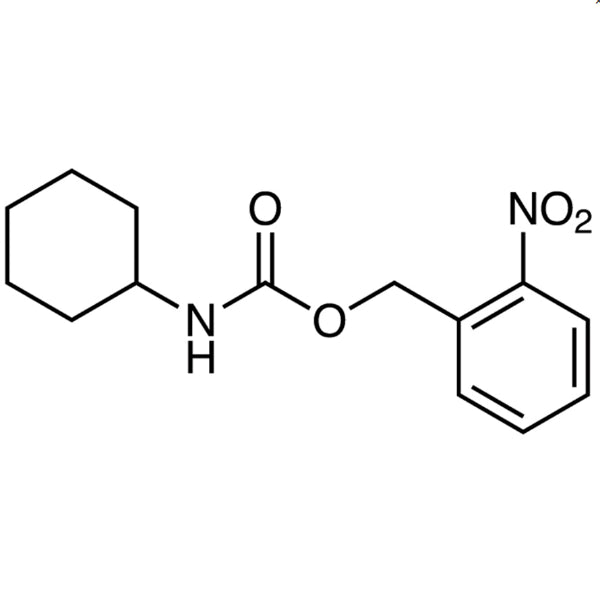
2-Nitrobenzyl Cyclohexylcarbamate is a chemical compound widely used in laboratory settings for its versatility in chemical reactions and molecular synthesis. It plays a crucial role in polymerization and substitution reactions, particularly within the fields of materials science and organic chemistry. This reagent is essential for the formation of polymers with specific structural characteristics, making it indispensable in research requiring controlled chemical transformations. Its ability to participate in various reaction mechanisms allows it to be a key component in the development of advanced materials and complex molecular structures.
The compound's stability and controlled reactivity make it a preferred choice for high-precision laboratory work. Its molecular structure, consisting of a nitrobenzyl group attached to a cyclohexylcarbamate, provides specific reactivity that enables interactions with a range of substrates, including amines, carboxylic acids, and alcohols. This unique structure allows for targeted chemical modifications, which is vital in applications where reaction control is critical. Additionally, its solubility in organic solvents simplifies handling and manipulation, enhancing its usability in diverse experimental setups.
In Indonesian laboratories, 2-Nitrobenzyl Cyclohexylcarbamate is commonly used in polymer synthesis and molecular modification studies. Its role in creating structured polymers and enabling precise chemical reactions makes it a valuable tool for researchers working on advanced materials and synthetic chemistry projects. Its consistent performance and reliability contribute to the success of various scientific investigations in the region.
- Polymer synthesis applications benefit from this reagent’s ability to form structured polymer chains, enabling the development of advanced materials with tailored properties.
- Organic chemistry research utilizes its controlled reactivity for targeted molecular modifications, supporting the creation of complex chemical structures.
- Material science experiments rely on its stability and reactivity to produce polymers with specific functional groups, enhancing material performance.
- Molecular modification studies leverage its interaction with various substrates to facilitate precise chemical transformations in synthetic pathways.
- Industrial research applications use it for the development of new chemical compounds, contributing to innovation in chemical manufacturing processes.
| Brand | TCI |
|---|---|
| CAS number | 119137-03-0 |
| Molecular formula | — |
| Purity | — |
| Category | Materials Science > Polymer/Macromolecule Reagents > Polymerization Reagents |
| Pack sizes | Available in standard laboratory quantities |
| Physical form | Solid or liquid, depending on formulation |
| Storage | Store in a cool, dry place away from direct sunlight |
This compound should be stored in a cool, dry environment, away from direct sunlight and sources of heat. It is recommended to use airtight containers to prevent exposure to moisture and air, which could affect its stability. Proper labeling of containers is essential to ensure safe handling and prevent accidental use. In laboratory settings, it is important to follow standard chemical safety protocols, including the use of personal protective equipment when handling. Due to its reactivity, it should be stored separately from incompatible substances. Regular monitoring of storage conditions ensures the compound remains effective for its intended applications.
—
Produk Terkait
-
TCI B5774 5,10-Bis(4,4,5,5-tetramethyl-1,3,2-dioxaborolan-2-yl)naphtho[1,2-c:5,6-c']bis([1,2,5]oxadiazole)
Regular price Rp 10.255.350,00Regular price -
Dihydroiodide TCI B6569
Regular price From Rp 1.936.200,00Regular price -
Trifluoromethanesulfonate TCI B7003
Regular price From Rp 1.936.200,00Regular price
![5,10-Bis(4,4,5,5-tetramethyl-1,3,2-dioxaborolan-2-yl)naphtho[1,2-c:5,6-c']bis([1,2,5]oxadiazole) - TCI B5774 - AMI Scientific](http://amiscientific.com/cdn/shop/files/TCI2510B5774.jpg?v=1769180228&width=533)