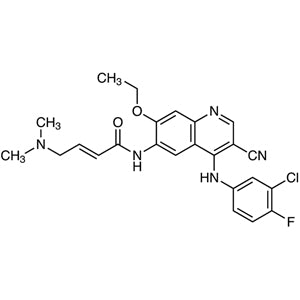
Neratinib is a chemical compound widely used in biochemical and pharmacological research, particularly in the study of enzyme inhibition. As an enzyme inhibitor, it plays a crucial role in controlling cellular metabolic processes. Its ability to modulate enzyme activity makes it an essential tool for researchers aiming to understand enzyme mechanisms and the biological effects of inhibition. In laboratory settings, neratinib is utilized as a key reagent for experiments requiring precise control over enzymatic activity. Its stability under various environmental conditions ensures reliable performance across different experimental setups.
Neratinib is preferred due to its chemical stability and specific inhibitory properties. It exhibits a complex molecular structure that allows it to effectively block intracellular signaling pathways, making it highly valuable in cancer and metabolic disorder research. The compound's specificity enables researchers to isolate and study the effects of enzyme inhibition without interfering with other biological processes. Its availability in solid form and appropriate concentration levels further enhances its usability in laboratory experiments, ensuring consistency and reproducibility in research outcomes.
In Indonesian laboratories, neratinib is commonly used in biochemical and pharmaceutical research. It is a key component in studies involving enzyme inhibition and drug development. Its application is widespread in academic and industrial research settings, contributing to advancements in understanding cellular processes and therapeutic interventions.
TCI brochures (PDF)
- Antitumor Molecular-Targeted Agents 2026-09-17 · p. 1
- Receptor Tyrosine Kinase (RTK) Inhibitors 2026-04-06 · p. 1
- Antimicrobials and Antitumor Agents for Research and Experimental Use 2025-04-24 · p. 17
- Pharmaceutical Ingredients for Research and Experimental Use 2026-03-09 · p. 18
- Enzyme Inhibition Studies: Neratinib is ideal for investigating how enzyme activity can be modulated, providing insights into metabolic pathways and drug mechanisms.
- Cancer Research: Its ability to block intracellular signaling pathways makes it a valuable tool in studying tumor growth and therapeutic resistance.
- Drug Development: Neratinib is used to evaluate the efficacy of enzyme inhibitors in pharmaceutical applications, supporting the creation of targeted therapies.
- Metabolic Disorder Analysis: It aids in studying how enzyme inhibition affects metabolic processes, contributing to the understanding of diseases like diabetes and obesity.
- Biochemical Assays: Its stability and specificity make it suitable for use in controlled biochemical experiments requiring precise enzyme activity modulation.
| Brand | TCI |
|---|---|
| CAS number | 698387-09-6 |
| Molecular formula | — |
| Purity | — |
| Category | Life Science > Biochemicals and Reagents > Enzymes, Enzyme Inhibitors, Enzyme Substrates |
| Pack sizes | Available in various quantities as per standard laboratory requirements |
| Physical form | Solid |
| Storage | Store in a cool, dry place away from direct sunlight |
Neratinib should be stored in a cool, dry environment to maintain its chemical stability. It is recommended to keep it in a sealed container to prevent exposure to moisture and air. Laboratory personnel should handle the compound with care, using appropriate personal protective equipment such as gloves and safety goggles. Storage conditions should avoid extreme temperatures and direct sunlight to ensure the integrity of the material. Proper labeling of containers is essential for safe handling and to prevent accidental contamination. Regular monitoring of storage conditions will help maintain the quality and effectiveness of the compound in research applications.
—
Product Categories
- Biochemicals and ReagentsEnzymes, Enzyme Inhibitors, Enzyme SubstratesEnzyme Inhibitors [Biochemicals and Reagents]
- Biochemicals and ReagentsPharmaceutical Research Reagents (for Experimental Use)Antitumor Research Reagents (for Experimental Use)
- Cell BiologyCancer ResearchAntitumor Agents for Research
- Cell BiologyCell Signaling and NeuroscienceKinase/Phosphatase Biology
- Pharmaceutical Development and Drug Discovery ResearchPharmaceutical Research Reagents (for Experimental Use)Antitumor Research Reagents (for Experimental Use)
Produk Terkait
-
Imatinib TCI I0906
Regular price From Rp 1.326.150,00Regular price -
SunitinibMalate TCI U0095
Regular price Rp 3.021.900,00Regular price -
TyrphostinAG835 TCI T3540
Regular price From Rp 2.016.000,00Regular price -
TyrphostinA1 TCI T3074
Regular price From Rp 1.670.550,00Regular price -
TyrphostinAG490 TCI T2962
Regular price Rp 1.378.650,00Regular price -
TyrphostinAG1478 TCI T2944
Regular price Rp 6.651.750,00Regular price -
Afatinib TCI A2870
Regular price From Rp 2.704.800,00Regular price -
Pelitinib TCI P2529
Regular price From Rp 3.446.100,00Regular price