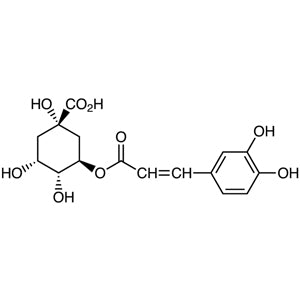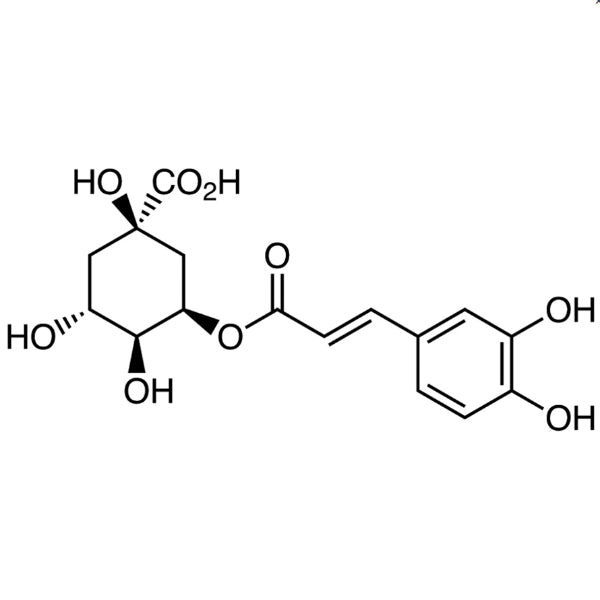
Neochlorogenic Acid (NCA) is a phenolic compound naturally found in various plants, particularly in fruits such as apples and mangoes. In the laboratory, it plays a crucial role in research related to nutrition and cell biology due to its ability to interact with multiple biological systems. This compound is widely used as a raw material for studies on antioxidant effects, metabolism, and pharmacological activity. Its presence in natural sources makes it a valuable tool for understanding the biochemical mechanisms of plant-derived compounds.
The stability and ease of analysis of NCA make it a preferred choice for scientific experiments. Its complex chemical structure, composed of chlorogenic acid and caffeine, allows for versatile applications in different research fields. The compound is colorless and soluble in organic solvents such as ethyl acetate and ethanol, which facilitates its use in analytical procedures. Its neutral chemical properties and ability to bind with various reagents further enhance its utility in scientific investigations.
In Indonesian laboratories, Neochlorogenic Acid is commonly used in public health, nutrition, and pharmacology research. It is frequently employed in studies examining the antioxidant effects of natural compounds. Its availability in various packaging formats supports its use across different experimental scales, making it a reliable and accessible material for researchers in Indonesia.
TCI brochures (PDF)
- Phytochemicals 2025-12-17 · p. 8
- Nutritional Research: Neochlorogenic Acid is used to study the bioavailability and metabolic pathways of plant-derived compounds, aiding in the development of functional foods and dietary supplements.
- Pharmacological Studies: The compound is utilized to investigate its potential therapeutic effects, including antioxidant and anti-inflammatory properties, in drug development.
- Cell Culture Experiments: NCA is incorporated into cell culture media to assess its impact on cellular metabolism and oxidative stress responses.
- Analytical Chemistry: Due to its solubility and stability, it is used as a standard in chromatographic and spectroscopic analyses for quality control.
- Environmental Toxicology: NCA is employed to evaluate the impact of plant-derived compounds on environmental and biological systems.
| Brand | TCI |
|---|---|
| CAS number | 906-33-2 |
| Molecular formula | — |
| Purity | — |
| Category | Life Science > Cell Biology > Nutrition Research |
| Pack sizes | Available in various sizes to suit different experimental needs |
| Physical form | Colorless solid |
| Storage | Store in a cool, dry place away from light |
Neochlorogenic Acid should be stored in a cool, dry place, away from direct light to maintain its stability and prevent degradation. It is recommended to use airtight containers made of glass or high-density polyethylene to protect it from moisture and contaminants. Since it is soluble in organic solvents, it should be handled in a well-ventilated area to avoid inhalation of vapors. Proper personal protective equipment, such as gloves and safety goggles, should be worn when handling the compound. It is not reactive under normal conditions, but care should be taken to avoid exposure to incompatible substances. Regular monitoring of storage conditions ensures the integrity of the material for scientific use.
—
Product Categories
Produk Terkait
-
ChlorogenicAcid TCI C0181
Regular price From Rp 2.306.850,00Regular price -
Amygdalin TCI A0443
Regular price From Rp 477.750,00Regular price -
Isoliquiritigenin TCI I0822
Regular price From Rp 1.035.300,00Regular price -
Icariin TCI I0862
Regular price From Rp 1.829.100,00Regular price -
Arbutin TCI A0522
Regular price From Rp 452.550,00Regular price -
AtropineSulfateMonohydrate TCI A0550
Regular price From Rp 1.856.400,00Regular price -
Zerumbone TCI Z0060
Regular price Rp 8.322.300,00Regular price -
Eugenol TCI A0232
Regular price From Rp 505.050,00Regular price