

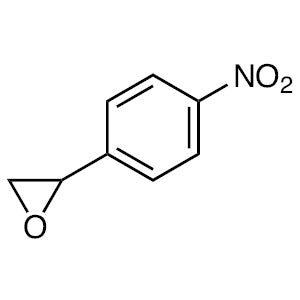
2-(4-Nitrophenyl)oxirane is a chemical compound widely used in organic reactions, particularly in the synthesis of heterocyclic compounds and complex molecular structures. As a cyclic ether, it contains an oxygen atom bonded to two carbon atoms, forming an oxirane ring. This structural feature makes it a valuable reagent in the formation of new chemical bonds, such as nucleophilic or electrophilic reactions. In laboratory settings, it plays a crucial role in building complex molecules, supporting both organic chemistry research and the development of pharmaceutical compounds.
The compound's high reactivity is due to the nitro group on the phenyl ring, which enhances its sensitivity to chemical reactions. Its cyclic structure also provides a degree of stability, allowing it to remain effective under specific conditions without rapid degradation. These characteristics make it a preferred choice for reactions requiring a balance between reactivity and stability. Its versatility supports a wide range of synthetic applications in both academic and industrial research environments.
In Indonesian laboratories, 2-(4-Nitrophenyl)oxirane is commonly used in organic chemistry research, particularly in projects focused on the synthesis of complex compounds. Its availability and chemical properties make it a standard reagent in many chemical laboratories, supporting both basic research and advanced synthetic methodologies. Its role in creating new molecular structures is essential for advancing chemical knowledge and pharmaceutical development in the region.
Related TCI products
- TCI N1271 2461-42-9 2-[(Naphthalen-1-yloxy)methyl]oxirane
- TCI M3638 2211-94-1 2-[(4-Methoxyphenoxy)methyl]oxirane
- TCI C0797 2186-24-5 2-[(p-Tolyloxy)methyl]oxirane
- TCI B6472 2212-06-8 2-[(4-Bromophenoxy)methyl]oxirane
- TCI B5601 7144-65-2 2-[([1,1'-Biphenyl]-2-yloxy)methyl]oxirane
- TCI M3827 2186-25-6 2-[(m-Tolyloxy)methyl]oxirane
- Organic synthesis of heterocyclic compounds due to its reactivity and structural versatility.
- Development of pharmaceutical compounds through the formation of complex molecular frameworks.
- Research in chemical bonding mechanisms involving nucleophilic and electrophilic reactions.
- Creation of new molecular structures in academic and industrial chemical laboratories.
- Support for advanced synthetic methodologies in both teaching and research environments.
| Brand | TCI |
|---|---|
| CAS number | 6388-74-5 |
| Molecular formula | — |
| Purity | — |
| Category | Chemistry > Building Blocks > Non-Heterocyclic Building Blocks |
| Pack sizes | Available in various quantities as per standard chemical supply practices |
| Physical form | Liquid |
| Storage | Store in a cool, dry place away from light and incompatible materials |
This compound should be stored in a cool, dry environment, away from direct sunlight and sources of heat. It is recommended to use airtight containers made of materials compatible with organic solvents to prevent contamination and evaporation. Due to its reactivity, it should be handled in a well-ventilated area, ideally under a fume hood, to minimize exposure. Avoid contact with incompatible substances such as strong acids or bases. Always use appropriate personal protective equipment, including gloves and safety goggles, when handling this material. Proper storage and handling ensure the compound remains effective and safe for use in laboratory applications.
—
Produk Terkait
-
2-[(Naphthalen-1-yloxy)methyl]oxirane TCI N1271
Regular price From Rp 1.353.450,00Regular price -
2-[(4-Methoxyphenoxy)methyl]oxirane TCI M3638
Regular price From Rp 1.776.600,00Regular price -
2-[(p-Tolyloxy)methyl]oxirane TCI C0797
Regular price From Rp 2.094.750,00Regular price -
2-[(4-Bromophenoxy)methyl]oxirane TCI B6472
Regular price From Rp 2.306.850,00Regular price -
2-[([1,1'-Biphenyl]-2-yloxy)methyl]oxirane TCI B5601
Regular price From Rp 1.936.200,00Regular price -
2-[(m-Tolyloxy)methyl]oxirane TCI M3827
Regular price From Rp 2.650.200,00Regular price -
AllylGlycidylEther TCI A0221
Regular price From Rp 477.750,00Regular price -
3-(Oxiran-2-yl)-7-oxabicyclo[410]heptane(mixtureofisomers) TCI V0195
Regular price From Rp 3.870.300,00Regular price
![2461-42-9 2-[(Naphthalen-1-yloxy)methyl]oxirane - AMI Scientific](http://amiscientific.com/cdn/shop/files/TCI2510N1271.jpg?v=1767131049&width=533)
![2211-94-1 2-[(4-Methoxyphenoxy)methyl]oxirane - AMI Scientific](http://amiscientific.com/cdn/shop/files/TCI2510M3638.jpg?v=1767128578&width=533)
![2-[(p-Tolyloxy)methyl]oxirane (CAS 2186-24-5) - TCI C0797 - AMI Scientific](http://amiscientific.com/cdn/shop/files/TCI2510C0797.jpg?v=1767095778&width=533)
![2-[(4-Bromophenoxy)methyl]oxirane (CAS 2212-06-8) - TCI B6472 - AMI Scientific](http://amiscientific.com/cdn/shop/files/TCI2510B6472_1a9ec45a-c16f-4c99-b578-b25c29fb1141.jpg?v=1767865906&width=533)
![2-[([1,1'-Biphenyl]-2-yloxy)methyl]oxirane (CAS 7144-65-2) - TCI B5601 - AMI Scientific](http://amiscientific.com/cdn/shop/files/TCI2510B5601_239fac61-21d5-432a-90e8-7e23ed070ae0.jpg?v=1767862574&width=533)
![2186-25-6 2-[(m-Tolyloxy)methyl]oxirane - AMI Scientific](http://amiscientific.com/cdn/shop/files/TCI2510M3827.jpg?v=1769143073&width=533)

![106-87-6 3-(Oxiran-2-yl)-7-oxabicyclo[4.1.0]heptane (mixture of isomers) - AMI Scientific](http://amiscientific.com/cdn/shop/files/TCI2510V0195.jpg?v=1767145750&width=533)