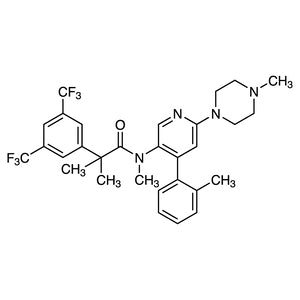
Netupitant is a pharmacological compound widely used in pharmaceutical research and drug development, particularly in antiemetic therapy studies. It plays a crucial role in laboratories by enabling researchers to investigate the effects and mechanisms of action of various compounds within biological systems. As a pharmaceutical research reagent, it supports experimental work aimed at understanding how specific substances interact with physiological processes. This compound is essential for evaluating the efficacy of potential treatments for nausea and vomiting, making it a valuable tool in both human and animal studies.
Netupitant is known for its stability and consistent chemical properties, which make it a preferred choice for laboratory use. It exhibits antagonistic activity at the 5-HT3 receptor, a key player in the pathways responsible for nausea and vomiting. This characteristic allows researchers to explore its potential in developing new therapeutic agents. Its chemical structure is well-defined, facilitating molecular interactions analysis in diverse biological contexts. The compound’s versatility supports both in vitro and in vivo experiments, enhancing its applicability across various research fields.
In Indonesian laboratories, Netupitant is commonly used in pharmacological and pharmacodynamic studies. It serves as a critical reagent for evaluating the effectiveness of compounds in managing nausea symptoms. Its reliable performance and well-documented properties make it a trusted resource for researchers aiming to advance drug development and understand biological mechanisms.
- Antiemetic Therapy Research: Netupitant is ideal for studying compounds that target nausea and vomiting, offering insights into receptor interactions and therapeutic potential.
- Pharmacological Mechanism Studies: Its antagonistic activity at 5-HT3 receptors makes it suitable for investigating the molecular pathways involved in emesis.
- In Vitro Drug Screening: The compound supports testing the efficacy of new drugs in controlled laboratory environments, providing reliable data for further development.
- Animal Model Experiments: Netupitant is used in vivo studies to assess the effects of pharmaceutical agents on nausea in animal models, aiding in preclinical research.
- Pharmacodynamic Analysis: Its stable properties enable accurate measurement of drug effects on biological systems, supporting detailed pharmacological research.
| Brand | TCI |
|---|---|
| CAS number | 290297-26-6 |
| Molecular formula | — |
| Purity | — |
| Category | Life Science > Biochemicals and Reagents > Pharmaceutical Research Reagents |
| Pack sizes | As per supplier specifications |
| Physical form | Solid (as per standard product description) |
| Storage | Store in a cool, dry place away from light |
Netupitant should be stored in a cool, dry environment, away from direct light to maintain its chemical stability. It is recommended to use airtight containers to prevent moisture absorption and contamination. Proper labeling of storage containers is essential for safe handling and traceability. Laboratory personnel should wear appropriate personal protective equipment, such as gloves and safety goggles, when handling the compound. Regular monitoring of storage conditions ensures the integrity of the material. Adhering to standard laboratory safety protocols minimizes risks and ensures the compound remains effective for research purposes.
—
Produk Terkait
-
TCI B5774 5,10-Bis(4,4,5,5-tetramethyl-1,3,2-dioxaborolan-2-yl)naphtho[1,2-c:5,6-c']bis([1,2,5]oxadiazole)
Regular price Rp 10.255.350,00Regular price -
Dihydroiodide TCI B6569
Regular price From Rp 1.936.200,00Regular price -
Trifluoromethanesulfonate TCI B7003
Regular price From Rp 1.936.200,00Regular price
![5,10-Bis(4,4,5,5-tetramethyl-1,3,2-dioxaborolan-2-yl)naphtho[1,2-c:5,6-c']bis([1,2,5]oxadiazole) - TCI B5774 - AMI Scientific](http://amiscientific.com/cdn/shop/files/TCI2510B5774.jpg?v=1769180228&width=533)