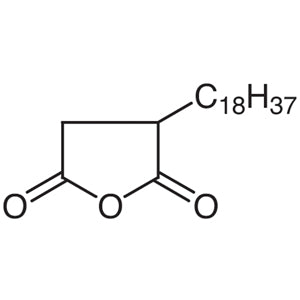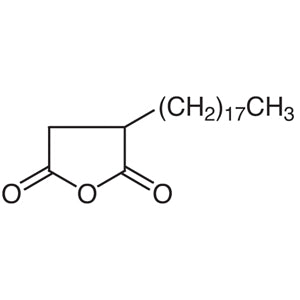
Octadecylsuccinic Anhydride from TCI (product code O0018) is a cyclic anhydride derived from succinic acid that carries a long eighteen-carbon alkyl chain. In the laboratory, it serves as a non-heterocyclic building block for introducing both a long hydrophobic group and a reactive carboxyl function into a target molecule. Alcohols, amines, and water all open its anhydride ring readily, so researchers can prepare esters, amides, or fatty-chain dicarboxylic acids in a single, fairly simple reaction step.
The main advantage of this compound is its dual character. The octadecyl chain gives it strong lipophilic properties, while the anhydride ring provides a reaction site that is selective towards nucleophiles. When the ring opens, it leaves one free carboxyl group that can be used for further coupling or to give a surface an ionisable charge. This combination is why the compound is chosen for surface modification, surfactant synthesis, and polymer research, where a single structure has to balance hydrophilic and hydrophobic segments.
In Indonesia, this material is relevant to organic chemistry laboratories at universities, materials research centres, and industrial research and development units that work with amphiphilic molecules. It suits student projects and thesis work on esterification and amidation, as well as studies of modified materials, emulsifiers, and functional polymers. Because the reagent comes from TCI, researchers get consistent material for repeated experiments and for comparing results between research groups.
Related TCI products
- TCI B1613 7538-42-3 2-Buten-1-ylsuccinic Anhydride
- TCI I0146 41375-88-6 Isooctadecylsuccinic Anhydride (mixture of branched chain isomers)
- TCI H0616 10500-34-2 2-Hexen-1-ylsuccinic Anhydride (cis- and trans- mixture)
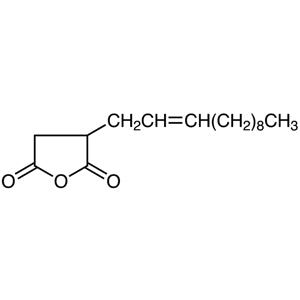
- TCI D0976 19780-11-1 2-Dodecen-1-ylsuccinic Anhydride (cis- and trans- mixture)
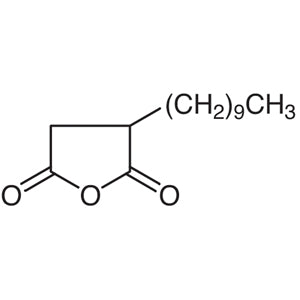
- TCI D0036 18470-76-3 Decylsuccinic Anhydride
- TCI D0977 2561-85-5 Dodecylsuccinic Anhydride
- Surface modification: the anhydride ring reacts with hydroxyl or amine groups on a substrate, attaching a long octadecyl chain that makes the treated surface noticeably more hydrophobic.
- Surfactant synthesis: when the ring opens it yields a molecule with a lipophilic C18 tail and a free carboxyl head group, which is the basic structure of an anionic amphiphile.
- Ester and amide preparation: alcohols and amines open the ring in a single step, so fatty-chain esters and amides can be made without complex activation reagents or multi-step routes.
- Polymer research: the compound can graft hydrophobic side chains onto polymers containing hydroxyl or amine groups, letting researchers tune the balance between hydrophilic and hydrophobic segments.
- Teaching and research on ring-opening reactions: it clearly shows how cyclic anhydrides react with nucleophiles, which makes it useful for practical organic chemistry teaching and for mechanism studies.
| Brand | TCI (product code O0018) |
|---|---|
| CAS number | 47458-32-2 |
| Molecular formula | — |
| Purity | — |
| Category | Chemistry > Building Blocks > Non-Heterocyclic Building Blocks |
| Pack sizes | as listed in the current TCI catalogue; please confirm the available size when enquiring |
| Physical form | see the TCI certificate of analysis for appearance details |
| Storage | keep the container tightly closed and away from moisture, because water opens the anhydride ring |
Store Octadecylsuccinic Anhydride in its original, tightly sealed TCI container in a cool, dry, well-ventilated place away from direct sunlight and heat. Moisture opens the anhydride ring and turns the compound into its dicarboxylic acid, so keep it away from humid air, and reseal the container promptly after each use. A desiccator or dry cabinet is a good choice for long-term storage. Store it separately from strong bases, strong oxidisers, alcohols, and amines unless you are using them in a planned reaction. Follow standard laboratory practice: wear safety glasses, chemical-resistant gloves, and a lab coat, and weigh and transfer the material in a fume hood or a well-ventilated area to avoid breathing in dust. Read the TCI safety data sheet before use, and dispose of waste according to your institution's chemical waste procedures.
—
Produk Terkait
-
2-Buten-1-ylsuccinicAnhydride TCI B1613
Regular price From Rp 2.439.150,00Regular price -
IsooctadecylsuccinicAnhydride(mixtureofbranchedchainisomers) TCI I0146
Regular price Rp 3.021.900,00Regular price -
2-Hexen-1-ylsuccinicAnhydride(cis-andtrans-mixture) TCI H0616
Regular price Rp 4.213.650,00Regular price -
2-Dodecen-1-ylsuccinicAnhydride(cis-andtrans-mixture) TCI D0976
Regular price From Rp 610.050,00Regular price -
DecylsuccinicAnhydride TCI D0036
Regular price Rp 3.551.100,00Regular price -
DodecylsuccinicAnhydride TCI D0977
Regular price Rp 3.683.400,00Regular price -
HexadecylsuccinicAnhydride TCI H0079
Regular price Rp 3.021.900,00Regular price -
ValericAnhydride TCI V0006
Regular price From Rp 875.700,00Regular price