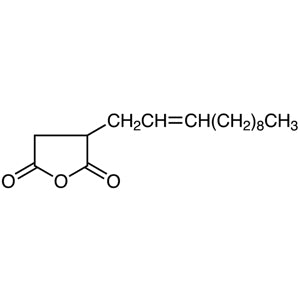
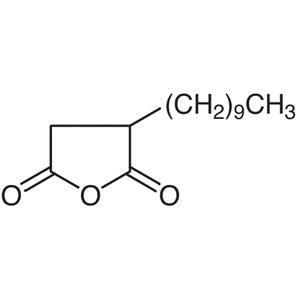
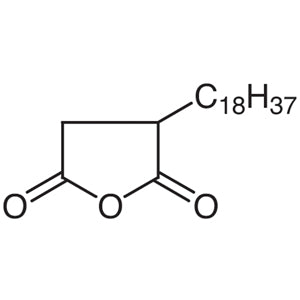
TCI H0079 Hexadecylsuccinic Anhydride is a succinic anhydride derivative carrying a saturated hexadecyl chain sixteen carbons long. The compound serves both as a hydrophobic grafting reagent and as a building block for assembling amphiphilic molecules. Its five-membered anhydride ring opens readily on contact with nucleophiles such as alcohols or amines, forming a stable covalent bond while releasing one free carboxylate group. Because of this, a single reaction step is enough to attach a long hydrophobic tail and at the same time provide a hydrophilic site on the modified molecule or surface.
Compared with its unsaturated analogue, this saturated version offers better chemical stability because it has no double bond vulnerable to oxidation or side reactions. Its straight alkyl chain is able to pack itself neatly, so modified products tend to give an ordered surface layer and consistent water-repellent properties. The material presents as a solid to waxy substance at room temperature, making it easy to weigh out without risk of spillage. Its good solubility in non-polar organic solvents also simplifies running the reaction in such systems.
In Indonesian laboratories the product is typically handled within synthetic chemistry and materials groups that prepare amphiphilic structures, surface modifiers and hydrophobic conjugates. It is catalogued under Chemistry > Building Blocks > Non-Heterocyclic Building Blocks, which places it alongside other reagents used to introduce defined functional fragments. Academic research units, industrial development laboratories and formulation groups all draw on this type of reagent when a long alkyl tail must be attached in one controlled step.
Related TCI products
- TCI B1613 7538-42-3 2-Buten-1-ylsuccinic Anhydride
- TCI H0616 10500-34-2 2-Hexen-1-ylsuccinic Anhydride (cis- and trans- mixture)
- TCI D0976 19780-11-1 2-Dodecen-1-ylsuccinic Anhydride (cis- and trans- mixture)
- TCI D0036 18470-76-3 Decylsuccinic Anhydride
- TCI D0977 2561-85-5 Dodecylsuccinic Anhydride
- TCI O0018 47458-32-2 Octadecylsuccinic Anhydride
- Amphiphilic molecule synthesis — the reagent supplies a long hydrophobic tail and a free carboxylate in one ring-opening step, giving the two opposing regions an amphiphile requires.
- Hydrophobic surface modification — nucleophilic sites on a substrate open the anhydride ring, and the neatly packing straight alkyl chains build an ordered, consistently water-repellent layer.
- Covalent grafting onto amine-bearing compounds — amines open the five-membered ring to form a stable covalent bond, anchoring the hexadecyl fragment without additional coupling reagents.
- Esterification of alcohol-functionalised materials — alcohols react with the anhydride to give a stable linkage while liberating one carboxylate group as a new hydrophilic handle.
- Non-heterocyclic building block chemistry — as a catalogued building block it introduces a defined sixteen-carbon fragment into larger target structures during multi-step synthetic work.
| Brand | TCI |
|---|---|
| CAS number | 4200-91-3 |
| Molecular formula | — |
| Purity | — |
| Category | Chemistry > Building Blocks > Non-Heterocyclic Building Blocks |
| Pack sizes | available in the standard TCI catalogue pack sizes; please confirm the packaging option when ordering |
| Physical form | solid to waxy material at room temperature |
| Storage | keep in a tightly closed container, protected from moisture |
Store the anhydride in a tightly closed container in a cool, dry place, since anhydride rings react with moisture and atmospheric humidity can gradually degrade the reagent. Glass bottles with well-sealing caps are suitable, and the original container should be resealed immediately after each withdrawal. Weigh the solid or waxy material using clean, dry spatulas and dry glassware to avoid introducing water into the stock. Handle the compound in a fume hood or a well-ventilated area, and wear a laboratory coat, safety goggles and chemical-resistant gloves. Keep the reagent away from nucleophilic chemicals, including alcohols and amines, until they are deliberately combined in a reaction. Label all containers clearly and follow institutional procedures for chemical waste disposal.
—
Produk Terkait
-
2-Buten-1-ylsuccinicAnhydride TCI B1613
Regular price From Rp 2.491.650,00Regular priceRp 1.757.700,00Sale price From Rp 2.491.650,00 -
2-Hexen-1-ylsuccinicAnhydride(cis-andtrans-mixture) TCI H0616
Regular price Rp 4.266.150,00Regular priceRp 2.998.800,00Sale price Rp 4.266.150,00 -
2-Dodecen-1-ylsuccinicAnhydride(cis-andtrans-mixture) TCI D0976
Regular price From Rp 662.550,00Regular priceRp 478.800,00Sale price From Rp 662.550,00 -
DecylsuccinicAnhydride TCI D0036
Regular price Rp 3.603.600,00Regular priceRp 2.535.750,00Sale price Rp 3.603.600,00 -
DodecylsuccinicAnhydride TCI D0977
Regular price Rp 3.735.900,00Regular priceRp 2.628.150,00Sale price Rp 3.735.900,00 -
OctadecylsuccinicAnhydride TCI O0018
Regular price From Rp 2.994.600,00Regular priceRp 2.109.450,00Sale price From Rp 2.994.600,00 -
IsooctadecylsuccinicAnhydride(mixtureofbranchedchainisomers) TCI I0146
Regular price Rp 3.074.400,00Regular priceRp 2.165.100,00Sale price Rp 3.074.400,00