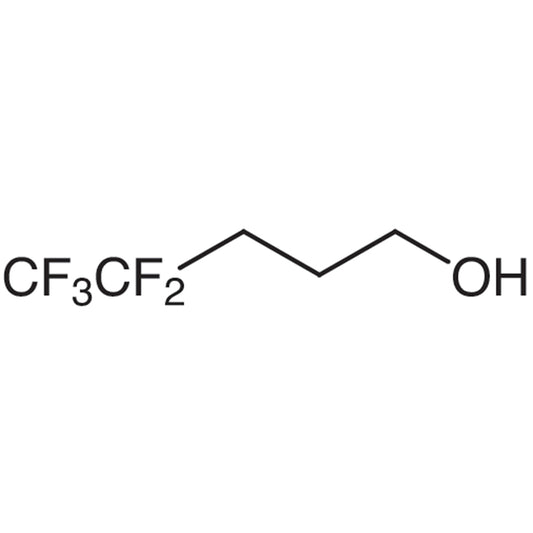
2,2,3,3,4,4,5,5-Octafluoro-1-pentanol from TCI is a fluorinated alcohol with a five-carbon chain. Four of its carbon atoms carry fluorine atoms, and the chain ends in a primary hydroxyl group. It is an important fluorinated building block for adding perfluoroalkyl segments to organic molecules and polymers. In the laboratory it is used to synthesize fluorinated esters, ethers and monomers. It also works as a specialty solvent that can dissolve compounds that do not dissolve well in ordinary organic solvents.
Its main character comes from the fluorocarbon segment. This segment is very stable and lowers surface energy, so materials made from it tend to repel both water and oils. The primary hydroxyl group stays reactive for esterification, etherification and urethane formation, which lets researchers graft the fluorinated chain onto many different molecular frameworks. The fluorine atoms also make the OH group more acidic than in ordinary alcohols, which changes how it forms hydrogen bonds. This mix of chemical resistance, oxidative stability and controlled reactivity is why it is popular in materials research.
In Indonesia, octafluoro-1-pentanol is mainly used in university research groups, polymer and materials science laboratories, and industrial R&D units that work on fluorinated compounds. Synthetic chemists use it to prepare fluorinated intermediates and monomers. Materials researchers use it to change the surface properties of coatings and polymer films. AMI Scientific supplies this TCI building block to Indonesian laboratories that need a well-characterized fluorinated alcohol for synthesis, formulation studies and specialty solvent work.
TCI brochures (PDF)
- Fluorous Chemistry 2025-01-21 · p. 5
- Building Blocks for Organic Semiconductor 2026-03-24 · p. 44
- Fluorination Reagents, Fluorinated Building Blocks 2026-03-18 · p. 54
Related TCI products
- TCI D2329 375-50-8 Octafluoro-1,4-diiodobutane (stabilized with Copper chip)
- TCI D3590 3107-98-0 Dimethyl Octafluoroadipate
- TCI D3573 335-48-8 1,4-Dibromooctafluorobutane
- TCI D2330 2200-71-7 4,4'-Dimethoxyoctafluorobiphenyl
- TCI P1342 148043-73-6 4,4,5,5,5-Pentafluoro-1-pentanol
- TCI N0810 355-28-2 1H,1H-Nonafluoro-1-pentanol
- Synthesis of fluorinated esters: the reactive primary hydroxyl group allows straightforward esterification, so the stable perfluoroalkyl segment can be attached to many different carboxylic acid frameworks.
- Preparation of fluorinated ethers: its primary alcohol takes part in etherification reactions, giving researchers a practical way to build fluorinated ether structures for further synthetic or materials studies.
- Fluorinated monomer development: grafting the fluorocarbon chain onto polymerizable units produces monomers whose polymers show the low surface energy and repellency typical of fluorinated materials.
- Urethane formation and surface modification: the hydroxyl group reacts to form urethane linkages, so fluorinated segments can be built into polymer backbones or coatings for hydrophobic and oleophobic surfaces.
- Specialty solvent use: its fluorinated character helps it dissolve compounds that dissolve poorly in ordinary organic solvents, which supports difficult reactions, dissolution tests and sample preparation work.
| Brand | TCI (product code O0114) |
|---|---|
| CAS number | 355-80-6 |
| Molecular formula | — |
| Purity | — |
| Category | Chemistry > Building Blocks > Fluorinated Building Blocks |
| Pack sizes | available in the pack sizes listed in the TCI catalog; please confirm current options with AMI Scientific |
| Physical form | liquid fluorinated alcohol |
| Storage | keep tightly closed in a cool, dry, well-ventilated place, following the TCI Safety Data Sheet |
Store 2,2,3,3,4,4,5,5-Octafluoro-1-pentanol in its original, tightly sealed container in a cool, dry and well-ventilated area. Keep it away from heat sources, open flames and incompatible materials such as strong oxidizing agents and reactive bases. Chemically resistant glass or fluoropolymer containers are suitable for transferring and storing portions. Handle it in a fume hood and wear nitrile gloves, safety goggles and a lab coat. Avoid breathing vapors and avoid contact with skin and eyes. Always read the TCI Safety Data Sheet before use, and dispose of waste as halogenated organic waste under local regulations.
—
Produk Terkait
-
Octafluoro-1,4-diiodobutane(stabilizedwithCopperchip) TCI D2329
Regular price From Rp 2.518.950,00Regular price -
DimethylOctafluoroadipate TCI D3590
Regular price From Rp 955.500,00Regular price -
1,4-Dibromooctafluorobutane TCI D3573
Regular price Rp 2.147.250,00Regular price -
4,4'-Dimethoxyoctafluorobiphenyl TCI D2330
Regular price From Rp 928.200,00Regular price -
4,4,5,5,5-Pentafluoro-1-pentanol TCI P1342
Regular price From Rp 1.856.400,00Regular price -
1H,1H-Nonafluoro-1-pentanol TCI N0810
Regular price From Rp 1.035.300,00Regular price -
1H,1H-Undecafluoro-1-hexanol TCI U0074
Regular price Rp 3.207.750,00Regular price -
TridecafluorohexylBromide TCI T2479
Regular price From Rp 1.458.450,00Regular price