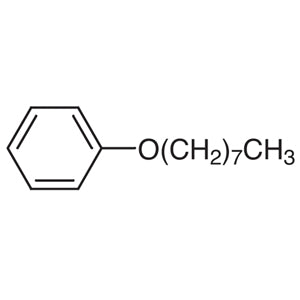
n-Octyl Phenyl Ether (TCI O0224) is a chemical compound widely used in laboratory settings for various organic synthesis reactions. It serves as a versatile building block in the development of complex molecular structures, making it an essential component in chemical research. This compound is particularly valuable for its ability to participate in reactions that require stable and controllable reactivity. Its presence in the laboratory supports the creation of surfactants, solvents, and active pharmaceutical ingredients, contributing to the advancement of chemical experimentation.
The compound’s non-polar nature and excellent solvency for non-polar substances make it a preferred choice for many laboratory applications. Its stability under normal laboratory conditions ensures consistent performance across different experiments. Additionally, its relatively low toxicity and availability in liquid form enhance its usability and safety in a laboratory environment. These properties collectively make n-Octyl Phenyl Ether a reliable and efficient material for chemical synthesis and analysis.
In Indonesian laboratories, n-Octyl Phenyl Ether is commonly used in research and development activities, especially in the fields of organic chemistry and pharmaceutical sciences. Its role in the synthesis of complex molecules aligns with the needs of academic and industrial research institutions in Indonesia. The compound’s ease of handling and storage further supports its integration into routine laboratory workflows, ensuring its continued relevance in chemical experimentation.
Related TCI products
- Organic synthesis reactions benefit from n-Octyl Phenyl Ether due to its stable chemical properties and ability to participate in controlled reactions.
- It is widely used in the preparation of surfactants, as its non-polar nature allows it to act as an effective surface-active agent.
- The compound is suitable for creating solvents that can dissolve non-polar substances, making it ideal for extraction and purification processes.
- In pharmaceutical research, it serves as a building block for the synthesis of active pharmaceutical ingredients, supporting drug development efforts.
- Its use in chemical separation techniques is common because of its solvency properties, aiding in the isolation of target compounds from complex mixtures.
| Brand | TCI |
|---|---|
| CAS number | 1818-07-1 |
| Molecular formula | — |
| Purity | — |
| Category | Chemistry > Building Blocks > Non-Heterocyclic Building Blocks |
| Pack sizes | Available in various sizes as per supplier specifications |
| Physical form | Liquid |
| Storage | Store in a cool, dry place away from direct sunlight |
n-Octyl Phenyl Ether should be stored in a cool, dry place, away from direct sunlight and sources of heat. It is recommended to use sealed containers made of materials that are compatible with organic solvents to prevent evaporation and contamination. Due to its non-polar nature, it is important to ensure proper ventilation in the laboratory to avoid inhalation of vapors. The compound is relatively stable under normal laboratory conditions, but it should be handled with care to prevent accidental spills or exposure. Regular inspection of storage containers is advised to maintain the integrity of the material and ensure safe laboratory practices.
—
Produk Terkait
-
n-Octyl4-Hydroxybenzoate TCI O0443
Regular price Rp 1.724.100,00Regular price -
2,2-Di-n-octyl-1,3-propanediol TCI D2842
Regular price From Rp 3.525.900,00Regular price -
2-Nitrophenyln-OctylEther[MatrixforFABMSandliquidSIMS] TCI S0380
Regular price From Rp 505.050,00Regular price -
AmylEther TCI A0451
Regular price From Rp 1.749.300,00Regular price -
AllylPhenylEther TCI A0234
Regular price From Rp 1.140.300,00Regular price -
AllylGlycidylEther TCI A0221
Regular price From Rp 477.750,00Regular price -
VanillylButylEther TCI V0161
Regular price From Rp 875.700,00Regular price -
o-Tolyl3,5-XylylEther TCI T2213
Regular price From Rp 3.683.400,00Regular price
![37682-29-4 2-Nitrophenyl n-Octyl Ether [Matrix for FABMS and liquid SIMS] - AMI Scientific](http://amiscientific.com/cdn/shop/files/TCI2510S0380.jpg?v=1769143466&width=533)