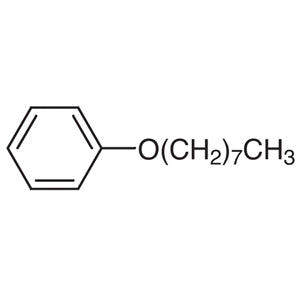
2-Nitrophenyl n-Octyl Ether is a chemical compound widely used as a matrix in mass spectrometry techniques, particularly in matrix-assisted laser desorption/ionization (MALDI) and liquid secondary ion mass spectrometry (SIMS). It serves as a medium that facilitates the ionization of target molecules without causing structural damage, making it essential for accurate and consistent data acquisition in analytical laboratories. This compound is especially valuable for analyzing complex and fragile molecules that are difficult to ionize using conventional methods. Its role in enhancing the efficiency and reliability of mass spectrometry processes has made it a standard reagent in advanced chemical analysis.
The compound is preferred due to its chemical stability and ability to form complexes with target molecules, which simplifies the ionization process. Its unique molecular structure allows it to reduce non-specific ionization effects, thereby improving the resolution and accuracy of mass spectrometry data. These properties make it an ideal choice for applications requiring high sensitivity and specificity. Additionally, its compatibility with various analytical techniques ensures consistent performance across different experimental setups, making it a reliable tool for researchers.
In Indonesian laboratories, 2-Nitrophenyl n-Octyl Ether is commonly used in analytical research, especially in organic chemistry, pharmacology, and environmental studies. Its application in mass spectrometry enables scientists to study complex samples with greater precision. The compound's effectiveness in reducing ionization interference and enhancing data quality makes it a preferred reagent for advanced analytical work in both academic and industrial settings.
Related TCI products
- TCI S0378 619-25-0 3-Nitrobenzyl Alcohol [Matrix for FABMS and liquid SIMS]
- TCI S0376 111-42-2 Diethanolamine [Matrix for FABMS and liquid SIMS]
- TCI S0373 56-81-5 Glycerol [Matrix for FABMS and liquid SIMS]
- TCI H1622 1634-82-8 4'-Hydroxyazobenzene-2-carboxylic Acid [Matrix for MALDI-TOF/MS]
- TCI D2933 490-79-9 2,5-Dihydroxybenzoic Acid [Matrix for MALDI-TOF/MS]
- TCI D2932 530-59-6 3,5-Dimethoxy-4-hydroxycinnamic Acid [Matrix for MALDI-TOF/MS]
- Matrix-assisted laser desorption/ionization (MALDI) for high-resolution molecular analysis due to its ability to facilitate ionization without damaging molecular structure.
- Liquid secondary ion mass spectrometry (SIMS) for surface analysis, as it enhances ionization efficiency and reduces background noise in complex samples.
- Organic chemistry research for analyzing compounds that are difficult to ionize directly, providing accurate and reproducible mass spectrometry data.
- Environmental analysis for detecting trace organic pollutants in soil and water samples, offering reliable ionization and minimal interference.
- Pharmaceutical research for characterizing drug molecules and metabolites, ensuring precise identification and quantification in complex biological matrices.
| Brand | TCI |
|---|---|
| CAS number | 37682-29-4 |
| Molecular formula | — |
| Purity | — |
| Category | Analytical Chemistry > Analytical Reagents > Mass Spectrometry (MS) Reagents |
| Pack sizes | Available in various quantities as per standard reagent packaging |
| Physical form | Liquid |
| Storage | Store in a cool, dry place away from direct sunlight |
This compound should be stored in a cool, dry environment, away from direct sunlight and sources of heat. It is recommended to use airtight containers to prevent moisture absorption and contamination. Due to its chemical nature, it should be handled with care, using appropriate personal protective equipment such as gloves and safety goggles. Avoid exposure to incompatible substances, and ensure proper ventilation in the workspace. The material is not classified as hazardous under standard handling conditions, but standard laboratory safety protocols should be followed to ensure safe usage and storage.
—
Produk Terkait
-
3-NitrobenzylAlcohol[MatrixforFABMSandliquidSIMS] TCI S0378
Regular price From Rp 557.550,00Regular priceRp 389.550,00Sale price From Rp 557.550,00 -
Diethanolamine[MatrixforFABMSandliquidSIMS] TCI S0376
Regular price From Rp 505.050,00Regular priceRp 352.800,00Sale price From Rp 505.050,00 -
Glycerol[MatrixforFABMSandliquidSIMS] TCI S0373
Regular price From Rp 557.550,00Regular priceRp 389.550,00Sale price From Rp 557.550,00 -
4'-Hydroxyazobenzene-2-carboxylicAcid[MatrixforMALDI-TOF/MS] TCI H1622
Regular price Rp 1.724.100,00Regular priceRp 1.205.400,00Sale price Rp 1.724.100,00 -
2,5-DihydroxybenzoicAcid[MatrixforMALDI-TOF/MS] TCI D2933
Regular price From Rp 1.008.000,00Regular priceRp 720.300,00Sale price From Rp 1.008.000,00 -
3,5-Dimethoxy-4-hydroxycinnamicAcid[MatrixforMALDI-TOF/MS] TCI D2932
Regular price Rp 2.650.200,00Regular priceRp 1.869.000,00Sale price Rp 2.650.200,00 -
trans-CinnamicAcid[MatrixforMALDI-TOF/MS] TCI C3412
Regular price Rp 1.351.350,00Regular priceRp 960.750,00Sale price Rp 1.351.350,00 -
n-OctylPhenylEther TCI O0224
Regular price From Rp 3.367.350,00Regular priceRp 2.354.100,00Sale price From Rp 3.367.350,00