

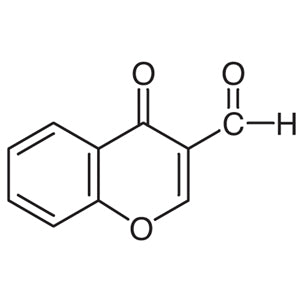
Chromone-3-carboxaldehyde is a chemical compound classified under the heterocyclic category, commonly used as a building block in the synthesis of complex molecules. It serves as a fundamental component in organic chemistry, particularly in the development of bioactive compounds and pharmaceuticals. Its core structure, chromone, forms the basis of many naturally occurring substances such as flavonoids and antioxidants. In laboratory settings, it plays a crucial role in constructing molecular frameworks, especially in research focused on drug discovery and synthetic chemistry.
This compound is valued for its chemical stability and moderate reactivity, making it suitable for various reactions such as aldol condensation, substitution, and other organic transformations. Its specific molecular structure allows it to act as a versatile linker between different functional groups, enhancing its utility in synthetic pathways. The availability of high-purity solid form ensures consistent results and reliability in experimental processes, making it a preferred choice for researchers.
In Indonesian laboratories, Chromone-3-carboxaldehyde is widely used in organic chemistry research, particularly in the study of bioactive compounds and the synthesis of pharmacological agents. It is commonly found in academic and research institutions where scientists are working on drug development and molecular structure analysis. Its role in advancing chemical research is significant, supporting both fundamental and applied studies in the field.
- Organic synthesis applications benefit from its role as a versatile building block for constructing complex molecular structures.
- Pharmaceutical research utilizes it in the development of bioactive compounds and drug candidates due to its structural versatility.
- Antioxidant compound synthesis relies on its ability to participate in reactions that form stable, functional molecular frameworks.
- Academic research in chemistry uses it for teaching and experimental purposes, emphasizing its importance in synthetic methodologies.
- Bioactive molecule development leverages its structural properties to create compounds with potential therapeutic applications.
| Brand | TCI |
|---|---|
| CAS number | 17422-74-1 |
| Molecular formula | — |
| Purity | — |
| Category | Chemistry > Building Blocks > Heterocyclic Building Blocks |
| Pack sizes | — |
| Physical form | Solid |
| Storage | Store in a cool, dry place away from light and moisture |
Chromone-3-carboxaldehyde should be stored in a cool, dry environment, away from direct light and moisture to maintain its chemical stability. It is recommended to use airtight containers to prevent exposure to air and potential degradation. As a solid, it is typically handled in a well-ventilated laboratory setting to ensure safe working conditions. General laboratory precautions include wearing appropriate personal protective equipment, such as gloves and safety goggles, when handling the compound. It is important to avoid contact with skin and eyes, and to follow standard chemical safety protocols during storage and use. Proper labeling of containers is essential to ensure safe handling and prevent accidental exposure.
—
Produk Terkait
-
Chromone-2-carboxylicAcid TCI O0290
Regular price Rp 1.961.400,00Regular priceRp 1.387.050,00Sale price Rp 1.961.400,00 -
Chromone TCI C4072
Regular price Rp 1.749.300,00Regular priceRp 1.239.000,00Sale price Rp 1.749.300,00 -
Chromone-3-carbonitrile TCI C3075
Regular price Rp 1.538.250,00Regular priceRp 1.090.950,00Sale price Rp 1.538.250,00 -
Chromone-3-carboxylicAcid TCI C2367
Regular price Rp 1.220.100,00Regular priceRp 868.350,00Sale price Rp 1.220.100,00 -
Indole-6-carboxaldehyde TCI I0743
Regular price Rp 2.411.850,00Regular priceRp 1.702.050,00Sale price Rp 2.411.850,00 -
Imidazole-2-carboxaldehyde TCI I0809
Regular price Rp 822.150,00Regular priceRp 590.100,00Sale price Rp 822.150,00 -
Indole-2-carboxaldehyde TCI I0852
Regular price Rp 4.001.550,00Regular priceRp 2.814.000,00Sale price Rp 4.001.550,00 -
Tetrahydro-2H-pyran-4-carboxaldehyde TCI T4039
Regular price Rp 2.518.950,00Regular priceRp 1.776.600,00Sale price Rp 2.518.950,00


