

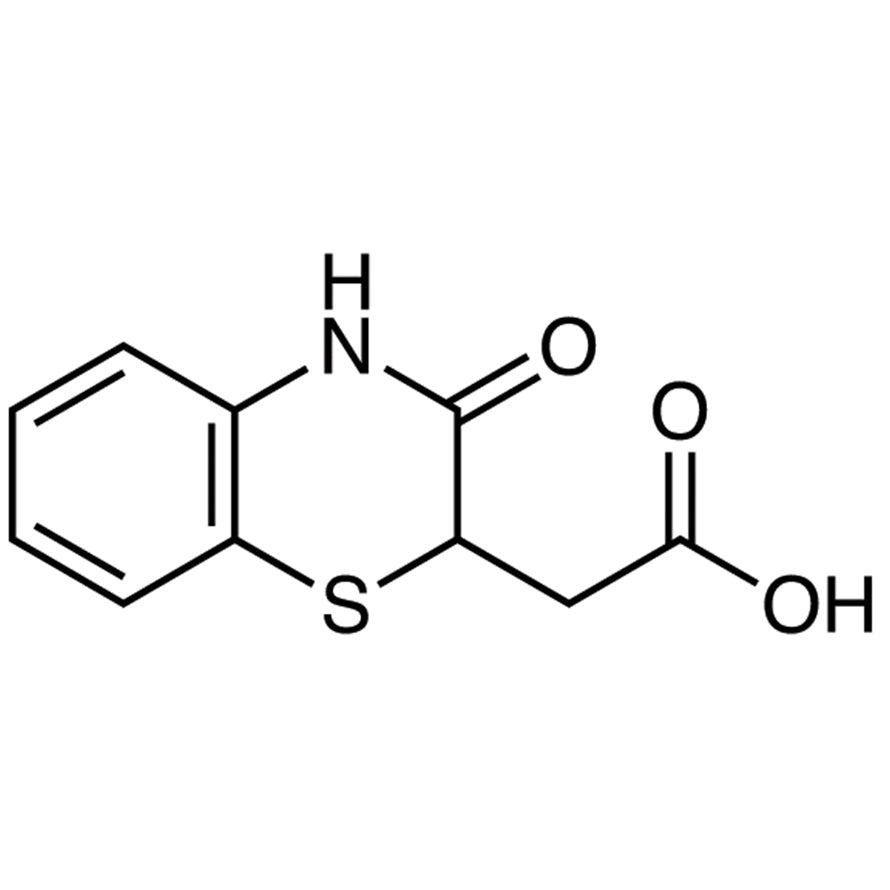
3-Oxo-3,4-dihydro-2H-1,4-benzothiazine-2-acetic Acid is a chemical compound widely used in life sciences research. It belongs to the category of bioactive small molecules, which are essential for studying biological mechanisms and cellular processes. This compound plays a crucial role in various laboratory applications, particularly in cell biology, where it helps researchers investigate the effects of specific molecules on cellular signaling pathways and enzyme activity. Its unique chemical structure allows it to interact with multiple biological targets, making it a valuable tool in biochemical and pharmacological studies.
The compound’s stability and solubility in organic solvents make it a preferred choice for laboratory use. Its ability to bind to target proteins enhances its utility in developing protein modulators and inhibitors. These properties contribute to its effectiveness in both basic and applied research, enabling scientists to explore molecular interactions with precision. The compound’s versatility and specificity ensure that it remains a reliable reagent for a wide range of experimental setups, supporting both academic and industrial research efforts.
In Indonesian laboratories, this compound is commonly used in cell biology and pharmacology research. Its application in studying biological pathways and enzyme activity makes it a key component in experimental protocols. Researchers in Indonesia rely on this compound for its consistent performance and reliability, ensuring accurate and reproducible results in their studies. Its widespread use underscores its importance in advancing scientific understanding in the region.
Related TCI products
- TCI D4242 55453-87-7 6,11-Dihydro-11-oxodibenzo[b,e]oxepin-2-acetic Acid
- TCI B4554 5325-20-2 2H-1,4-Benzothiazin-3(4H)-one
- TCI M1661 30322-02-2 7-Methyl-1,4-benzothiazin-3-one
- TCI T2941 652-37-9 Theophylline-7-acetic Acid
- TCI I0863 1798-06-7 2-(4-Iodophenyl)acetic Acid
- TCI T4102 20924-05-4 Thymine-1-acetic Acid
- Cell signaling pathway analysis due to its ability to modulate enzyme activity and interact with biological targets.
- Pharmacological research for developing protein modulators and enzyme inhibitors in drug discovery.
- Biochemical studies focusing on molecular interactions and target-specific binding properties.
- Enzyme activity assays to evaluate the compound's influence on specific biochemical reactions.
- Molecular biology experiments requiring precise and stable chemical reagents for reproducible results.
| Brand | TCI |
|---|---|
| CAS number | 6270-74-2 |
| Molecular formula | — |
| Purity | — |
| Category | Life Science > Cell Biology > Bioactive Small Molecules |
| Pack sizes | Available in various quantities as per standard laboratory supply |
| Physical form | Solid, crystalline or powder, depending on formulation |
| Storage | Store in a cool, dry place away from light and moisture |
This compound should be stored in a cool, dry environment, away from direct light and moisture to maintain its stability and effectiveness. It is recommended to use airtight containers to prevent exposure to air and contaminants. Due to its chemical nature, it should be handled with appropriate personal protective equipment, such as gloves and safety goggles, to ensure laboratory safety. Proper ventilation is also essential when working with this compound to minimize inhalation risks. Regular inspection of storage conditions is advised to ensure the compound remains in optimal condition for use in research applications.
—
Produk Terkait
-
6,11-Dihydro-11-oxodibenzo[b,e]oxepin-2-aceticAcid TCI D4242
Regular price From Rp 795.900,00Regular price -
2H-1,4-Benzothiazin-3(4H)-one TCI B4554
Regular price From Rp 584.850,00Regular price -
7-Methyl-1,4-benzothiazin-3-one TCI M1661
Regular price From Rp 452.550,00Regular price -
Theophylline-7-aceticAcid TCI T2941
Regular price Rp 1.035.300,00Regular price -
2-(4-Iodophenyl)aceticAcid TCI I0863
Regular price From Rp 1.220.100,00Regular price -
Thymine-1-aceticAcid TCI T4102
Regular price From Rp 3.790.500,00Regular price -
2-[4-(4,4,5,5-Tetramethyl-1,3,2-dioxaborolan-2-yl)phenyl]aceticAcid TCI T3754
Regular price From Rp 1.298.850,00Regular price -
1H-Tetrazole-5-aceticAcid TCI T2737
Regular price From Rp 5.619.600,00Regular price
![6,11-Dihydro-11-oxodibenzo[b,e]oxepin-2-acetic Acid (CAS 55453-87-7) - TCI D4242 - AMI Scientific](http://amiscientific.com/cdn/shop/files/TCI2510D4242.jpg?v=1768205037&width=533)


![797755-07-8 2-[4-(4,4,5,5-Tetramethyl-1,3,2-dioxaborolan-2-yl)phenyl]acetic Acid - AMI Scientific](http://amiscientific.com/cdn/shop/files/TCI2510T3754.jpg?v=1768206624&width=533)
