

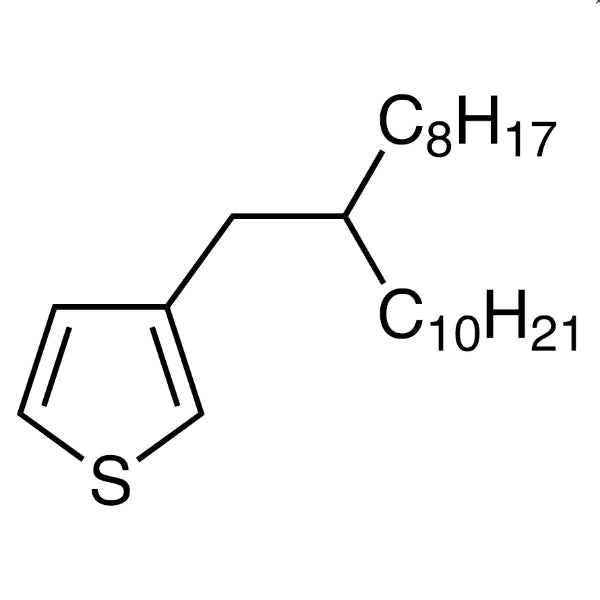
3-(2-Octyldodecyl)thiophene is a chemical compound widely used in material science research, particularly in the development of advanced polymers and macromolecules. This compound plays a crucial role in laboratories where researchers are focused on creating new materials with enhanced electronic and optical properties. Its unique molecular structure allows it to interact effectively with various other substances, making it a versatile building block for semiconductor applications. It is commonly used in the synthesis of organic films, conductive materials, and electronic structures, supporting innovation in modern material technologies.
The compound is preferred due to its stable chemical properties and thermal resistance, which are essential for maintaining performance under extreme conditions. Its molecular complexity enables it to be integrated into a wide range of material designs, offering flexibility in the development of conductive and responsive materials. The compound’s ability to maintain structural integrity and functionality in different environments makes it a reliable choice for high-performance material research. Additionally, its compatibility with various synthesis methods ensures its widespread use in both academic and industrial settings.
In Indonesian laboratories, 3-(2-Octyldodecyl)thiophene is a key component in scientific research, especially in the field of material technology. It is frequently used in studies aimed at improving the efficiency and stability of electronic materials. Its presence in research projects highlights its importance in advancing Indonesia’s capabilities in material science and technological innovation.
TCI brochures (PDF)
- Building Blocks for Organic Semiconductor 2026-03-24 · p. 38
Related TCI products
- TCI B6166 1268060-77-0 2-Bromo-3-(2-octyldodecyl)thiophene
- TCI B4488 1320201-22-6 2,6-Bis(trimethylstannyl)-4,8-bis[(2-n-octyldodecyl)oxy]benzo[1,2-b:4,5-b']dithiophene
- TCI B4536 469912-82-1 2,5-Bis(trimethylstannyl)thieno[3,2-b]thiophene
- TCI D4274 83834-10-0 3,7-Dibromodibenzo[b,d]thiophene
- TCI D4033 53255-78-0 3,4-Dibromothieno[2,3-b]thiophene
- TCI D4032 25121-86-2 2,5-Dibromothieno[2,3-b]thiophene
- Organic Film Synthesis: This compound is ideal for creating thin, conductive organic films used in flexible electronics and optoelectronic devices.
- Conductive Material Development: Its molecular structure supports the creation of materials with enhanced electrical conductivity, suitable for advanced electronic applications.
- Semiconductor Building Blocks: It serves as a foundational element in the development of semiconductor materials, enabling the design of high-performance electronic components.
- Electronic Structure Fabrication: The compound is used in the construction of electronic structures, contributing to the development of next-generation electronic devices.
- Material Stability Testing: Its thermal and chemical stability make it suitable for testing the durability of materials under extreme conditions.
| Brand | TCI |
|---|---|
| CAS number | 1268060-76-9 |
| Molecular formula | — |
| Purity | — |
| Category | Materials Science > Material Building Blocks > Polymer/Macromolecule Semiconductor Building Blocks |
| Pack sizes | — |
| Physical form | — |
| Storage | Store in a cool, dry place away from light |
This compound should be stored in a cool, dry environment, away from direct sunlight and sources of heat. It is recommended to keep it in a tightly sealed container to prevent exposure to moisture and air. Due to its chemical nature, it should be handled with appropriate personal protective equipment, such as gloves and safety goggles, to ensure laboratory safety. Proper ventilation is essential when working with this material to minimize inhalation risks. It is important to avoid contact with incompatible substances and to follow standard laboratory safety protocols. The compound should not be disposed of in the environment and should be handled in accordance with local regulations for chemical waste.
—
Produk Terkait
-
2-Bromo-3-(2-octyldodecyl)thiophene TCI B6166
Regular price Rp 5.194.350,00Regular priceRp 3.647.700,00Sale price Rp 5.194.350,00 -
2,6-Bis(trimethylstannyl)-4,8-bis[(2-n-octyldodecyl)oxy]benzo[1,2-b:4,5-b']dithiophene TCI B4488
Regular price Rp 4.743.900,00Regular priceRp 3.332.700,00Sale price Rp 4.743.900,00 -
2,5-Bis(trimethylstannyl)thieno[3,2-b]thiophene TCI B4536
Regular price Rp 3.207.750,00Regular priceRp 2.258.550,00Sale price Rp 3.207.750,00 -
3,7-Dibromodibenzo[b,d]thiophene TCI D4274
Regular price Rp 7.075.950,00Regular priceRp 4.963.350,00Sale price Rp 7.075.950,00 -
3,4-Dibromothieno[2,3-b]thiophene TCI D4033
Regular price Rp 10.997.700,00Regular priceRp 7.705.950,00Sale price Rp 10.997.700,00 -
2,5-Dibromothieno[2,3-b]thiophene TCI D4032
Regular price Rp 8.690.850,00Regular priceRp 6.093.150,00Sale price Rp 8.690.850,00 -
3,5-Dibromodithieno[3,2-b:2',3'-d]thiophene TCI D3800
Regular price Rp 3.763.200,00Regular priceRp 2.647.050,00Sale price Rp 3.763.200,00 -
2,6-Dibromodithieno[3,2-b:2',3'-d]thiophene TCI D3799
Regular price Rp 2.623.950,00Regular priceRp 1.850.100,00Sale price Rp 2.623.950,00

![1320201-22-6 2,6-Bis(trimethylstannyl)-4,8-bis[(2-n-octyldodecyl)oxy]benzo[1,2-b:4,5-b']dithiophene - AMI Scientific](http://amiscientific.com/cdn/shop/files/TCI2510B4488.jpg?v=1768815625&width=533)
![469912-82-1 2,5-Bis(trimethylstannyl)thieno[3,2-b]thiophene - AMI Scientific](http://amiscientific.com/cdn/shop/files/TCI2510B4536.jpg?v=1768815633&width=533)
![3,7-Dibromodibenzo[b,d]thiophene (CAS 83834-10-0) - TCI D4274 - AMI Scientific](http://amiscientific.com/cdn/shop/files/TCI2510D4274.jpg?v=1768818058&width=533)
![3,4-Dibromothieno[2,3-b]thiophene (CAS 53255-78-0) - TCI D4033 - AMI Scientific](http://amiscientific.com/cdn/shop/files/TCI2510D4033.jpg?v=1768818002&width=533)
![2,5-Dibromothieno[2,3-b]thiophene (CAS 25121-86-2) - TCI D4032 - AMI Scientific](http://amiscientific.com/cdn/shop/files/TCI2510D4032.jpg?v=1769180636&width=533)
![3,5-Dibromodithieno[3,2-b:2',3'-d]thiophene (CAS 502764-54-7) - TCI D3800 - AMI Scientific](http://amiscientific.com/cdn/shop/files/TCI2510D3800.jpg?v=1768817954&width=533)
![TCI D3799 67061-69-2 2,6-Dibromodithieno[3,2-b:2',3'-d]thiophene — struktur kimia](http://amiscientific.com/cdn/shop/files/TCI2510D3799-struktur.jpg?v=1791525006&width=533)