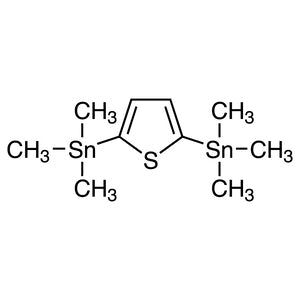
2,5-Bis(trimethylstannyl)thieno[3,2-b]thiophene is an organic compound widely used in scientific research, particularly in the development of semiconductors and polymer materials. This compound belongs to the thiophene family and possesses a complex molecular structure with unique electronic properties. Its role in the laboratory is critical for the synthesis of materials with tailored conductive or optical characteristics. Due to its structural complexity and reactivity, it is a valuable tool for researchers aiming to create advanced functional materials.
The compound's high reactivity, attributed to its trimethylstannyl groups, makes it ideal for chemical modifications that can lead to a wide range of applications. Its ability to form stable molecular structures and interact with metal atoms further enhances its utility in material synthesis. These properties contribute to its popularity among scientists working on cutting-edge research in materials science. The compound's versatility and chemical stability make it a preferred choice for experiments requiring precise control over material properties.
In Indonesian laboratories, this compound is commonly used in applied research projects focused on organic semiconductors, chemical sensors, and electrolytic materials. Researchers from educational institutions and research organizations rely on it for experiments that demand materials with specific electronic properties. Its role in advancing material science applications is well recognized in the scientific community.
TCI brochures (PDF)
- Thiophenes 2026-06-29 · p. 13
- Building Blocks for Organic Semiconductor 2026-03-24 · p. 37
Related TCI products
- TCI B6395 86134-26-1 2,5-Bis(trimethylstannyl)thiophene
- TCI B5490 1160823-78-8 4,8-Bis[(2-ethylhexyl)oxy]-2,6-bis(trimethylstannyl)benzo[1,2-b:4,5-b']dithiophene
- TCI B5377 477789-30-3 trans-1,2-Bis[5-(trimethylstannyl)thiophen-2-yl]ethene
- TCI B4854 143367-56-0 5,5'-Bis(trimethylstannyl)-2,2'-bithiophene
- TCI B4685 1271439-08-7 4,8-Bis(2-butyl-n-octyloxy)-2,6-bis(trimethylstannyl)benzo[1,2-b:4,5-b']dithiophene
- TCI B4488 1320201-22-6 2,6-Bis(trimethylstannyl)-4,8-bis[(2-n-octyldodecyl)oxy]benzo[1,2-b:4,5-b']dithiophene
- Organic semiconductor development: This compound is ideal for creating materials with tailored electronic properties, enabling efficient charge transport in organic devices.
- Chemical sensor fabrication: Its reactivity and molecular structure make it suitable for designing sensitive and selective chemical sensors.
- Electrolytic material synthesis: The compound's stability and reactivity support the development of advanced electrolytic materials for energy storage applications.
- Polymer-based optoelectronic devices: Its optical properties and molecular structure are beneficial in the creation of optoelectronic materials with specific light interaction capabilities.
- Material modification research: The compound's ability to interact with metal atoms allows for the exploration of new material properties through chemical modification techniques.
| Brand | TCI |
|---|---|
| CAS number | 469912-82-1 |
| Molecular formula | — |
| Purity | — |
| Category | Materials Science > Material Building Blocks > Polymer/Macromolecule Semiconductor Building Blocks |
| Pack sizes | — |
| Physical form | — |
| Storage | Store in a cool, dry place away from light and moisture |
This compound should be stored in a cool, dry environment, away from direct light and moisture to maintain its stability and reactivity. It is recommended to use airtight containers made of materials that are chemically inert, such as glass or high-density polyethylene, to prevent contamination and degradation. Due to its reactivity, it should be handled with appropriate personal protective equipment, including gloves and safety goggles, to ensure laboratory safety. Proper ventilation should be maintained in the workspace to minimize exposure to vapors. The compound should be stored separately from incompatible substances to avoid any potential chemical interactions. Regular inspection of storage conditions is advised to ensure the material remains in optimal condition for research use.
—
Produk Terkait
-
2,5-Bis(trimethylstannyl)thiophene TCI B6395
Regular price From Rp 1.749.300,00Regular priceRp 1.239.000,00Sale price From Rp 1.749.300,00 -
4,8-Bis[(2-ethylhexyl)oxy]-2,6-bis(trimethylstannyl)benzo[1,2-b:4,5-b']dithiophene TCI B5490
Regular price From Rp 3.419.850,00Regular priceRp 2.406.600,00Sale price From Rp 3.419.850,00 -
trans-1,2-Bis[5-(trimethylstannyl)thiophen-2-yl]ethene TCI B5377
Regular price Rp 7.182.000,00Regular priceRp 5.037.900,00Sale price Rp 7.182.000,00 -
5,5'-Bis(trimethylstannyl)-2,2'-bithiophene TCI B4854
Regular price From Rp 2.121.000,00Regular priceRp 1.498.350,00Sale price From Rp 2.121.000,00 -
4,8-Bis(2-butyl-n-octyloxy)-2,6-bis(trimethylstannyl)benzo[1,2-b:4,5-b']dithiophene TCI B4685
Regular price Rp 3.498.600,00Regular priceRp 2.462.250,00Sale price Rp 3.498.600,00 -
2,6-Bis(trimethylstannyl)-4,8-bis[(2-n-octyldodecyl)oxy]benzo[1,2-b:4,5-b']dithiophene TCI B4488
Regular price Rp 4.743.900,00Regular priceRp 3.332.700,00Sale price Rp 4.743.900,00 -
4,8-Bis[5-(2-ethylhexyl)thiophen-2-yl]-2,6-bis(trimethylstannyl)benzo[1,2-b:4,5-b']dithiophene TCI B4437
Regular price Rp 5.300.400,00Regular priceRp 3.722.250,00Sale price Rp 5.300.400,00 -
4,8-Bis(n-octyloxy)-2,6-bis(trimethylstannyl)benzo[1,2-b:4,5-b']dithiophene TCI B4378
Regular price Rp 5.009.550,00Regular priceRp 3.518.550,00Sale price Rp 5.009.550,00