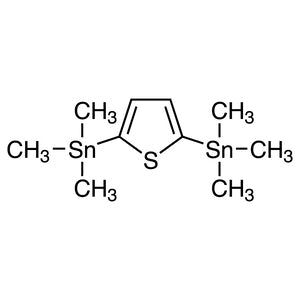
Trans-1,2-Bis[5-(trimethylstannyl)thiophen-2-yl]ethene is a complex chemical compound used in scientific material research, particularly in the development of semiconductor and polymer materials. This compound plays a crucial role in laboratories where advanced material synthesis is required. Its unique molecular structure enables the formation of stable and flexible chemical bonds, making it a valuable tool for researchers working on molecular-level innovations. The compound is widely utilized in the field of organometallic chemistry and conductive material development due to its ability to participate in complex chemical reactions under controlled conditions.
The properties that make this compound a preferred choice include its high chemical specificity and stability in reactive environments. It exhibits controlled reactivity, which allows for precise manipulation and synthesis of molecular structures in laboratory settings. Additionally, its ability to form complex structures makes it ideal for applications requiring high precision and reproducibility. These characteristics are essential for researchers aiming to develop new materials with unique electrical and optical properties. The compound’s stability and reactivity are carefully balanced to ensure consistent performance in various experimental conditions.
In Indonesian laboratories, this compound is commonly used in material science research, especially in electrochemistry and semiconductor technology. Researchers from educational institutions and research organizations frequently employ it to develop novel materials with conductive and optical properties. Its application in these fields highlights its importance in advancing scientific knowledge and technological innovation in Indonesia.
TCI brochures (PDF)
- Building Blocks for Organic Semiconductor 2026-03-24 · p. 37
Related TCI products
- TCI B4437 1352642-37-5 4,8-Bis[5-(2-ethylhexyl)thiophen-2-yl]-2,6-bis(trimethylstannyl)benzo[1,2-b:4,5-b']dithiophene
- TCI B5490 1160823-78-8 4,8-Bis[(2-ethylhexyl)oxy]-2,6-bis(trimethylstannyl)benzo[1,2-b:4,5-b']dithiophene
- TCI B4854 143367-56-0 5,5'-Bis(trimethylstannyl)-2,2'-bithiophene
- TCI B4685 1271439-08-7 4,8-Bis(2-butyl-n-octyloxy)-2,6-bis(trimethylstannyl)benzo[1,2-b:4,5-b']dithiophene
- TCI B4536 469912-82-1 2,5-Bis(trimethylstannyl)thieno[3,2-b]thiophene
- TCI B4488 1320201-22-6 2,6-Bis(trimethylstannyl)-4,8-bis[(2-n-octyldodecyl)oxy]benzo[1,2-b:4,5-b']dithiophene
- Electrochemical research benefits from this compound due to its ability to form stable and conductive molecular structures, enabling precise control over electron transport properties.
- Semiconductor material development utilizes this compound for creating complex molecular frameworks that enhance the performance of electronic devices.
- Polymer synthesis applications leverage its unique molecular structure to design advanced macromolecules with tailored chemical and physical properties.
- Conductive material innovation relies on its reactivity and stability to fabricate materials with enhanced electrical conductivity and durability.
- Organic semiconductor research employs this compound to explore new pathways for creating high-performance electronic components.
| Brand | TCI |
|---|---|
| CAS number | 477789-30-3 |
| Molecular formula | — |
| Purity | — |
| Category | Materials Science > Material Building Blocks > Polymer/Macromolecule Semiconductor Building Blocks |
| Pack sizes | Available in various quantities as per standard laboratory supply specifications |
| Physical form | Solid, typically in crystalline or powder form |
| Storage | Store in a cool, dry place away from moisture and direct sunlight |
This compound should be stored in a cool, dry environment to maintain its chemical stability and prevent degradation. It is recommended to use airtight containers made of materials that are chemically inert, such as glass or high-density polyethylene, to avoid any unwanted reactions. Due to its reactivity, it should be handled in a well-ventilated laboratory area, preferably under a fume hood, to minimize exposure. Proper personal protective equipment, including gloves and safety goggles, should always be worn when handling this material. Regular monitoring of storage conditions is essential to ensure the compound remains suitable for use in laboratory applications.
—
Produk Terkait
-
4,8-Bis[5-(2-ethylhexyl)thiophen-2-yl]-2,6-bis(trimethylstannyl)benzo[1,2-b:4,5-b']dithiophene TCI B4437
Regular price Rp 5.300.400,00Regular priceRp 3.722.250,00Sale price Rp 5.300.400,00 -
4,8-Bis[(2-ethylhexyl)oxy]-2,6-bis(trimethylstannyl)benzo[1,2-b:4,5-b']dithiophene TCI B5490
Regular price From Rp 3.419.850,00Regular priceRp 2.406.600,00Sale price From Rp 3.419.850,00 -
5,5'-Bis(trimethylstannyl)-2,2'-bithiophene TCI B4854
Regular price From Rp 2.121.000,00Regular priceRp 1.498.350,00Sale price From Rp 2.121.000,00 -
4,8-Bis(2-butyl-n-octyloxy)-2,6-bis(trimethylstannyl)benzo[1,2-b:4,5-b']dithiophene TCI B4685
Regular price Rp 3.498.600,00Regular priceRp 2.462.250,00Sale price Rp 3.498.600,00 -
2,5-Bis(trimethylstannyl)thieno[3,2-b]thiophene TCI B4536
Regular price From Rp 3.207.750,00Regular priceRp 2.258.550,00Sale price From Rp 3.207.750,00 -
2,6-Bis(trimethylstannyl)-4,8-bis[(2-n-octyldodecyl)oxy]benzo[1,2-b:4,5-b']dithiophene TCI B4488
Regular price Rp 4.743.900,00Regular priceRp 3.332.700,00Sale price Rp 4.743.900,00 -
4,8-Bis(n-octyloxy)-2,6-bis(trimethylstannyl)benzo[1,2-b:4,5-b']dithiophene TCI B4378
Regular price Rp 5.009.550,00Regular priceRp 3.518.550,00Sale price Rp 5.009.550,00 -
2,5-Bis(trimethylstannyl)thiophene TCI B6395
Regular price From Rp 1.749.300,00Regular priceRp 1.239.000,00Sale price From Rp 1.749.300,00